
Toward the end of 2025, USD/JPY continues to show consistent bullish bias, remaining near the highs of the year. Part of this weakness in the Japanese yen can be explained by its low interest rate, one of the lowest among major central banks globally. However, recent economic dynamics suggest that the Bank of Japan (BOJ) may begin adjusting its monetary policy stance, which could eventually support a more stable strengthening of the yen during 2026.

What Could the BOJ’s New Stance Look Like?
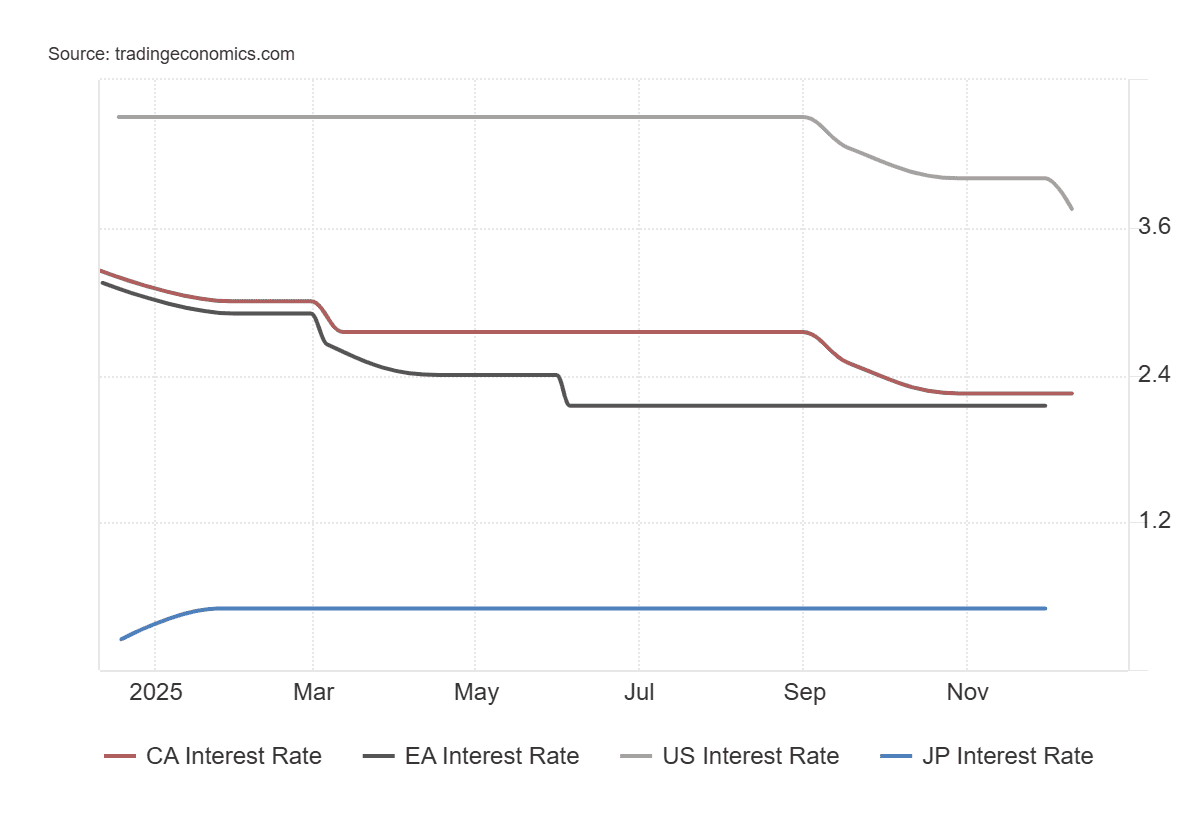
Currently, the BOJ’s interest rate is significantly lower than that of other major central banks, making it difficult for the yen to regain ground against other currencies. Such low rates make Japanese fixed-income investments less attractive, which limits demand for yen.
At the time of writing, the BOJ plans to end 2025 with a rate of 0.75%, higher than the 0.5% maintained through most of the year, but still far below its peers: the United States (3.75%), Canada (2.25%), and the European Union (2.15%). In comparative terms, the yen remains one of the least competitive currencies for fixed-income investors.
Source: TradingEconomics
Looking ahead to 2026, the BOJ could enter the year as one of the few central banks expected to raise interest rates, moving from the stable 0.5% level to the new 0.75%. This shift is mainly due to one of the pillars of its monetary policy — inflation — no longer being temporary and beginning to show greater persistence.
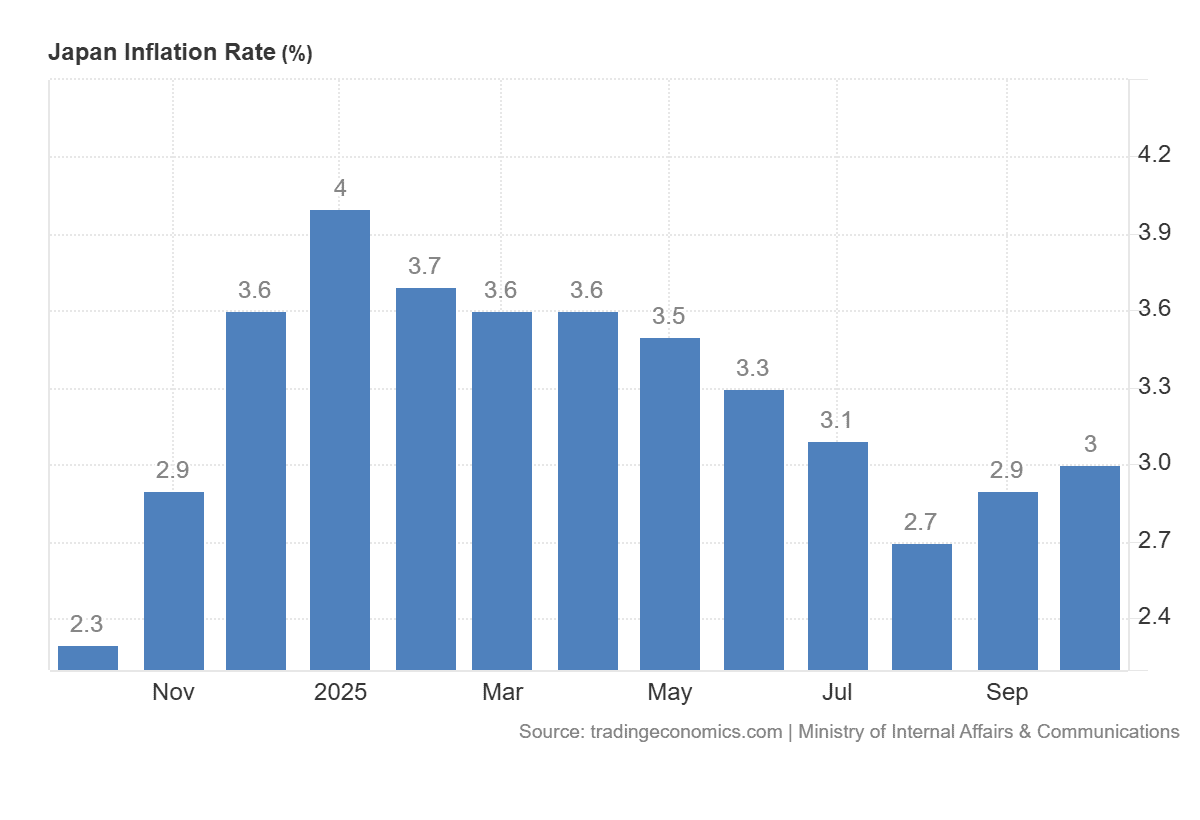
After reaching an annual low of 2.7% in August, inflation climbed to 3.0% in October, once again moving away from the 2% target. This demonstrates that inflationary pressures have become significant again and could become a serious issue if the BOJ decides to maintain excessively low rates in 2026.
Source: TradingEconomics
Additionally, wage growth in Japan is at one of its highest levels in the past three decades. At the end of 2024, the average increase was 3.6%, and by the end of 2025 it is expected to exceed 4.0%. If this trend continues, it could drive greater domestic consumption, further pushing up prices and fueling inflationary pressures in 2026.
Another important factor is that the prolonged weakness of the yen has become both an economic and political issue. Officials within the government and the BOJ have noted that a weak yen raises the cost of imports, which eventually pushes up domestic prices. Prime Minister Sanae Takaichi recently stated that, aside from pro-growth policies expected for 2026, yen weakness remains one of the main risks for the Japanese economy. This suggests that, along with potential government support measures for the currency, the BOJ may need to step away from its ultra-loose monetary stance and move toward policy normalization to strengthen the yen.
Considering all this, the 2026 outlook points to a yen that begins the year relatively weak but with increasing potential for recovery if the BOJ begins implementing rate hikes. As one of the only central banks likely to raise rates in 2026, Japan could see sustained improvements in yen demand, encouraging greater investor interest. This could produce a bearish bias in USD/JPY, especially if the Federal Reserve confirms that it will maintain neutral or even lower rates in 2026, making it more difficult for the dollar to hold its ground.
Technical Outlook for USD/JPY in 2026
Source: StoneX, Tradingview
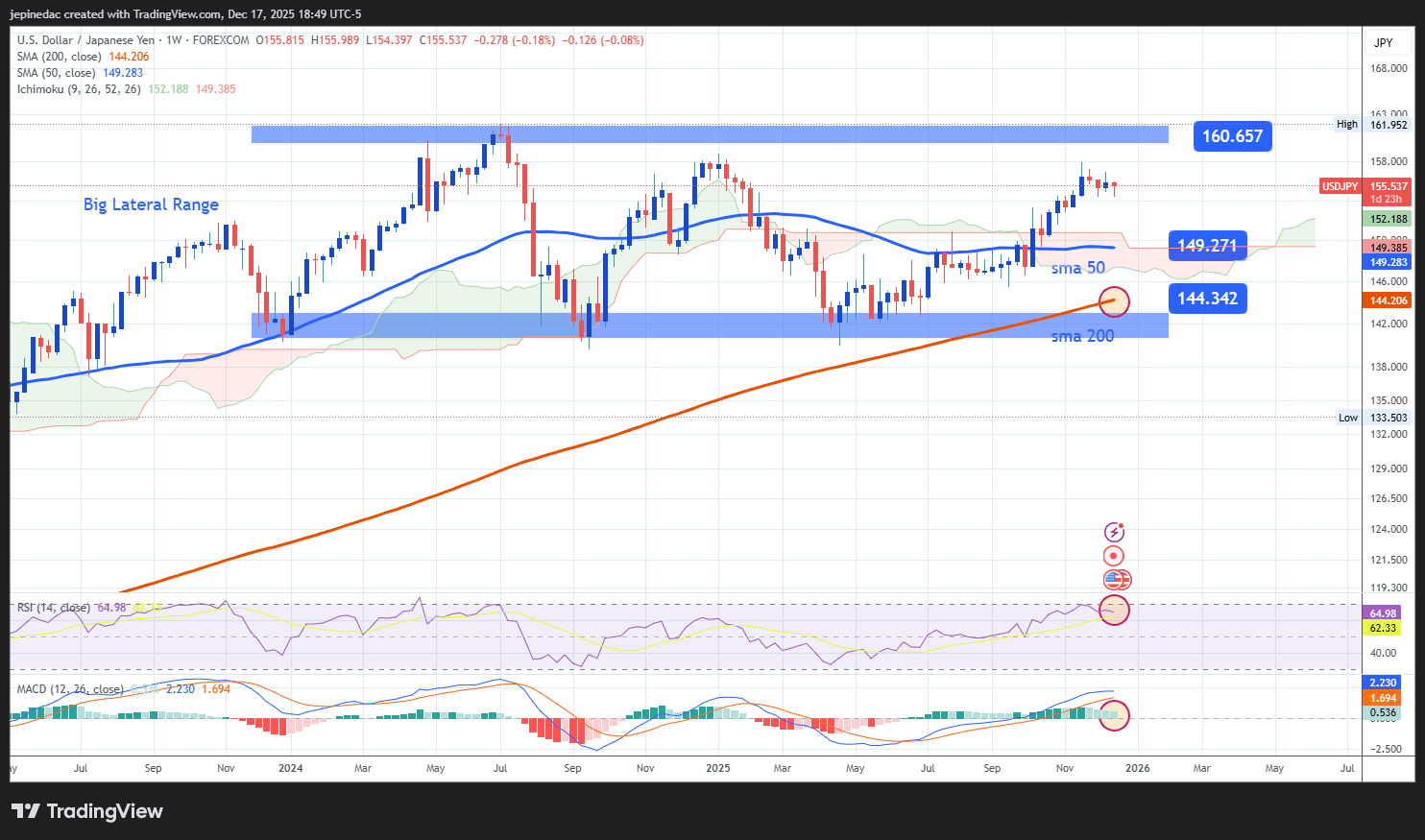
- The Large Lateral Range Remains Intact: Since January 2024, USD/JPY has traded within a broad sideways range between the upper boundary at 160 yen per dollar and the lower boundary near 140 yen per dollar. Despite the dollar’s recovery against the yen in 2025, the bullish momentum still appears insufficient to break out of this dominant range. Even when price attempted to approach levels not seen since June 2024, it quickly encountered renewed weakness, reinforcing the resilience of this lateral structure. If the neutrality observed in the last weeks of 2025 persists, the bullish bias that dominated much of the year could be at risk entering the first quarter of 2026.
- RSI: The RSI has begun showing a downward slope, suggesting that average bullish momentum has weakened during the final weeks of 2025. If this behavior continues into early 2026, it could pave the way for stronger selling pressure, favoring the yen and increasing downward momentum in USD/JPY.
- MACD: The MACD histogram maintains consistent declines toward the zero line, signaling weakening strength in the weekly moving averages. If this structure continues, it could indicate the emergence of stronger bearish pressure heading into 2026.
Key Levels:
- 160.600 – Key Resistance: A level not seen since 2024, marking the upper boundary of the large lateral range. A move into this zone could revive a more dominant bullish bias and allow the development of a more structured uptrend for 2026.
- 149.271 – Nearby Barrier: This zone is aligned with the 50-period simple moving average on the weekly chart. A return to this level could mark the end of the bullish momentum that prevailed through much of 2025, opening the door to a period of indecision within the broader range.
- 144.300 – Main Support: This level corresponds to the 200-week moving average and represents an inflection point for price strength. Bearish movements that revisit this area could trigger a shift in momentum, allowing a more substantial downtrend to begin forming in favor of the yen during 2026.
Written by Julian Pineda, CFA, CMT – Market Analyst
Follow him at: @julianpineda25