
As the trading week came to a close, the USD/MXN posted a decline of just over 0.8%, following strong selling pressure after the release of NFP data in the United States. For now, expectations remain focused on the short-term performance of the dollar. However, as long as the outlook for Fed rate cuts persists, driven by a weakening labor market, demand for the dollar could be compromised, favoring additional downward pressure on the pair.

Employment Data Arrives
The NFP figures for August came in well below expectations. While forecasts pointed to 75,000 new jobs, the official figure was only 22,000, confirming a significant slowdown in the U.S. labor market.
In fact, the last four NFP readings have consistently been below 100,000 jobs, reinforcing the idea that the labor market is going through a challenging period in the short term. This scenario could play a decisive role in the central bank’s upcoming decisions for the remainder of the year.

Source: TradingEconomics
These results align with what the Fed indicated at Jackson Hole, where it signaled that employment would become a priority in upcoming monetary policy decisions. Moreover, CME Group data now reflects an 85.8% probability of a 0.25% rate cut at the September 17 meeting, a 67.8% probability of another cut on October 29, and a 63.6% probability of a further cut on December 10. This outlines a scenario in which the benchmark rate could fall from the current 4.5% to 3.75% by the end of 2025, consolidating a clear trend of significant cuts over the coming months.
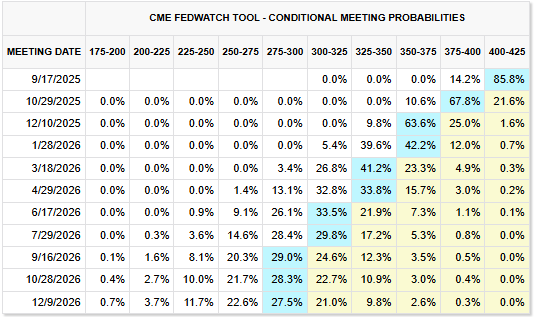
Source: CMEGroup
This outlook reinforces the idea that dollar-denominated investments could lose appeal in the short term, particularly as Mexico continues to maintain a much higher benchmark rate of 7.75%, compared with the U.S. rate of 4.5%. Although Banxico has also shifted toward a more dovish stance, the gap still favors Mexico. This differential could allow the Mexican peso to gain ground consistently, strengthening the case for a more dominant bearish bias in USD/MXN movements.
What About the Dollar’s Strength?
The DXY index, which measures the dollar’s strength against a basket of currencies, reacted to the employment data by returning to the 98 level in the short term, maintaining the downward trend seen in recent weeks. For now, the index shows no signs of significant recovery, highlighting that confidence in the dollar remains weak.
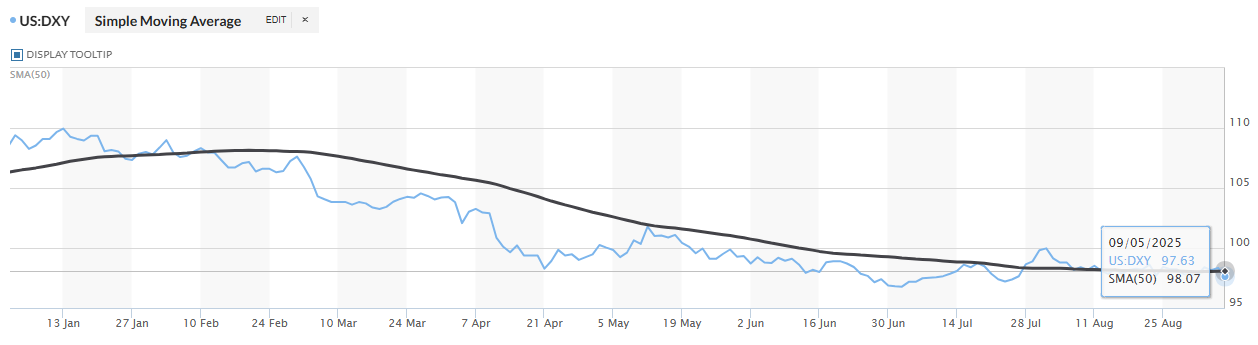
Source: MarketWatch
If the DXY continues to weaken, confidence in the U.S. dollar could deteriorate further, reducing demand for the currency and sustaining a bearish outlook for USD/MXN in the sessions ahead.
USD/MXN Technical Outlook

Source: StoneX, Tradingview
- Sideways Range Holds: Despite volatility following the employment data, USD/MXN continues to trade within the sideways channel that has dominated in the short term, between resistance at 18.85 pesos per dollar and support at 18.50. This lack of direction keeps this range as the most important technical structure to monitor. As long as it remains intact, the consolidation of a new defined trend will be difficult.
- RSI: remains around the neutral 50 level, reflecting balance between buying and selling momentum over the last 14 sessions. This neutrality will continue to be key for short-term moves.
- TRIX: the exponential moving average line remains below the neutral 0 level, indicating that the prevailing directional bias still favors sellers. If it continues to trend lower, selling pressure could gain further relevance in the short term.
Key Levels:
- 18.50 – Key Support: a psychological level that coincides with recent lows. A sustained break below would open the way for another bearish leg, extending the downtrend observed in prior weeks.
- 18.85 – Near-Term Barrier: corresponds to the top of the sideways range and is the most important short-term resistance. A sustained breakout above could trigger a dominant bullish bias, breaking the current neutral structure.
- 19.16 – Final Resistance: aligned with the 23.6% Fibonacci retracement, this is the most critical reference level. A sustained move above would validate a stronger bullish bias and open the way to a more consistent upward trend.
Written by Julian Pineda, CFA – Market Analyst
Follow him at: @julianpineda25