

Learn how GDP releases influence forex markets, currencies, volatility, and trading decisions, and how traders use GDP data in forex analysis.
Gross domestic product (GDP) releases are major events in forex trading and regularly feature on the economic news calendar watched by traders around the world. In the foreign exchange market, GDP data often drives volatility, shifts market liquidity, and influences price movements across major currency pairs.
A quarterly GDP report measures the value of goods and services produced within an economy. Because GDP reflects overall economic activity, it can affect expectations for rates, central bank policy, and the value of currencies such as the US dollar (USD). As a result, GDP releases are closely monitored across global FX markets in developed and emerging markets worldwide.
In the forex market, GDP matters most when it changes how the market expects central banks to respond. Growth data can influence inflation expectations, labor market outlooks, and the projected path of interest rates, all of which shape positioning in currency markets.
This guide explains what is GDP, how it is measured by official sources such as the Bureau of Economic Analysis, and how traders use GDP data in analysis for forex. You’ll learn how GDP affects the value of currencies, why GDP surprises can move prices during an active trading session, and how GDP relationships with data such as retail sales can support more structured trading decisions.
Mini glossary
- Gross domestic product (GDP): A measure of the total value of goods and services produced within an economy over a specific period.
- Bureau of Economic Analysis: A statistical agency that publishes GDP data for the United States, including revisions and supporting information (used here as an example of a major GDP source).
- Foreign exchange market / forex market: The global market where currencies are traded and exchange rates are determined.
- Currency pairs: Two currencies quoted together (for example, EUR/USD), showing the exchange rate between them.
- Exchange rate: The price of one currency in terms of another.
- Market liquidity: How easily positions can be opened or closed without significantly affecting price; liquidity influences spreads and execution costs.
- Trading session: A period of higher trading activity linked to regional market hours, such as the London, New York, or Asian session.
- Safe havens: Assets and currencies, including gold and sometimes silver, that may attract demand during risk‑off conditions.
- Volatility: The speed and size of price movements in the market, often higher around major economic data releases.
What is GDP?
GDP measures the total value of goods and services produced within an economy over a defined time frame. It is one of the most widely used measures of economic performance and a key reference point in forex trading.
GDP is typically reported as:
- Quarterly growth (often annualized), and/or
- Year‑over‑year GDP growth
In forex markets, the headline GDP number matters, but price reactions are often driven by how the data compares with expectations. A GDP release can show growth in absolute terms and still weaken a currency if the market expected a stronger performance. This reaction highlights why GDP is treated as a high‑impact news event that can reprice exchange rates quickly.
Who publishes GDP and when is it released?
GDP figures are published by national statistical agencies in each economy. In the United States, GDP is released by the Bureau of Economic Analysis. In Europe, GDP data is compiled by national statistical offices and coordinated by Eurostat, while the United Kingdom publishes GDP through the Office for National Statistics.
Comparable GDP reports are also produced by Statistics New Zealand and Statistics South Africa. The U.S. GDP release is shown here as an example because it is one of the most closely followed and frequently traded GDP reports in global forex markets, with clear quarterly revisions that illustrate how GDP data can influence currency price movements.
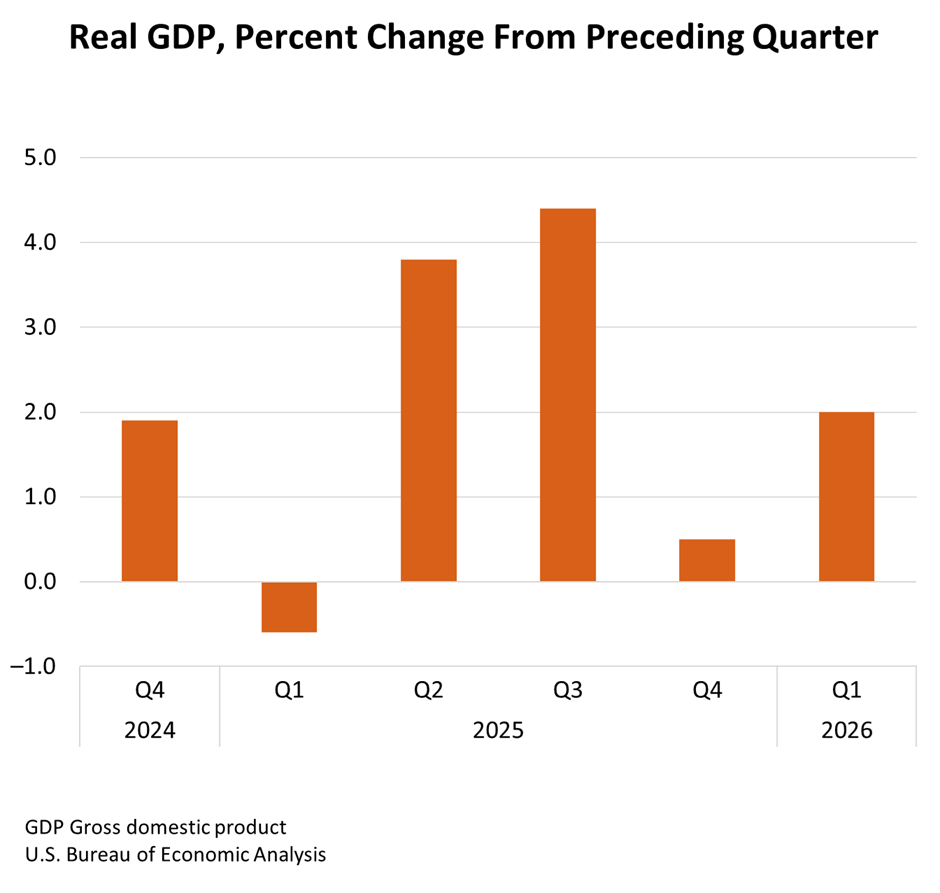
Source: Bureau of Economic Analysis
Example (United States):
In early 2026, GDP data showed that economic output in the U.S. expanded following a weaker previous quarter. Growth was supported by consumer spending, investment, government activity, and trade flows measured in billions of dollars, while imports partially offset the headline number.
Why GDP matters in the foreign exchange market
- The first GDP estimate often generates the largest immediate reaction in FX markets.
- Revisions can still affect exchange rates if they change expectations for growth or rates.
- GDP releases often coincide with periods of higher trading volume, when market liquidity and spreads can change quickly, especially during active global sessions such as New York or London hours.
The four components of GDP
A common GDP formula is:
GDP = C + I + G + (X − M)
These components matter because the relationships between them help traders assess the quality of growth and its potential impact on currencies.
Consumption (C)
Consumption reflects household spending on goods and services. Strong consumption can support growth expectations and influence interest rates. Traders often compare consumption trends with retail sales data to confirm momentum.
Investment (I)
Investment includes business spending and changes in inventories. Inventory‑driven growth can inflate GDP temporarily, which may affect how the market prices the data.
Government (G)
Government spending contributes directly to GDP by adding domestic output. In global markets, traders often assess whether government support is sustainable or temporary.
Net exports (X − M)
Net exports represent exports minus imports. Imports are subtracted because GDP measures domestic production. Changes in trade flows can influence GDP and, in turn, the value of currencies through shifting growth expectations.
How GDP is calculated
GDP is compiled from a wide range of surveys and economic sources covering production, income, and expenditure. Beyond the headline number, the report provides detailed information that helps traders understand whether growth is broad‑based or concentrated in specific sectors.
For forex trading, traders typically focus on:
- The headline GDP figure
- Revisions
- Which components drove growth
- What the data implies for future rates and central bank policy
How traders use GDP in forex analysis
GDP is a core input in analysis because it helps traders compare economic momentum between countries and regions. In the forex market, GDP is most useful when combined with other indicators and news events.
A practical GDP checklist:
- Compare the GDP result with expectations.
- Cross‑check GDP against related data such as inflation, employment, and retail sales.
- Assess how the data may influence interest rates.
- Monitor how currency pairs respond on the chart during the session.
Long‑term and short‑term effects on currencies
Over the long term, stronger GDP growth can support a currency by improving confidence in the economy and attracting capital flows. Over the short term, price reactions are often driven by surprise, positioning, and volatility during the release.
GDP does not move the market every time. However, when GDP data shifts expectations for policy or growth, it can lead to sharp price movements, changes in spreads, and adjustments in trader positions, particularly during high‑liquidity sessions.
GDP, safe havens, and risk sentiment
During periods of uncertainty, GDP data can interact with broader risk sentiment. In risk‑off conditions, flows may move toward safe havens such as gold or certain currencies, even if GDP growth is relatively stable. These dynamics highlight how GDP fits into a wider network of macroeconomic relationships.


