






AUD Under Pressure Ahead Of Tomorrows RBA Meeting
RBA are widely expected to cut rates tomorrow to a fresh new low of 0.75%.
Share this:

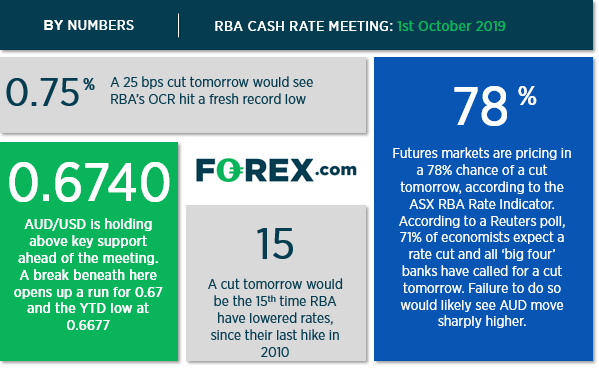
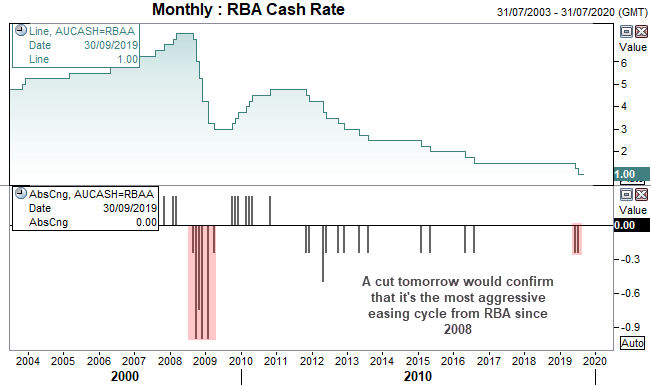
RBA are expected to cut rate tomorrow by 25 bps, to a new record low of 0.75%. RBA last cut rates back in July, having already done so in June to shave 50 bps over the two months, which takes the total amount of cuts to 14 since their last hike in 2010. Interestingly, if RBA are to cut again tomorrow, it will be the first time they have cut three or more times over 5-month period since 2008.
And this could well be the case after unemployment rose. The CESI indicator shows that economic data has underperformed relative to expectations these past two weeks, so there does appear to be a case for another cut. And futures markets an economists agree, with a 78% probability of a cut tomorrow being implied by the ASX RBA Rate Indicator and 71% of economics polled by Reuters also on board with this outcome. If we look at the 1-year OIS, it suggests a 92% chance of rates being at 0.5% in 12 months which leaves room for one more cut. Of course, we don’t expect RBNZ to want to have a higher cash rate, so any movement from RBA increases the likelihood of another cut or two from RBNZ.
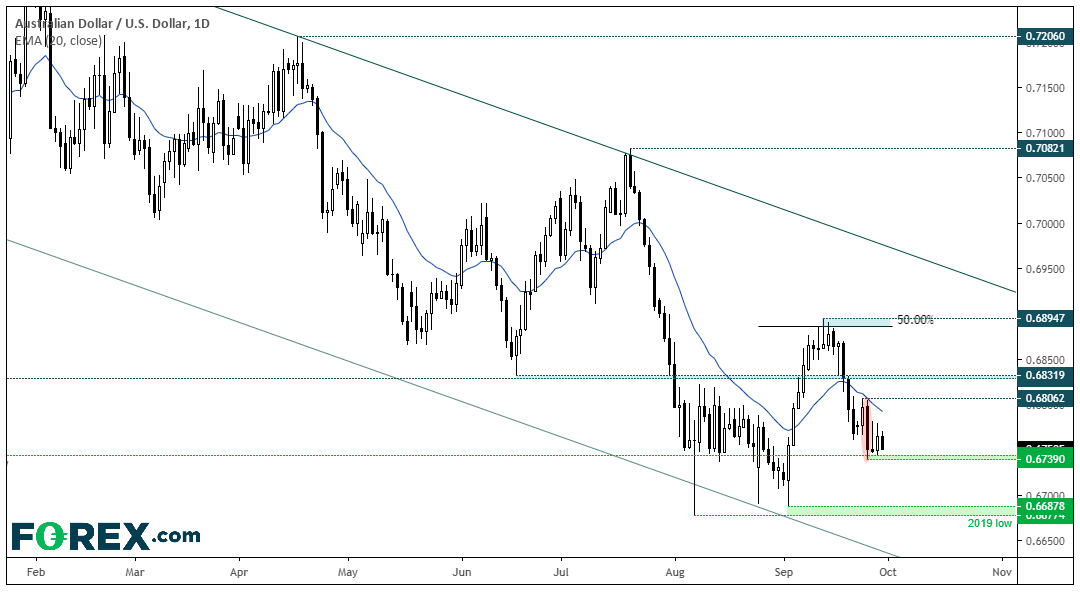
As we noted on Friday, several AUD pairs sit at key levels ahead of tomorrow’s RBA meeting. With markets expecting a cut, it may be down to whether RBA signal further easing in their statement which help decides whether we see a bearish follow-through on AUD. Obviously, the biggest upside threat for the Aussie is if RBA hold rates and refrain from a dovish statement, although we suspect this is a low probability outcome given they’ve remained dovish when speaking publicly. So if they opt to effectively confirm a cut in Q4, it should see AUD spike lower, at least temporarily.
The analysis remains unchanged since Friday; the daily trend remains bearish, so the bias is for a downside break whilst it remains beneath the 0.6806 high.
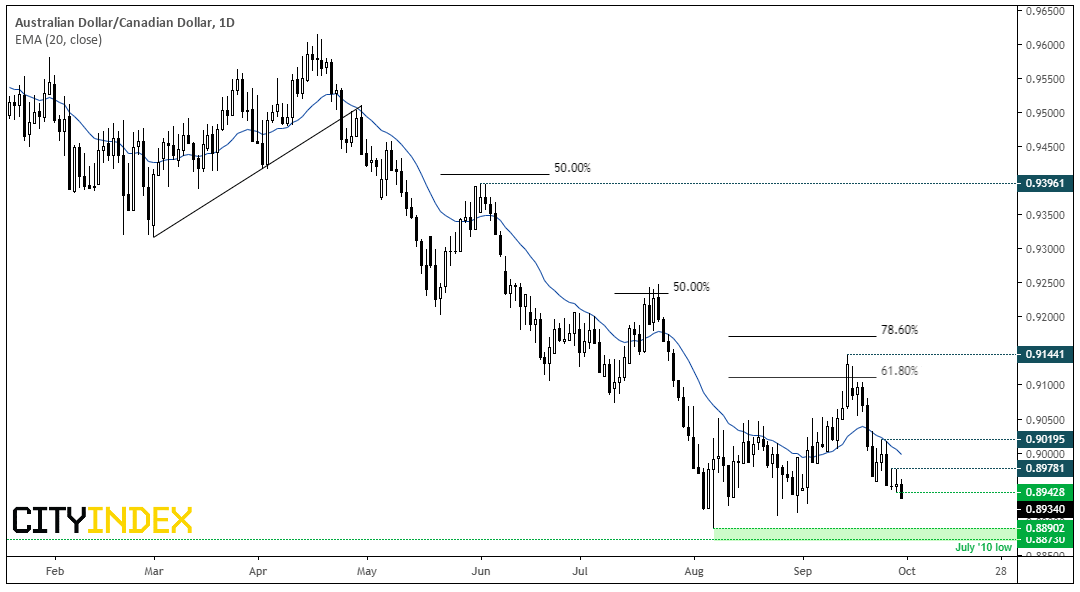
AUD/CAD has seen an intraday breakout from compression ahead of the UK open. The dominant trend remains bearish and the cycle highs sit around 0.8978 and 0.9020. Following the completion of an ABC correction at 0.9144, we now expect AUD/CAD to head for (and possibly break beneath) the 2010 low. We doubt it will break upon first attempt but it makes a suitable interim target for bears.
Related analysis:
It Could Be Make Or Break For The Aussie, With Several Pairs Sitting At Support
AU Unemployment Rises, RBA To Ease Again In October?
RBA Hold Rates, AUD Sticks To Its Lows Ahead Of GDP
RBA are expected to cut rate tomorrow by 25 bps, to a new record low of 0.75%. RBA last cut rates back in July, having already done so in June to shave 50 bps over the two months, which takes the total amount of cuts to 14 since their last hike in 2010. Interestingly, if RBA are to cut again tomorrow, it will be the first time they have cut three or more times over 5-month period since 2008.
And this could well be the case after unemployment rose. The CESI indicator shows that economic data has underperformed relative to expectations these past two weeks, so there does appear to be a case for another cut. And futures markets an economists agree, with a 78% probability of a cut tomorrow being implied by the ASX RBA Rate Indicator and 71% of economics polled by Reuters also on board with this outcome. If we look at the 1-year OIS, it suggests a 92% chance of rates being at 0.5% in 12 months which leaves room for one more cut. Of course, we don’t expect RBNZ to want to have a higher cash rate, so any movement from RBA increases the likelihood of another cut or two from RBNZ.
As we noted on Friday, several AUD pairs sit at key levels ahead of tomorrow’s RBA meeting. With markets expecting a cut, it may be down to whether RBA signal further easing in their statement which help decides whether we see a bearish follow-through on AUD. Obviously, the biggest upside threat for the Aussie is if RBA hold rates and refrain from a dovish statement, although we suspect this is a low probability outcome given they’ve remained dovish when speaking publicly. So if they opt to effectively confirm a cut in Q4, it should see AUD spike lower, at least temporarily.
The analysis remains unchanged since Friday; the daily trend remains bearish, so the bias is for a downside break whilst it remains beneath the 0.6806 high.
AUD/CAD has seen an intraday breakout from compression ahead of the UK open. The dominant trend remains bearish and the cycle highs sit around 0.8978 and 0.9020. Following the completion of an ABC correction at 0.9144, we now expect AUD/CAD to head for (and possibly break beneath) the 2010 low. We doubt it will break upon first attempt but it makes a suitable interim target for bears.
Related analysis:
It Could Be Make Or Break For The Aussie, With Several Pairs Sitting At Support
AU Unemployment Rises, RBA To Ease Again In October?
RBA Hold Rates, AUD Sticks To Its Lows Ahead Of GDP
Related tags:


The complete CFD trading experience
Award-winning platforms, competitive spreads, low commissions and dedicated support.
We live and breathe the markets and are dedicated to helping traders realise their ambitions as we continue to set the industry bar.
Economic calendar
Web Trader platform
Our sophisticated web-based platform is packed with features.
Related articles
USD/MXN Forecast: Peso Loses Momentum Ahead of Banxico Decision
Over recent trading sessions, the Mexican peso has started to show signs of losing strength against the U.S. dollar. This can be seen in the performance of USD/MXN, which has gained more than 1.7% over the last three sessions, highlighting the dollar's renewed strength against the peso.

Euro Short-term Outlook: EUR/USD Selloff Nears Critical Yearly Support 9 23 2026
Euro has fallen seven of the past nine sessions, with stretched momentum raising the stakes as EUR/USD closes in on a major inflection zone.


GBP/USD forecast: US dollar surges as bonds implode
The US dollar continued to press higher deep into the European session, supported by the slump in the bond markets as yields broke out across the curve. Following the recent hawkish Fed rate hike, yield spreads between the US and the rest of the world has continually increased, and that motion continued today, helped in part by some forecast-beating US macro data and hawkish Fed commentary.

StoneX Europe Ltd may make third party material available on this website which may contain information included but not limited to the conditions of financial markets. The material is for information purposes only and does not contain, and should not be construed as containing, investment advice and/or investment recommendation and/or an investment research and/or an offer of or solicitation for any transactions in financial instruments; any decision to enter into a specific transaction shall be made by the client following an assessment by him/her of their situation.
StoneX Europe Ltd makes no representation or warranty and assumes no liability as to the accuracy or completeness of the information provided, nor any loss arising from any investment based on a recommendation, forecast or other information supplied. You should always seek independent advice as to your suitability to speculate in any related markets and your ability to assume the associated risks, if you are at all unsure. We are not under any obligation to update any such material. Any opinion made may be personal to the author and may not reflect the opinion of StoneX Europe Ltd.