

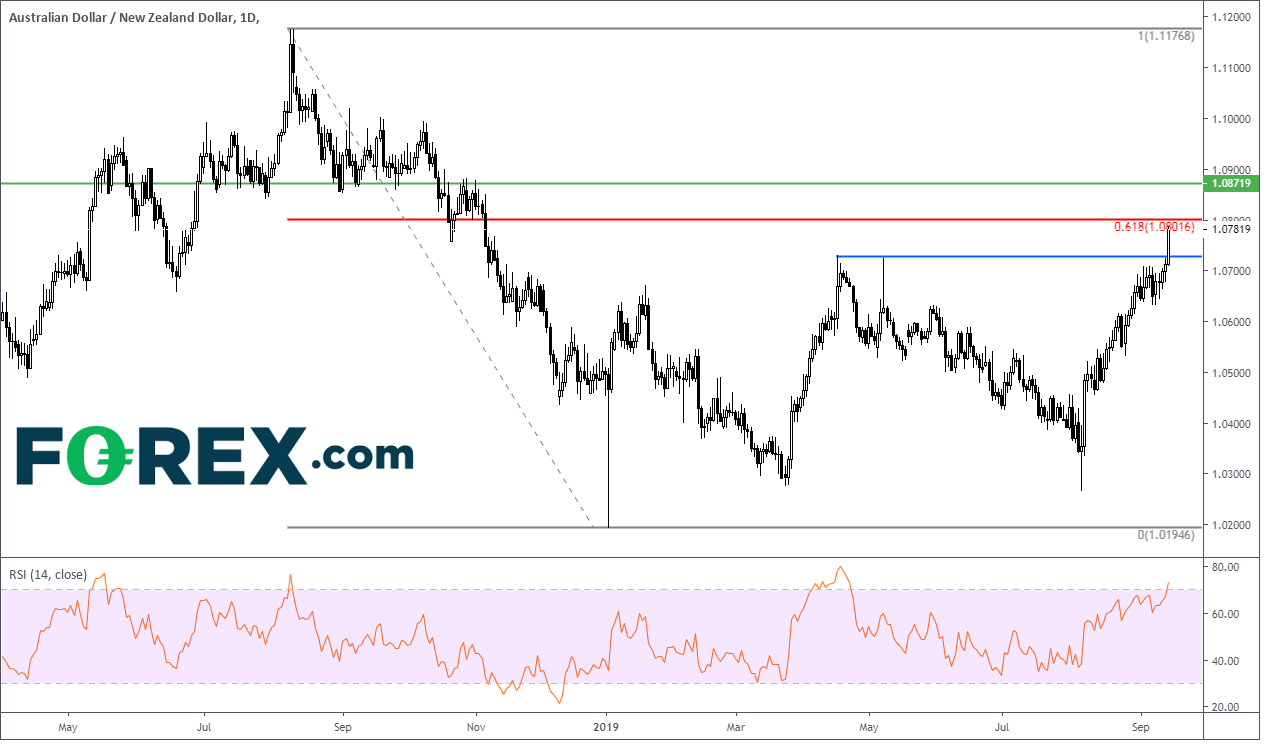


AUDNZD Breaks Out to New 2019 Highs
Why is the Australian Dollar outpacing the New Zealand Dollar?
Share this:

AUD/NZD has broken above 1.0729, it’s 2019 highs. Both the Australian Dollar and the New Zealand Dollar face many of the same risks from the trade war between China and the US. In a nutshell, a slowdown in China would cause a slowdown in both the Australian and New Zealand economies, as both are large exporters to China.
So why is the Australian Dollar outpacing the New Zealand Dollar? Q2 GDP for Australia is at 0.5% (MoM), however the RBA expects growth to strengthen gradually around trend over the next couple of years. The RBA held rates steady at its last meeting at 1.00%. In contrast, the RBNZ surprised the market by cutting 50bps to 1.00% at its August 7th meeting and said that growth has slowed and that headwinds continue to strengthen. Should economic growth slow more than the RBNZ expects, they have said they are willing to lower interest rates even further. Next week, New Zealand releases GDP for Q2. Previous GDP was at 0.6% (MoM) vs expectations for 0.4% next week.
With the 2 Central Banks hinting that their respective economics may be moving in opposite directions, it’s not surprising that AUD/NZD bottomed on the date of the last RBNZ meeting. Today the pair broke to new highs on the year (current high is 1.0785). However, there is resistance just above current levels at 1.0812, which is the 61.8% retracement from the August 2018 highs to the January 3rd spike lows. Next resistance level after that is horizontal resistance near 1.0875. Support below is at the previous highs of 1.0729. Also note the RSI has moved into overbought territory.

Source: Tradingview, City Index
AUD/NZD has broken above 1.0729, it’s 2019 highs. Both the Australian Dollar and the New Zealand Dollar face many of the same risks from the trade war between China and the US. In a nutshell, a slowdown in China would cause a slowdown in both the Australian and New Zealand economies, as both are large exporters to China.
So why is the Australian Dollar outpacing the New Zealand Dollar? Q2 GDP for Australia is at 0.5% (MoM), however the RBA expects growth to strengthen gradually around trend over the next couple of years. The RBA held rates steady at its last meeting at 1.00%. In contrast, the RBNZ surprised the market by cutting 50bps to 1.00% at its August 7th meeting and said that growth has slowed and that headwinds continue to strengthen. Should economic growth slow more than the RBNZ expects, they have said they are willing to lower interest rates even further. Next week, New Zealand releases GDP for Q2. Previous GDP was at 0.6% (MoM) vs expectations for 0.4% next week.
With the 2 Central Banks hinting that their respective economics may be moving in opposite directions, it’s not surprising that AUD/NZD bottomed on the date of the last RBNZ meeting. Today the pair broke to new highs on the year (current high is 1.0785). However, there is resistance just above current levels at 1.0812, which is the 61.8% retracement from the August 2018 highs to the January 3rd spike lows. Next resistance level after that is horizontal resistance near 1.0875. Support below is at the previous highs of 1.0729. Also note the RSI has moved into overbought territory.
Source: Tradingview, FOREX.com
Related tags:



The complete CFD trading experience
Award-winning platforms, competitive spreads, low commissions and dedicated support.
We live and breathe the markets and are dedicated to helping traders realise their ambitions as we continue to set the industry bar.
Economic calendar
Web Trader platform
Our sophisticated web-based platform is packed with features.
Related articles
USD/JPY forecast: US dollar strengths amid hawkish Fed despite recent oil weakness
The US dollar has extended its gains this morning, even if oil prices finished lower for the fifth consecutive day yesterday. Oil prices have bounced back in this first half of today’s session, causing a bit of pressure on currencies that rely on energy imports such as the euro, pound, Swiss franc, and Japanese yen. But it was the dollar that was exerting the most pressure, amid hawkish FedSpeak. Meanwhile, European indices and precious metals were also under a bit of pressure amid the strength of the dollar.

EUR/AUD, GBP/AUD Outlook: Rates, risk and metals reinforce bearish technical case
EUR/AUD and GBP/AUD are coiling near support, with recent correlations suggesting the Aussie’s strength is being driven more by rates, risk and metals than energy.


US Dollar Price Action Setups: USD/JPY, USD/CAD, EUR/USD, GBP/USD, Gold
The US Dollar has rallied since last week’s rate hike and USD/JPY remains a massive driver across the USD complex.

StoneX Europe Ltd may make third party material available on this website which may contain information included but not limited to the conditions of financial markets. The material is for information purposes only and does not contain, and should not be construed as containing, investment advice and/or investment recommendation and/or an investment research and/or an offer of or solicitation for any transactions in financial instruments; any decision to enter into a specific transaction shall be made by the client following an assessment by him/her of their situation.
StoneX Europe Ltd makes no representation or warranty and assumes no liability as to the accuracy or completeness of the information provided, nor any loss arising from any investment based on a recommendation, forecast or other information supplied. You should always seek independent advice as to your suitability to speculate in any related markets and your ability to assume the associated risks, if you are at all unsure. We are not under any obligation to update any such material. Any opinion made may be personal to the author and may not reflect the opinion of StoneX Europe Ltd.