



DAX Today: Oil, Yields and German Data in Focus
The DAX has fallen for three consecutive sessions after reaching a record high on 28 August. Rising oil prices and Bund yields are now challenging the rally, while German business confidence and manufacturing data offer a more constructive signal for the domestic economy.
Share this:

The DAX closed Wednesday at 25,839.33, down 0.50%, extending its three-day decline to roughly 2.7% from the 28 August record close of 26,569.99. The index briefly fell to 25,727.93, its lowest level since late July.
The immediate driver has been the combination of higher oil prices and higher European bond yields. Brent has risen roughly 6% over the past week as the Iran conflict keeps the energy market on edge. At the same time, the 10-year German Bund yield has moved towards 3.4%.
That combination is particularly awkward for the DAX. Higher energy costs threaten margins for Germany’s industrial base, while higher yields raise the discount rate applied to equities. The market’s recent weakness therefore looks more like a macro valuation adjustment than a reassessment of the German recovery.
German Economic Indicators: Better, But Not Yet Broad-Based
The most encouraging domestic data came from the ifo Business Climate Index, which rose to 88.8 in August from 86.7 in July. Both current conditions and expectations improved, and the ifo institute noted that uncertainty continued to decline despite higher energy prices. Manufacturing sentiment improved particularly sharply, with companies expecting production to increase over the next three months.
That is significant because Germany has been trying to establish a sustainable recovery after a prolonged period of industrial weakness.
The problem is that the recovery remains uneven. August’s preliminary Composite PMI slipped to 51.0 from 51.3, while the services sector remained weak. Manufacturing, by contrast, recorded a much stronger 56.7 output reading, helped by stronger orders, defence spending and data-centre investment.
My interpretation is relatively constructive: Germany’s cyclical recovery is becoming more credible, but it is still heavily dependent on manufacturing rather than domestic demand. That makes the DAX vulnerable to another energy shock even as the underlying economic data improve.
German inflation is another complication. August CPI was expected at 2.9%, with core inflation around 2.4%, while energy prices were expected to be 10.5% higher year-on-year.
That combination leaves the ECB with considerably less room to respond aggressively to weaker growth of the current environment.
DAX Gainers and Losers
Today, Commerzbank leads the DAX with a gain of 1.70%, followed by adidas (+1.08%), Deutsche Bank (+1.06%) and Rheinmetall (+0.98%). Deutsche Telekom is also gaining early today, up around 1.5%, after reports that activist investor Elliott Investment Management has taken a stake and is pushing against a potential T-Mobile US transaction.
The other side of the market is more revealing.
Zalando is down 4.67%, Volkswagen -3.76%, GEA Group -3.52% and Daimler Truck -3.07%. The weakness in automotive and industrial names is consistent with the market’s current concern over energy costs, global demand and financing conditions.
Zalando’s decline also reflects stock-specific pressure after Goldman Sachs removed the company from its preferred list.
The sector rotation is enforced: banks and selected defensives are holding up better, while cyclical industrial and consumer names are carrying the selling pressure.
Economic Events Today
Today’s German calendar is unusually relevant for the DAX.
At 09:55 CET, the final German Services PMI is released. The preliminary August reading was only 48.5, below both the 50-point expansion threshold and the 50.1 consensus estimate. A meaningful upward revision would help reinforce the recovery argument; another weak reading would confirm that Germany’s improvement remains concentrated in manufacturing.
From the US, the focus shifts to initial jobless claims, the final Services PMI and ISM Services Index this afternoon. Those numbers matter primarily through their impact on US Treasury yields and Federal Reserve expectations.
DAX Technical Analysis
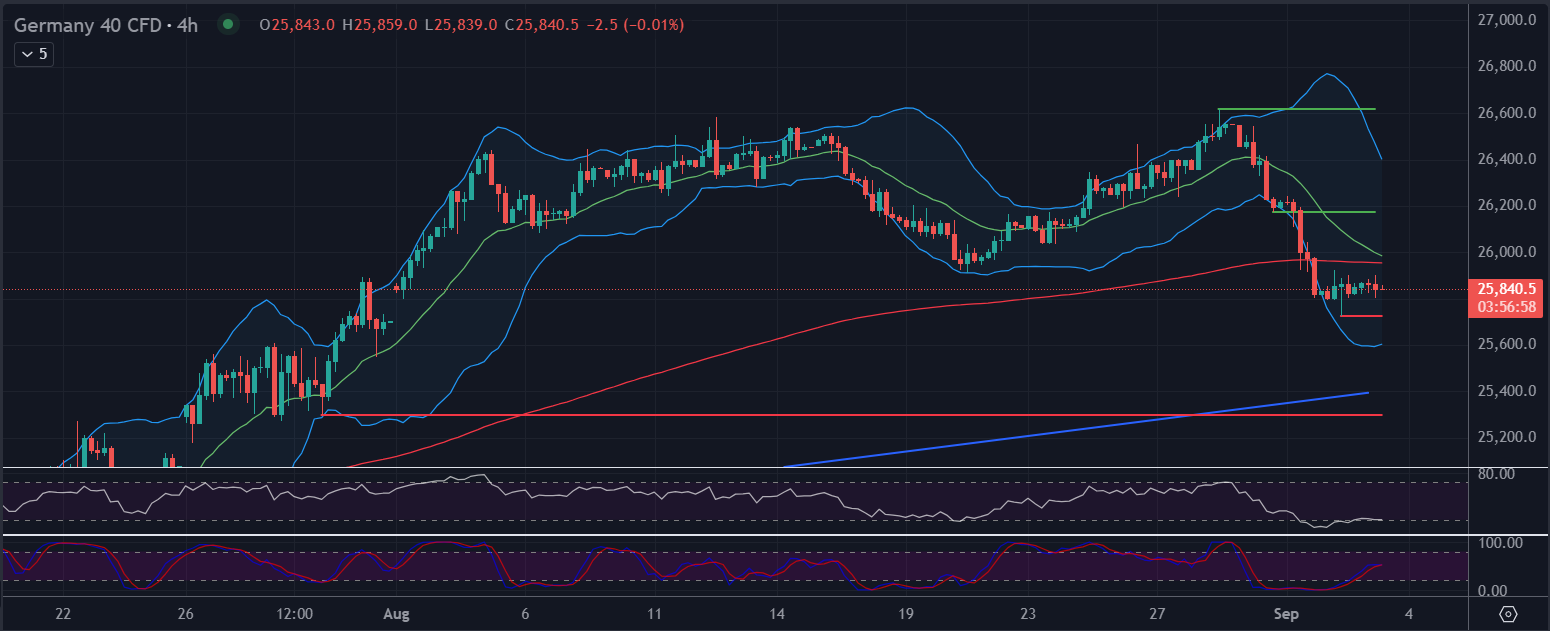
Technically, the DAX is in a short-term correction within a still-positive longer-term trend. The first important resistance is 26,173, corresponding to the 31 August low and the area around the 200-day moving average. Reclaiming this level would be the first sign that buyers are regaining control. Above it, the market faces the 26,619 record-high zone. On the downside, 25,724 is the first important support, followed by 25,297. A sustained break below 25,297 would materially weaken the broader technical structure and suggest that the correction is becoming more than a normal post-record consolidation. The DAX also recently moved below its lower Bollinger Band before showing initial stabilisation, while the 50- and 200-day moving averages continue to point higher.
DAX Outlook
The fundamental data show weakness but do not justify calling the German recovery off. On the contrary, the latest ifo data argues support for strength. What has changed is the cost of that recovery: oil is higher, Bund yields are higher and inflation is proving stickier.
If oil stabilises and Bund yields retreat, the DAX has a credible technical setup for a recovery towards 26,251 and eventually the record high. If energy prices continue climbing while yields remain near 3.4%, the pressure on cyclical stocks is likely to persist however.
For today’s session, the most important releases are therefore the German Services PMI and Crude oil prices (due to a above average draw of the crude oil inventories), followed by the US services data. The market needs evidence that the improving German manufacturing cycle is broadening into services and investments which are less reliant on energy prices.
Philip J Papageorgiou - Head of Investment Research
Philip on X (x twitter) - PhilipForexCom
Latest market news




The complete CFD trading experience
Award-winning platforms, competitive spreads, low commissions and dedicated support.
We live and breathe the markets and are dedicated to helping traders realise their ambitions as we continue to set the industry bar.
Economic calendar
Web Trader platform
Our sophisticated web-based platform is packed with features.
Related articles
S&P 500 Forecast: SPX rises as oil prices fall, but treasuries remain at multi-decade highs
U.S. stocks are rising on Friday after a volatile week that saw a surge in Treasury yields ripple through financial markets.


Oil Quietly Hands the Fed a Reason to Stay Hawkish
Oil prices and the U.S. dollar are both on the front foot as elevated energy costs feed Fed warnings that inflation may prove sticky.


S&P 500 forecast: Stocks extend drop as correction risks grow
US and global equity markets have extended Wednesday’s sell-off, with Wall Street opening lower after a weak handover from Asia and Europe. The deterioration in risk appetite has been spreading across global markets. The dollar was firmer, Treasury yields were holding onto yesterday’s gains, while gold, silver and bitcoin were all under pressure alongside equities and major currencies.
StoneX Europe Ltd may make third party material available on this website which may contain information included but not limited to the conditions of financial markets. The material is for information purposes only and does not contain, and should not be construed as containing, investment advice and/or investment recommendation and/or an investment research and/or an offer of or solicitation for any transactions in financial instruments; any decision to enter into a specific transaction shall be made by the client following an assessment by him/her of their situation.
StoneX Europe Ltd makes no representation or warranty and assumes no liability as to the accuracy or completeness of the information provided, nor any loss arising from any investment based on a recommendation, forecast or other information supplied. You should always seek independent advice as to your suitability to speculate in any related markets and your ability to assume the associated risks, if you are at all unsure. We are not under any obligation to update any such material. Any opinion made may be personal to the author and may not reflect the opinion of StoneX Europe Ltd.