



ECB Preview Mario Draghi Last Policy Decision
After eight years at the helm, today will be the last time we will see Mario Draghi deliver a press conference following the European Central Bank’s monetary policy decision.
Share this:

After eight years at the helm, today will be the last time we will see Mario Draghi deliver a press conference following the European Central Bank’s monetary policy decision. At the time of writing at midday in London, the euro was trading lower ahead of the ECB and as the markets awaited the EU’s decision on whether to extend the Brexit deadline to January 31. European stocks were higher, following on yesterday’s rebound on Wall Street.
The outgoing ECB President Mario Draghi is almost certain not to announce any new changes following last month’s rate cut and QE relaunch, but the Italian will face some pressing questions - make no mistake about it. Last month’s moves to cut rates further into negative and restart bond-buying has proved controversial to say the least, with the ECB’s Governing Council being split about the decision: the heads of the German, French, Dutch and Austrian central banks have all voiced opposition against parts of the package.
But Mr Draghi will no doubt try and make a strong plea in support of the stimulus package and spend a bulk of the time explaining and justifying that decision. With the eurozone economy continuing to weaken, it is probably going to be easier for him to make a strong case for the need to keep policy extraordinarily loose compared to, say, the Fed’s Jay Powell.
Indeed, the latest Eurozone Purchasing Managers’ Index (PMI) data released this morning showed German manufacturing activity contracted again in October while growth in the services sector slowed down further. However, there was good news from France, where both sectors expanded – but only just in the case of manufacturing. However, this was not enough to lift the Eurozone manufacturing PMI average out of contraction, as it remained at 57.7 in October.
Overall, with the Eurozone inflation dropping to a three-year low of 0.8% and well below the ECB’s 2% target, and GDP annual growth rate at just 1.2% and falling, Mario Draghi will depart at a time when the economy is slowing down.
But it is not fair to blame Draghi or the ECB for the slowdown. Clearly, monetary policy alone is not enough to support a fragile economy. Draghi may once again call for looser fiscal policy from European governments – especially with Brexit and US-China trade spat still fully unresolved – although it is likely that his pleas will fall on deaf ears.
Some would argue even that the ECB under Draghi’s leadership has helped to prevent a bigger slowdown – or a depression, even – following its decisive actions at the height of the Eurozone debt crisis. But deep down, Draghi will probably feel a little more frustrated than he would have liked knowing that his actions have not been enough to stimulate growth. So, he will depart with mixed feelings and his successor Christine Lagarde will no doubt have a lot of work to do.
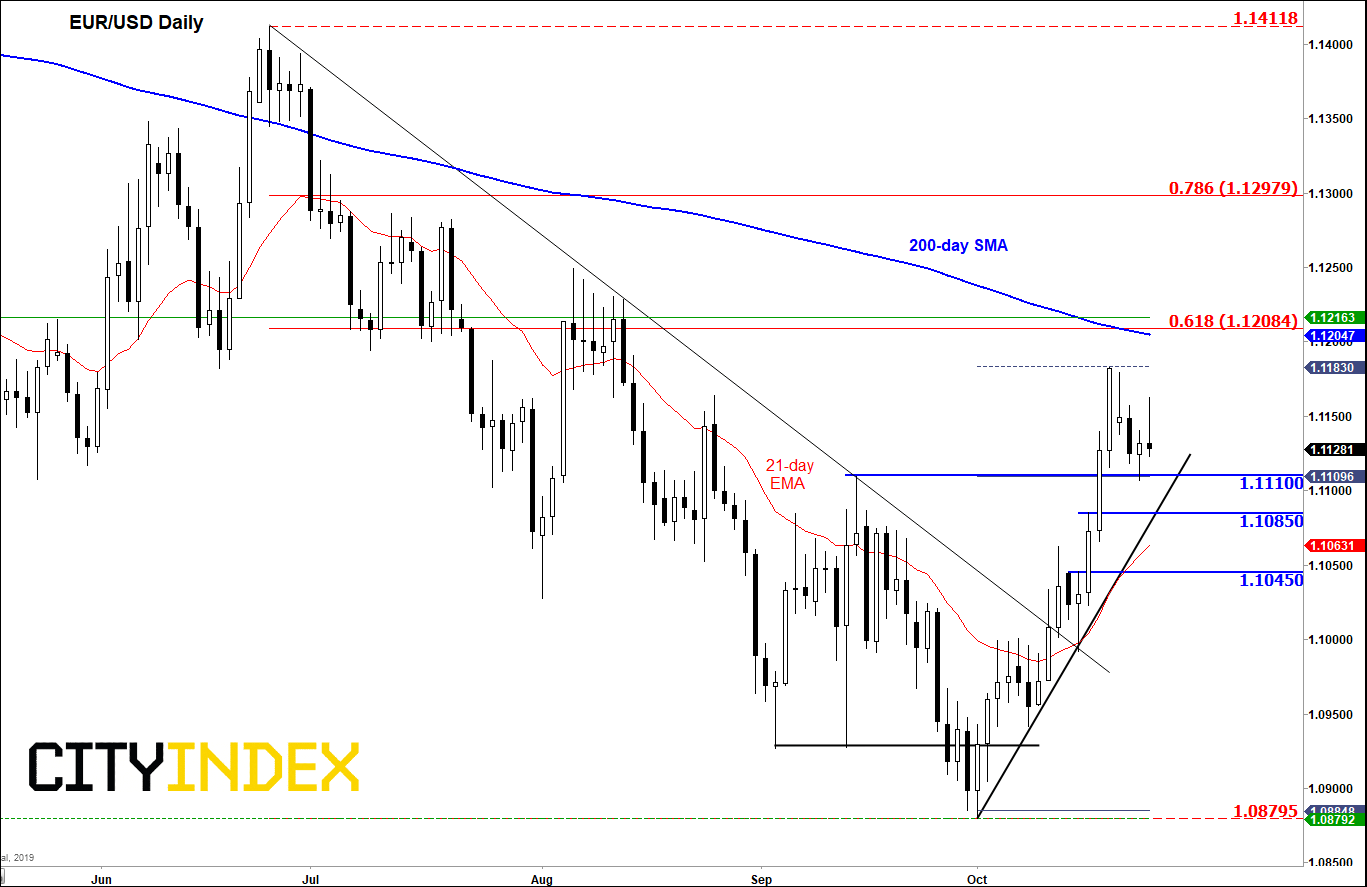
Source: eSignal and City Index
After eight years at the helm, today will be the last time we will see Mario Draghi deliver a press conference following the European Central Bank’s monetary policy decision. At the time of writing at midday in London, the euro was trading lower ahead of the ECB and as the markets awaited the EU’s decision on whether to extend the Brexit deadline to January 31. European stocks were higher, following on yesterday’s rebound on Wall Street.
The outgoing ECB President Mario Draghi is almost certain not to announce any new changes following last month’s rate cut and QE relaunch, but the Italian will face some pressing questions - make no mistake about it. Last month’s moves to cut rates further into negative and restart bond-buying has proved controversial to say the least, with the ECB’s Governing Council being split about the decision: the heads of the German, French, Dutch and Austrian central banks have all voiced opposition against parts of the package.
But Mr Draghi will no doubt try and make a strong plea in support of the stimulus package and spend a bulk of the time explaining and justifying that decision. With the eurozone economy continuing to weaken, it is probably going to be easier for him to make a strong case for the need to keep policy extraordinarily loose compared to, say, the Fed’s Jay Powell.
Indeed, the latest Eurozone Purchasing Managers’ Index (PMI) data released this morning showed German manufacturing activity contracted again in October while growth in the services sector slowed down further. However, there was good news from France, where both sectors expanded – but only just in the case of manufacturing. However, this was not enough to lift the Eurozone manufacturing PMI average out of contraction, as it remained at 57.7 in October.
Overall, with the Eurozone inflation dropping to a three-year low of 0.8% and well below the ECB’s 2% target, and GDP annual growth rate at just 1.2% and falling, Mario Draghi will depart at a time when the economy is slowing down.
But it is not fair to blame Draghi or the ECB for the slowdown. Clearly, monetary policy alone is not enough to support a fragile economy. Draghi may once again call for looser fiscal policy from European governments – especially with Brexit and US-China trade spat still fully unresolved – although it is likely that his pleas will fall on deaf ears.
Some would argue even that the ECB under Draghi’s leadership has helped to prevent a bigger slowdown – or a depression, even – following its decisive actions at the height of the Eurozone debt crisis. But deep down, Draghi will probably feel a little more frustrated than he would have liked knowing that his actions have not been enough to stimulate growth. So, he will depart with mixed feelings and his successor Christine Lagarde will no doubt have a lot of work to do.

Source: eSignal and FOREX.com.
Related tags:



The complete CFD trading experience
Award-winning platforms, competitive spreads, low commissions and dedicated support.
We live and breathe the markets and are dedicated to helping traders realise their ambitions as we continue to set the industry bar.
Economic calendar
Web Trader platform
Our sophisticated web-based platform is packed with features.
Related articles

USD/JPY forecast: US dollar strengths amid hawkish Fed despite recent oil weakness
The US dollar has extended its gains this morning, even if oil prices finished lower for the fifth consecutive day yesterday. Oil prices have bounced back in this first half of today’s session, causing a bit of pressure on currencies that rely on energy imports such as the euro, pound, Swiss franc, and Japanese yen. But it was the dollar that was exerting the most pressure, amid hawkish FedSpeak. Meanwhile, European indices and precious metals were also under a bit of pressure amid the strength of the dollar.


EUR/AUD, GBP/AUD Outlook: Rates, risk and metals reinforce bearish technical case
EUR/AUD and GBP/AUD are coiling near support, with recent correlations suggesting the Aussie’s strength is being driven more by rates, risk and metals than energy.

EUR/USD Update: Will Fed Expectations Keep Pressure on the Euro?
The week continues to present challenges for the euro's short-term strength. This is reflected in the recent performance of EUR/USD, which has declined by nearly 0.6% over the last three trading sessions

StoneX Europe Ltd may make third party material available on this website which may contain information included but not limited to the conditions of financial markets. The material is for information purposes only and does not contain, and should not be construed as containing, investment advice and/or investment recommendation and/or an investment research and/or an offer of or solicitation for any transactions in financial instruments; any decision to enter into a specific transaction shall be made by the client following an assessment by him/her of their situation.
StoneX Europe Ltd makes no representation or warranty and assumes no liability as to the accuracy or completeness of the information provided, nor any loss arising from any investment based on a recommendation, forecast or other information supplied. You should always seek independent advice as to your suitability to speculate in any related markets and your ability to assume the associated risks, if you are at all unsure. We are not under any obligation to update any such material. Any opinion made may be personal to the author and may not reflect the opinion of StoneX Europe Ltd.