




EURUSD New 2019 low likely despite disappointing US data
The EUR/USD has been limping since it made a post-ECB high of 1.1110 nearly two weeks ago.
Share this:

The EUR/USD has been limping since it made a post-ECB high of 1.1110 nearly two weeks ago. After rallying on the back of ECB’s expected decision to re-introduce QE and cut rates to negative, rates have struggled to show any further bullish momentum. It all makes sense. After all, Germany is on the brink of a recession. Inflationary pressures are falling. Brexit uncertainty is rising. Need we any more reasons? Today, though, there was a bit of relief for the single currency as the latest German data was not too bad, while US macro pointers disappointed expectations. The bulls would also take heart from the fact the exchange rate hasn’t broken sharply lower in the face of those very poor German PMI numbers form yesterday. On balance, however, the path of least resistance still remains to the downside because of greater macro concerns over the Eurozone than the US economy.
The exchange rate tested waters above the $1.10 handle in reaction to the German IFO survey, which beat on the “current assessment” front (which came in at 98.5 vs. 96.9 expected and 97.4 prior), but the “expectations” index disappointed (falling to 90.8 vs. 92 expected, down from 91.3 previously). On top of this, the Richmond Fed Manufacturing Index came in sharply below expectations at -9 for September versus +1 expected and last. What’s more, the Conference Board reported a sharp drop in consumer confidence: to 125.1 from 135.1 when a reading of 134.1 was expected.
But with the Eurozone PMIs and German Ifo survey out of the way, there isn’t much in the way of major Eurozone data left for this popular pair this week. However, we will have more second-tier US macro numbers to look forward to as the week progresses. If, on the whole, these figures suggest the US economy is continuing to expand at a steady pace, then the greenback could find renewed bullish momentum and that could undermine the EUR/USD exchange rate. However, if today’s data is anything to go by and we further soft US macro pointers, then in that case the EUR/USD could find some much-needed support.
Source: eSignal and City Index.
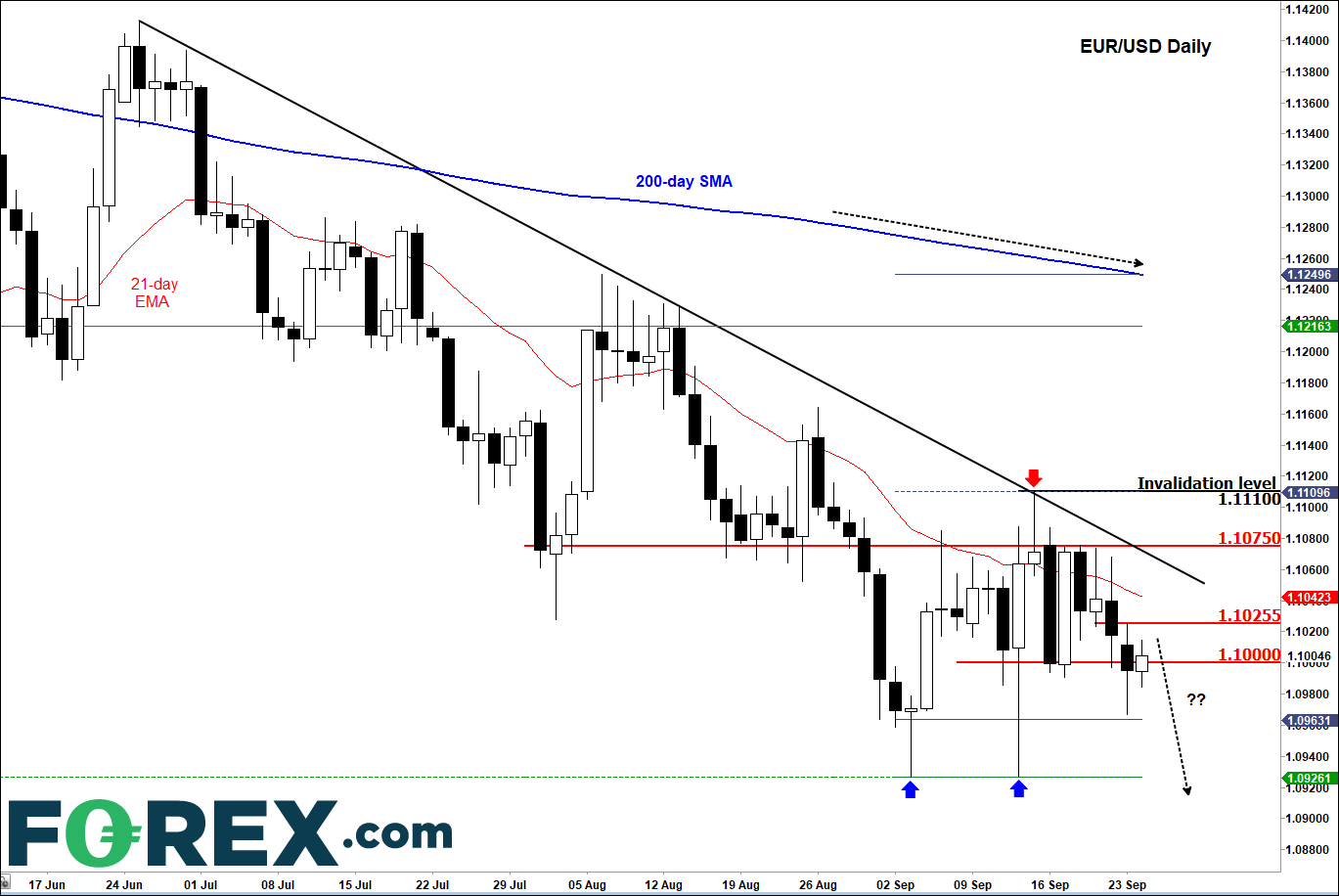
From a technical point of view, the fact that the EUR/USD is struggling to show any sort of strength is not exactly bullish is it? With rates continuing to make lower lows and lower highs, the pressure is growing. You get a feeling that all it needs is just a little push to trigger a few stops and ignite momentum selling. I continue to believe that liquidity below the post-ECB low at 1.0925 will be taken out soon. For avoidance of doubt, I am bearish until told otherwise by bullish price action.
The EUR/USD has been limping since it made a post-ECB high of 1.1110 nearly two weeks ago. After rallying on the back of ECB’s expected decision to re-introduce QE and cut rates to negative, rates have struggled to show any further bullish momentum. It all makes sense. After all, Germany is on the brink of a recession. Inflationary pressures are falling. Brexit uncertainty is rising. Need we any more reasons? Today, though, there was a bit of relief for the single currency as the latest German data was not too bad, while US macro pointers disappointed expectations. The bulls would also take heart from the fact the exchange rate hasn’t broken sharply lower in the face of those very poor German PMI numbers form yesterday. On balance, however, the path of least resistance still remains to the downside because of greater macro concerns over the Eurozone than the US economy.
The exchange rate tested waters above the $1.10 handle in reaction to the German IFO survey, which beat on the “current assessment” front (which came in at 98.5 vs. 96.9 expected and 97.4 prior), but the “expectations” index disappointed (falling to 90.8 vs. 92 expected, down from 91.3 previously). On top of this, the Richmond Fed Manufacturing Index came in sharply below expectations at -9 for September versus +1 expected and last. What’s more, the Conference Board reported a sharp drop in consumer confidence: to 125.1 from 135.1 when a reading of 134.1 was expected.
But with the Eurozone PMIs and German Ifo survey out of the way, there isn’t much in the way of major Eurozone data left for this popular pair this week. However, we will have more second-tier US macro numbers to look forward to as the week progresses. If, on the whole, these figures suggest the US economy is continuing to expand at a steady pace, then the greenback could find renewed bullish momentum and that could undermine the EUR/USD exchange rate. However, if today’s data is anything to go by and we further soft US macro pointers, then in that case the EUR/USD could find some much-needed support.
Source: eSignal and FOREX.com.
From a technical point of view, the fact that the EUR/USD is struggling to show any sort of strength is not exactly bullish is it? With rates continuing to make lower lows and lower highs, the pressure is growing. You get a feeling that all it needs is just a little push to trigger a few stops and ignite momentum selling. I continue to believe that liquidity below the post-ECB low at 1.0925 will be taken out soon. For avoidance of doubt, I am bearish until told otherwise by bullish price action.


The complete CFD trading experience
Award-winning platforms, competitive spreads, low commissions and dedicated support.
We live and breathe the markets and are dedicated to helping traders realise their ambitions as we continue to set the industry bar.
Economic calendar
Web Trader platform
Our sophisticated web-based platform is packed with features.
Related articles

USD/JPY outlook: Hawkish Fed recalibration pressures the yen
Stronger US growth momentum and rising Treasury yields are keeping USD/JPY pointed higher, even as Japanese policymakers try to limit the pressure building across domestic markets.


USD/MXN Forecast: Peso Loses Momentum Ahead of Banxico Decision
Over recent trading sessions, the Mexican peso has started to show signs of losing strength against the U.S. dollar. This can be seen in the performance of USD/MXN, which has gained more than 1.7% over the last three sessions, highlighting the dollar's renewed strength against the peso.


Euro Short-term Outlook: EUR/USD Selloff Nears Critical Yearly Support 9 23 2026
Euro has fallen seven of the past nine sessions, with stretched momentum raising the stakes as EUR/USD closes in on a major inflection zone.

StoneX Europe Ltd may make third party material available on this website which may contain information included but not limited to the conditions of financial markets. The material is for information purposes only and does not contain, and should not be construed as containing, investment advice and/or investment recommendation and/or an investment research and/or an offer of or solicitation for any transactions in financial instruments; any decision to enter into a specific transaction shall be made by the client following an assessment by him/her of their situation.
StoneX Europe Ltd makes no representation or warranty and assumes no liability as to the accuracy or completeness of the information provided, nor any loss arising from any investment based on a recommendation, forecast or other information supplied. You should always seek independent advice as to your suitability to speculate in any related markets and your ability to assume the associated risks, if you are at all unsure. We are not under any obligation to update any such material. Any opinion made may be personal to the author and may not reflect the opinion of StoneX Europe Ltd.