



Japan Core Inflation Turns Negative Yen Strengthens
Falling energy costs and a slowdown in economic activity are depressing prices, stirring worries about a come-back of deflation...
Share this:
As expected, the Bank of Japan today kept its key interest rate unchanged at Negative -0.100%.
At the same time, the central bank announced the launch of a new lending program worth 30 trillion yen to support small businesses hit hard by the coronavirus pandemic.
This new program, which funnel money to companies via commercial banks and other financial institutions, will bring the BOJ's coronavirus response measures to 75 trillion yen.
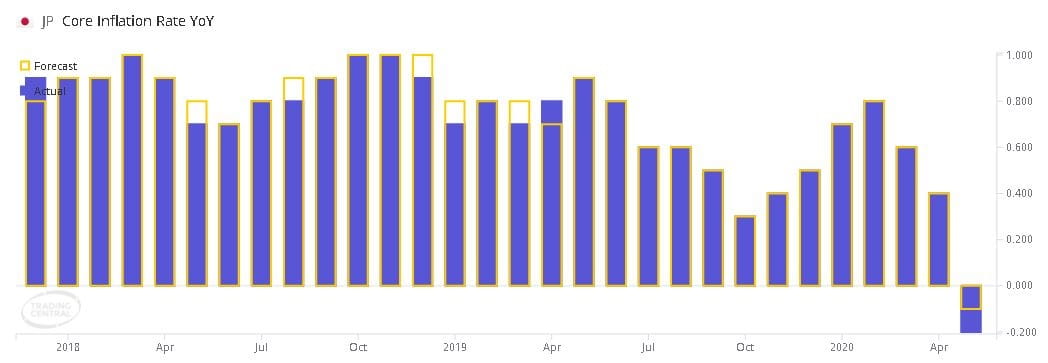
In fact, before the central bank's announcement, Japan's official data showed that Core Consumer Prices contracted 0.2% on year in April (-0.1% expected, +0.4% in March), the first Negative reading since 2016. Falling energy costs and a coronavirus-induced slowdown in economic activity are depressing prices, stirring worries about a come-back of deflation.
Source: Trading Central
Meanwhile, the Japanese yen has regained some strength against the U.S. dollar.
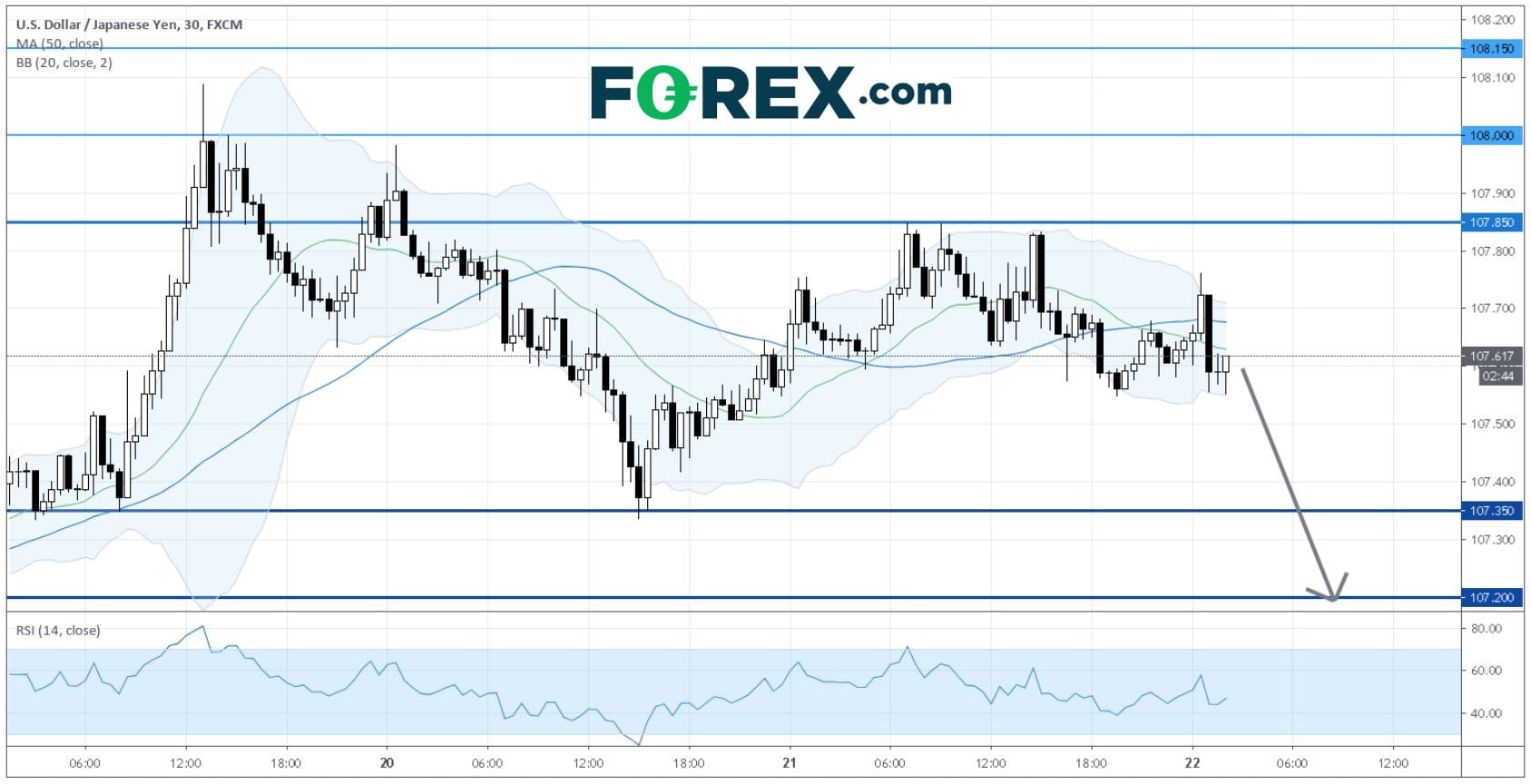
On an Intraday 30-minute Chart, USD/JPY rebounded to an Overhead Resistance at 107.85 yesterday before retreating.

Source: GAIN Capital, TradingView
Currently USD/JPY has returned to levels below the 20-period moving average, which has just crossed below the 50-period one.
And the relative strength index has not yet recovered the neutrality level of 50, suggesting a lack of upward momentum for the pair.
The technical configuration points to continued downside pressure.
The level of 107.85 (the high of yesterday) is acting as a key resistance.
Unless this level is surpassed, USD/JPY is expected to seek Downside Support at 107.35 and 107.20.
At the same time, the central bank announced the launch of a new lending program worth 30 trillion yen to support small businesses hit hard by the coronavirus pandemic.
This new program, which funnel money to companies via commercial banks and other financial institutions, will bring the BOJ's coronavirus response measures to 75 trillion yen.
In fact, before the central bank's announcement, Japan's official data showed that Core Consumer Prices contracted 0.2% on year in April (-0.1% expected, +0.4% in March), the first Negative reading since 2016. Falling energy costs and a coronavirus-induced slowdown in economic activity are depressing prices, stirring worries about a come-back of deflation.
Source: Trading Central
Meanwhile, the Japanese yen has regained some strength against the U.S. dollar.
On an Intraday 30-minute Chart, USD/JPY rebounded to an Overhead Resistance at 107.85 yesterday before retreating.
Source: GAIN Capital, TradingView
Currently USD/JPY has returned to levels below the 20-period moving average, which has just crossed below the 50-period one.
And the relative strength index has not yet recovered the neutrality level of 50, suggesting a lack of upward momentum for the pair.
The technical configuration points to continued downside pressure.
The level of 107.85 (the high of yesterday) is acting as a key resistance.
Unless this level is surpassed, USD/JPY is expected to seek Downside Support at 107.35 and 107.20.
As expected, the Bank of Japan today kept its key interest rate unchanged at Negative -0.100%.
At the same time, the central bank announced the launch of a new lending program worth 30 trillion yen to support small businesses hit hard by the coronavirus pandemic.
This new program, which funnel money to companies via commercial banks and other financial institutions, will bring the BOJ's coronavirus response measures to 75 trillion yen.
In fact, before the central bank's announcement, Japan's official data showed that Core Consumer Prices contracted 0.2% on year in April (-0.1% expected, +0.4% in March), the first Negative reading since 2016. Falling energy costs and a coronavirus-induced slowdown in economic activity are depressing prices, stirring worries about a come-back of deflation.
Source: Trading Central
Meanwhile, the Japanese yen has regained some strength against the U.S. dollar.
On an Intraday 30-minute Chart, USD/JPY rebounded to an Overhead Resistance at 107.85 yesterday before retreating.
Source: GAIN Capital, TradingView
Currently USD/JPY has returned to levels below the 20-period moving average, which has just crossed below the 50-period one.
And the relative strength index has not yet recovered the neutrality level of 50, suggesting a lack of upward momentum for the pair.
The technical configuration points to continued downside pressure.
The level of 107.85 (the high of yesterday) is acting as a key resistance.
Unless this level is surpassed, USD/JPY is expected to seek Downside Support at 107.35 and 107.20.
At the same time, the central bank announced the launch of a new lending program worth 30 trillion yen to support small businesses hit hard by the coronavirus pandemic.
This new program, which funnel money to companies via commercial banks and other financial institutions, will bring the BOJ's coronavirus response measures to 75 trillion yen.
In fact, before the central bank's announcement, Japan's official data showed that Core Consumer Prices contracted 0.2% on year in April (-0.1% expected, +0.4% in March), the first Negative reading since 2016. Falling energy costs and a coronavirus-induced slowdown in economic activity are depressing prices, stirring worries about a come-back of deflation.
Source: Trading Central
Meanwhile, the Japanese yen has regained some strength against the U.S. dollar.
On an Intraday 30-minute Chart, USD/JPY rebounded to an Overhead Resistance at 107.85 yesterday before retreating.
Source: GAIN Capital, TradingView
Currently USD/JPY has returned to levels below the 20-period moving average, which has just crossed below the 50-period one.
And the relative strength index has not yet recovered the neutrality level of 50, suggesting a lack of upward momentum for the pair.
The technical configuration points to continued downside pressure.
The level of 107.85 (the high of yesterday) is acting as a key resistance.
Unless this level is surpassed, USD/JPY is expected to seek Downside Support at 107.35 and 107.20.
Related tags:
Latest market news




The complete CFD trading experience
Award-winning platforms, competitive spreads, low commissions and dedicated support.
We live and breathe the markets and are dedicated to helping traders realise their ambitions as we continue to set the industry bar.
Economic calendar
Web Trader platform
Our sophisticated web-based platform is packed with features.
Related articles
Euro Forecast: EUR/USD Tumbles Towards Yearly Low as Daily RSI Goes Oversold
EUR/USD has been hit hard in the final month of the quarter as USD strength has shown up in a big way. With the pair set to challenge its yearly low as RSI has pushed into oversold territory, is there a chance for a pullback with some big headline risk hitting in the US over the next few days?
AUD/USD outlook: Aussie slips despite hawkish RBA ahead of key data
The AUD/USD was unable to benefit from the Reserve Bank of Australia’s 25-basis-point rate hike overnight. The RBA lifted the cash rate to 4.60%, in line with expectations. However, the Australian dollar weakened following the decision, with much of the Bank’s hawkish stance seemingly priced in ahead of the announcement. The US dollar has also remained largely supported following the recent turmoil in the bond markets.

Canadian Dollar Technical Outlook: USD/CAD Seven-Day Rally Tests Major Resistance 9 29 2026
USD/CAD is pressing into a major technical barrier after an extended advance, raising the risk for price inflection as momentum stretches.

StoneX Europe Ltd may make third party material available on this website which may contain information included but not limited to the conditions of financial markets. The material is for information purposes only and does not contain, and should not be construed as containing, investment advice and/or investment recommendation and/or an investment research and/or an offer of or solicitation for any transactions in financial instruments; any decision to enter into a specific transaction shall be made by the client following an assessment by him/her of their situation.
StoneX Europe Ltd makes no representation or warranty and assumes no liability as to the accuracy or completeness of the information provided, nor any loss arising from any investment based on a recommendation, forecast or other information supplied. You should always seek independent advice as to your suitability to speculate in any related markets and your ability to assume the associated risks, if you are at all unsure. We are not under any obligation to update any such material. Any opinion made may be personal to the author and may not reflect the opinion of StoneX Europe Ltd.