




Mexico Poor economic data and higher inflation
If the trend continues, Banxico will have a problem
Share this:

Mexico released its March trade balance earlier and the print continued the recent trend of poor economic data. The expectation was for $3.2B vs $2.681B in February. The result however was -$3.004B, although both imports and exports were much stronger YoY. Looking at some recent data from Mexico, a trend seems to be emerging. In addition to a worse than expected trade balance, other data over the past week missed expectations as well:
- Economic Activity (FEB): -3.9% expected; -5.1% actual - WORSE
- Retail Sales (FEB): -5.4% expected; -6.3% actual - WORSE
- Mid-Month Inflation report (APR): 5.84% expected; 6.05% actual – WORSE
The only report that was better was the March Unemployment rate, which was 3.9% vs 4.2% expected. However, the decrease in economic data and the rise in inflation should worry the Bank of Mexico (Banxico), who meet again on May 13th. Of course, before then, Mexico’s central bank will have a look at April Business Confidence and March Industrial Production, as well as another look at the inflation rate. However, if the trend continues, Banxico will have a problem: higher inflation and lower economic data!
What are emerging market economies?
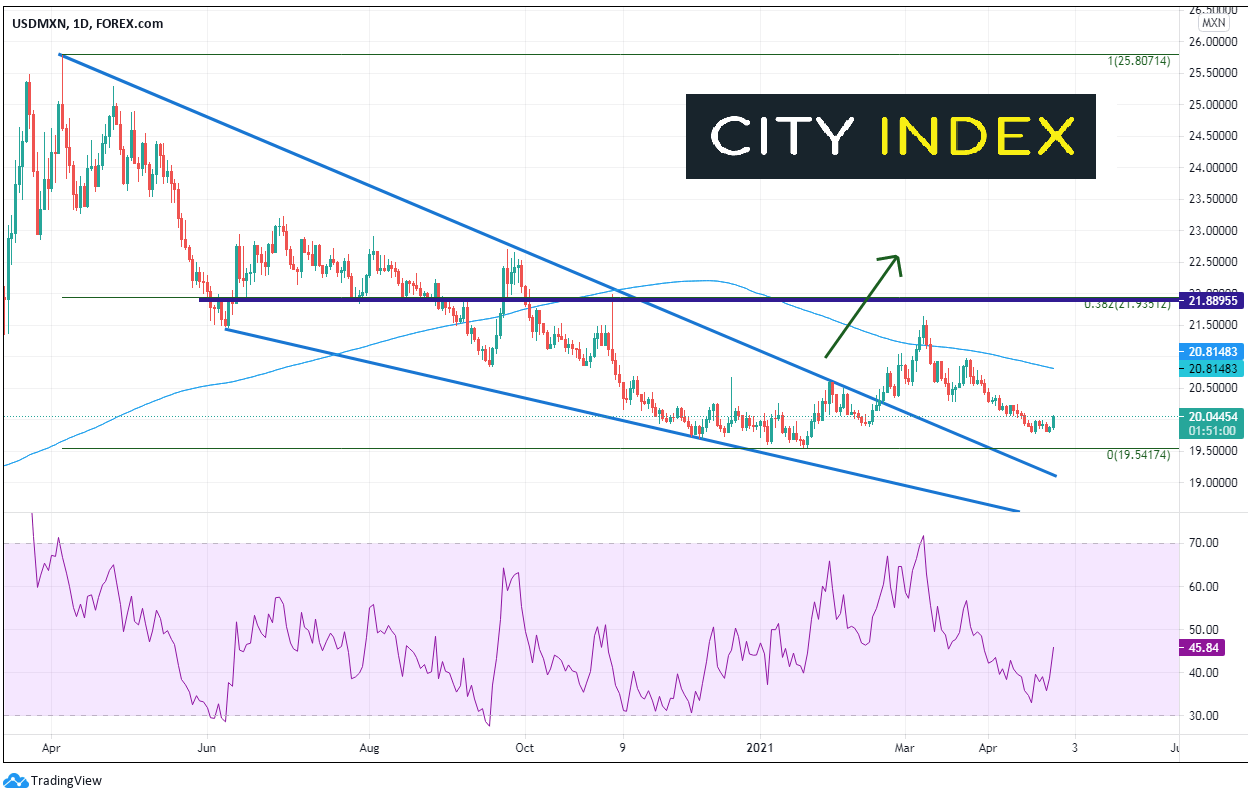
When the Bank of Mexico last met in March, the committee left rates unchanged at 4% after cutting 25bps in February. Banxico had to be happy when USD/MXN broke higher out of the descending wedge on February 18th, which the pair had been in since early April 2020. With the help of a strong US Dollar in first quarter of 2021, the pair briefly broke above the 200 Day Moving Average and made a high on March 8th at 21.6355. However, the pair pulled back into the March 25th meeting had continued lower since.
Source: Tradingview, City Index
On a 240-minute chart, after moving lower from the recent highs on March 8th, the pair formed another descending wedge, this time with the help of a weaker US Dollar. However, with poor data out of Mexico over the past week, USD/MXN was forced higher out of the descending wedge. First horizontal resistance is at 20.2475, and then a confluence of horizontal resistance and the 38.2% Fibonacci retracement level from the March 8th highs to the April 20th lows near 20.50. Support is back at the April 20th lows of 19.78518, the top downward sloping trendline of the wedge near 19.728 and the bottom trendline of the wedge near 19.64. Note that the RSI is just beneath the 70 overbought/neutral line.
Source: Tradingview, City Index
Learn more about forex trading opportunities.
Mexico released its March trade balance earlier and the print continued the recent trend of poor economic data. The expectation was for $3.2B vs $2.681B in February. The result however was -$3.004B, although both imports and exports were much stronger YoY. Looking at some recent data from Mexico, a trend seems to be emerging. In addition to a worse than expected trade balance, other data over the past week missed expectations as well:
- Economic Activity (FEB): -3.9% expected; -5.1% actual - WORSE
- Retail Sales (FEB): -5.4% expected; -6.3% actual - WORSE
- Mid-Month Inflation report (APR): 5.84% expected; 6.05% actual – WORSE
The only report that was better was the March Unemployment rate, which was 3.9% vs 4.2% expected. However, the decrease in economic data and the rise in inflation should worry the Bank of Mexico (Banxico), who meet again on May 13th. Of course, before then, Mexico’s central bank will have a look at April Business Confidence and March Industrial Production, as well as another look at the inflation rate. However, if the trend continues, Banxico will have a problem: higher inflation and lower economic data!
What are emerging market economies?
When the Bank of Mexico last met in March, the committee left rates unchanged at 4% after cutting 25bps in February. Banxico had to be happy when USD/MXN broke higher out of the descending wedge on February 18th, which the pair had been in since early April 2020. With the help of a strong US Dollar in first quarter of 2021, the pair briefly broke above the 200 Day Moving Average and made a high on March 8th at 21.6355. However, the pair pulled back into the March 25th meeting had continued lower since.
Source: Tradingview, FOREX.com
On a 240-minute chart, after moving lower from the recent highs on March 8th, the pair formed another descending wedge, this time with the help of a weaker US Dollar. However, with poor data out of Mexico over the past week, USD/MXN was forced higher out of the descending wedge. First horizontal resistance is at 20.2475, and then a confluence of horizontal resistance and the 38.2% Fibonacci retracement level from the March 8th highs to the April 20th lows near 20.50. Support is back at the April 20th lows of 19.78518, the top downward sloping trendline of the wedge near 19.728 and the bottom trendline of the wedge near 19.64. Note that the RSI is just beneath the 70 overbought/neutral line.
Source: Tradingview, FOREX.com
Learn more about forex trading opportunities.
Related tags:
Latest market news




The complete CFD trading experience
Award-winning platforms, competitive spreads, low commissions and dedicated support.
We live and breathe the markets and are dedicated to helping traders realise their ambitions as we continue to set the industry bar.
Economic calendar
Web Trader platform
Our sophisticated web-based platform is packed with features.
Related articles
USD/JPY outlook: Hawkish Fed recalibration pressures the yen
Stronger US growth momentum and rising Treasury yields are keeping USD/JPY pointed higher, even as Japanese policymakers try to limit the pressure building across domestic markets.
Gold, silver slammed as hawkish Fed repricing reignites dollar upside
Gold and silver had held up surprisingly well against surging US yields. Wednesday’s DXY breakout may have changed that equation.
USD/MXN Forecast: Peso Loses Momentum Ahead of Banxico Decision
Over recent trading sessions, the Mexican peso has started to show signs of losing strength against the U.S. dollar. This can be seen in the performance of USD/MXN, which has gained more than 1.7% over the last three sessions, highlighting the dollar's renewed strength against the peso.

StoneX Europe Ltd may make third party material available on this website which may contain information included but not limited to the conditions of financial markets. The material is for information purposes only and does not contain, and should not be construed as containing, investment advice and/or investment recommendation and/or an investment research and/or an offer of or solicitation for any transactions in financial instruments; any decision to enter into a specific transaction shall be made by the client following an assessment by him/her of their situation.
StoneX Europe Ltd makes no representation or warranty and assumes no liability as to the accuracy or completeness of the information provided, nor any loss arising from any investment based on a recommendation, forecast or other information supplied. You should always seek independent advice as to your suitability to speculate in any related markets and your ability to assume the associated risks, if you are at all unsure. We are not under any obligation to update any such material. Any opinion made may be personal to the author and may not reflect the opinion of StoneX Europe Ltd.