


Mind the Gap after Brexit Vote
Markets are likely to gap on the reopen Monday morning in Asia
Share this:

According to Investopedia, “a gap is an area of a chart where a security’s price either rises or falls from the previous day’s close with no trading occurring in between.” Let’s look at the logic behind this: traders don’t perceive value above or below the previous day’s close until a certain level. Traders will step into the market at a certain level usually for 1 of 2 reasons:
- A trader believes price will reverse (i.e.…move back into the gap) and move in the opposite direction, therefore providing him value
- A trader will take profits and close out a position by buying or selling in the opposite direction of the gap
The first price traded will be the price to measure the distance of the gap (from the previous day’s close to the first price level traded). Large gaps can be dangerous to a solvency of a trader.
It’s rare to have a gap in currency markets, as they are traded 24 hours. Therefore, there is no open or close to “gap”. However, currency markets can gap over weekends, as the market is closed from Friday evening New York until Monday morning Asia.
The UK Parliament vote on Saturday is a binary event. The vote is going to either pass or fail. As a result, the markets are likely to gap on the reopen Monday morning in Asia (Sunday evening in US). If the Brexit vote passes, the Pound and Euro pairs, along with stock indexes, are likely to gap higher. If the Brexit vote fails, the Pound and Euro pair, along with stock indexes, are likely to gap lower.
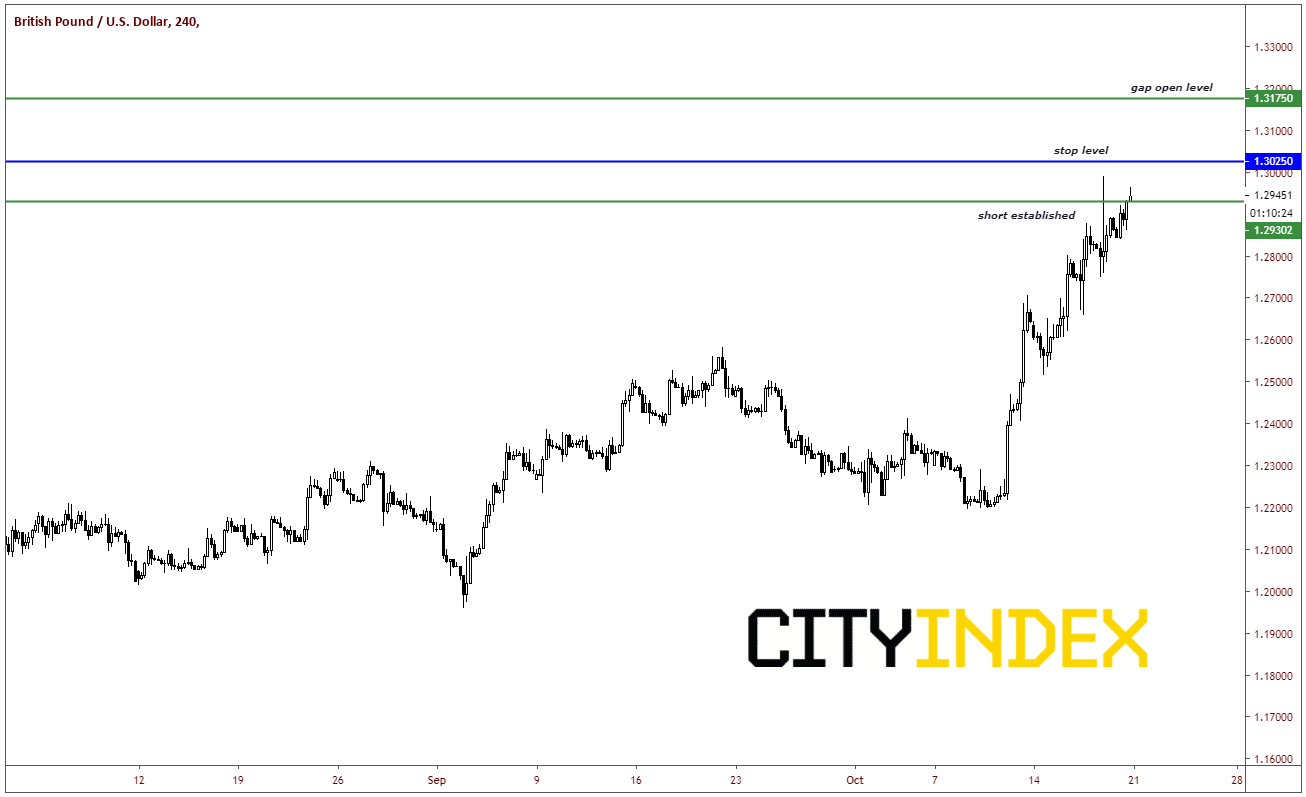
As an example, let’s say that I believe the Brexit vote will fail, and I am short GBP/USD from 1.2925. I have placed a stop at 1.3025 (100 pips away). Assume now that the Brexit vote passes, and price gaps higher on the Monday morning Asian open to 1.3175. My stop order (which is now a buy or “get me out” order) will not be filled until there is a seller, which is at 1.3170 OR HIGHER, depending on how many other sellers are at that level. Therefore on the gap, my stop order, which was a 100-pip loss, now becomes a 250-pip loss. This is the reason gaps can be so dangerous to traders.
Source: Tradingview, City Index
On the other hand, if price gaps lower, I could be in the money by the same amount. Acceptable risk/reward should be considered for each trader.
My colleague Matt Simpson wrote about measuring GBP price possibilities via implied volatility earlier today. Check it out here.
According to Investopedia, “a gap is an area of a chart where a security’s price either rises or falls from the previous day’s close with no trading occurring in between.” Let’s look at the logic behind this: traders don’t perceive value above or below the previous day’s close until a certain level. Traders will step into the market at a certain level usually for 1 of 2 reasons:
- A trader believes price will reverse (i.e.…move back into the gap) and move in the opposite direction, therefore providing him value
- A trader will take profits and close out a position by buying or selling in the opposite direction of the gap
The first price traded will be the price to measure the distance of the gap (from the previous day’s close to the first price level traded). Large gaps can be dangerous to a solvency of a trader.
It’s rare to have a gap in currency markets, as they are traded 24 hours. Therefore, there is no open or close to “gap”. However, currency markets can gap over weekends, as the market is closed from Friday evening New York until Monday morning Asia.
The UK Parliament vote on Saturday is a binary event. The vote is going to either pass or fail. As a result, the markets are likely to gap on the reopen Monday morning in Asia (Sunday evening in US). If the Brexit vote passes, the Pound and Euro pairs, along with stock indexes, are likely to gap higher. If the Brexit vote fails, the Pound and Euro pair, along with stock indexes, are likely to gap lower.
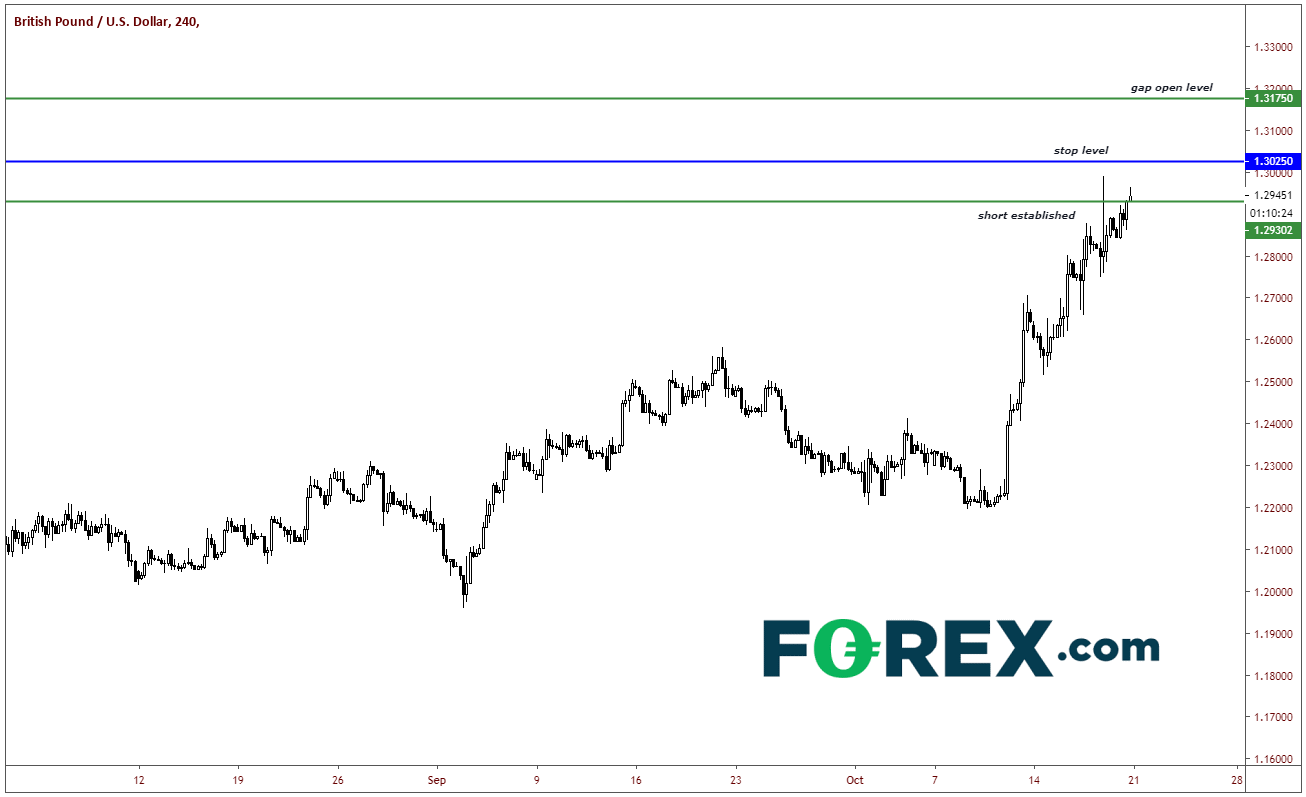
As an example, let’s say that I believe the Brexit vote will fail, and I am short GBP/USD from 1.2925. I have placed a stop at 1.3025 (100 pips away). Assume now that the Brexit vote passes, and price gaps higher on the Monday morning Asian open to 1.3175. My stop order (which is now a buy or “get me out” order) will not be filled until there is a seller, which is at 1.3170 OR HIGHER, depending on how many other sellers are at that level. Therefore on the gap, my stop order, which was a 100-pip loss, now becomes a 250-pip loss. This is the reason gaps can be so dangerous to traders.
Source: Tradingview, FOREX.com
On the other hand, if price gaps lower, I could be in the money by the same amount. Acceptable risk/reward should be considered for each trader.
My colleague Matt Simpson wrote about measuring GBP price possibilities via implied volatility earlier today. Check it out here.
Latest market news




The complete CFD trading experience
Award-winning platforms, competitive spreads, low commissions and dedicated support.
We live and breathe the markets and are dedicated to helping traders realise their ambitions as we continue to set the industry bar.
Economic calendar
Web Trader platform
Our sophisticated web-based platform is packed with features.
Related articles
USD/JPY Q4 2026 Outlook: Hawkish Fed Pricing Clashes With Intervention Risk
The year-end tug-of-war is clear: hawkish Fed pricing supports USD/JPY, while intervention risk limits the upside.


Japanese Yen Forecast: USD/JPY 4% Rally Challenges Post-Intervention Downtrend 9 24 2026
USD/JPY momentum has shifted sharply higher, putting a major resistance confluence in focus as U.S. and Japanese event risk builds.


Oil Quietly Hands the Fed a Reason to Stay Hawkish
Oil prices and the U.S. dollar are both on the front foot as elevated energy costs feed Fed warnings that inflation may prove sticky.

StoneX Europe Ltd may make third party material available on this website which may contain information included but not limited to the conditions of financial markets. The material is for information purposes only and does not contain, and should not be construed as containing, investment advice and/or investment recommendation and/or an investment research and/or an offer of or solicitation for any transactions in financial instruments; any decision to enter into a specific transaction shall be made by the client following an assessment by him/her of their situation.
StoneX Europe Ltd makes no representation or warranty and assumes no liability as to the accuracy or completeness of the information provided, nor any loss arising from any investment based on a recommendation, forecast or other information supplied. You should always seek independent advice as to your suitability to speculate in any related markets and your ability to assume the associated risks, if you are at all unsure. We are not under any obligation to update any such material. Any opinion made may be personal to the author and may not reflect the opinion of StoneX Europe Ltd.