






The BOC and The Canadian Dollar
The BOC meets tomorrow and must decide whether they need to cut rates or leave them unchanged
Share this:

The Bank of Canada meets tomorrow and must decide whether they need to cut rates or leave them unchanged at 1.75%. The market is expecting the BOC to leave rates unchanged, as inflation is hovering near 2.0% and GDP has been strong. The more important issue the Committee will have to address is how they will revise (if at all) their growth and inflation outlook. With much in the world in a manufacturing slowdown and in rate cutting mode, the Members must determine if they feel the need to follow suit and revise their forecasts lower. It is also possible the United State-Mexico-Canada Agreement (USMCA) may be ratified, as early as this week. Members will need to determine if this should be factored into the BOC forecasts.
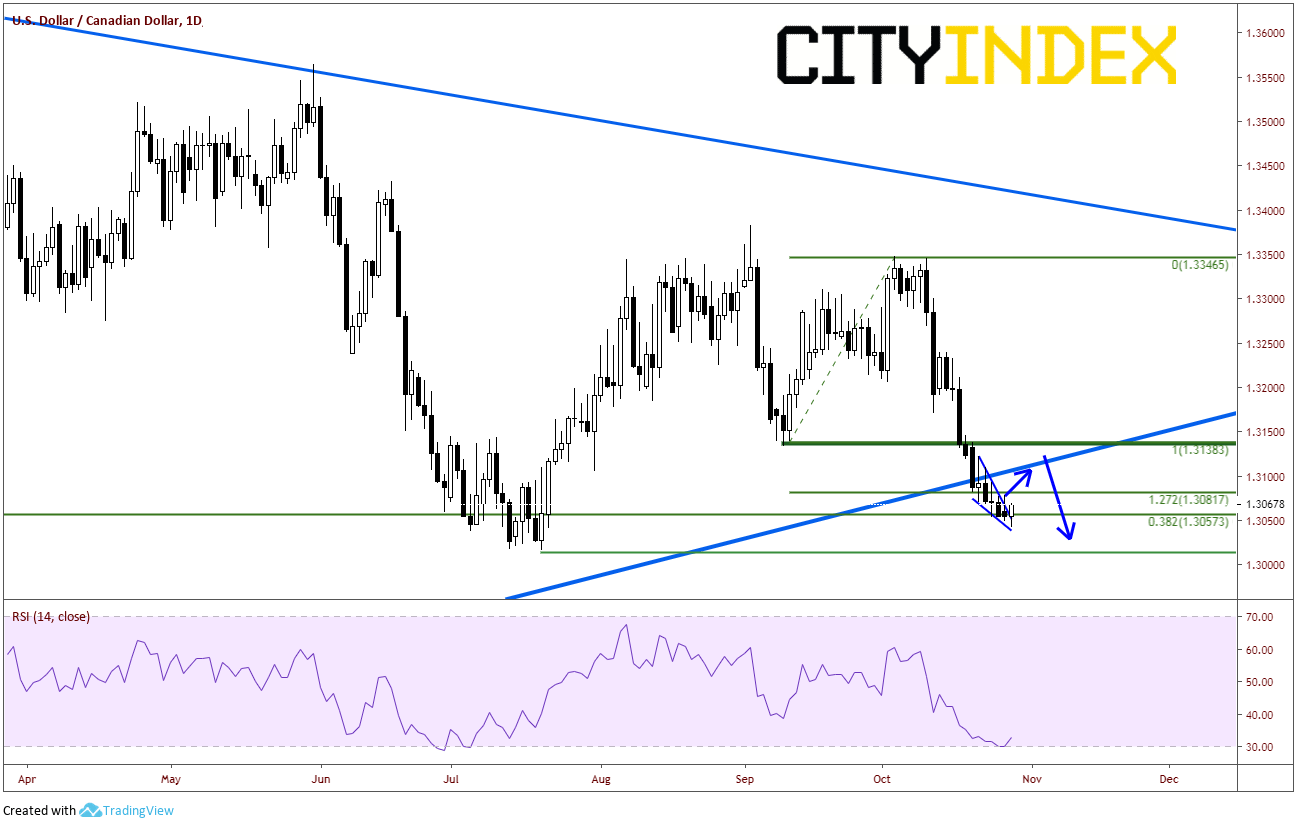
Last week we discussed how USD/CAD is breaking, and now consolidating, below a long-term trendline. This breakdown makes sense from a simple fundamental standpoint as the US is in rate cutting mode while Canada is in a holding pattern. The Canadian Dollar should be stronger than the US Dollar, as the market prices in interest rates differentials.
Source: Tradingview, City Index
However, as USD/CAD now appears to be breaking out of a descending wedge pattern, we need to see if bears can hold the market below 1.3100, which is the upward sloping long term trendline. 1.3183 remain strong horizontal resistance as well. If the pair holds below those levels, the price could be down to 1.3000 in a hurry.
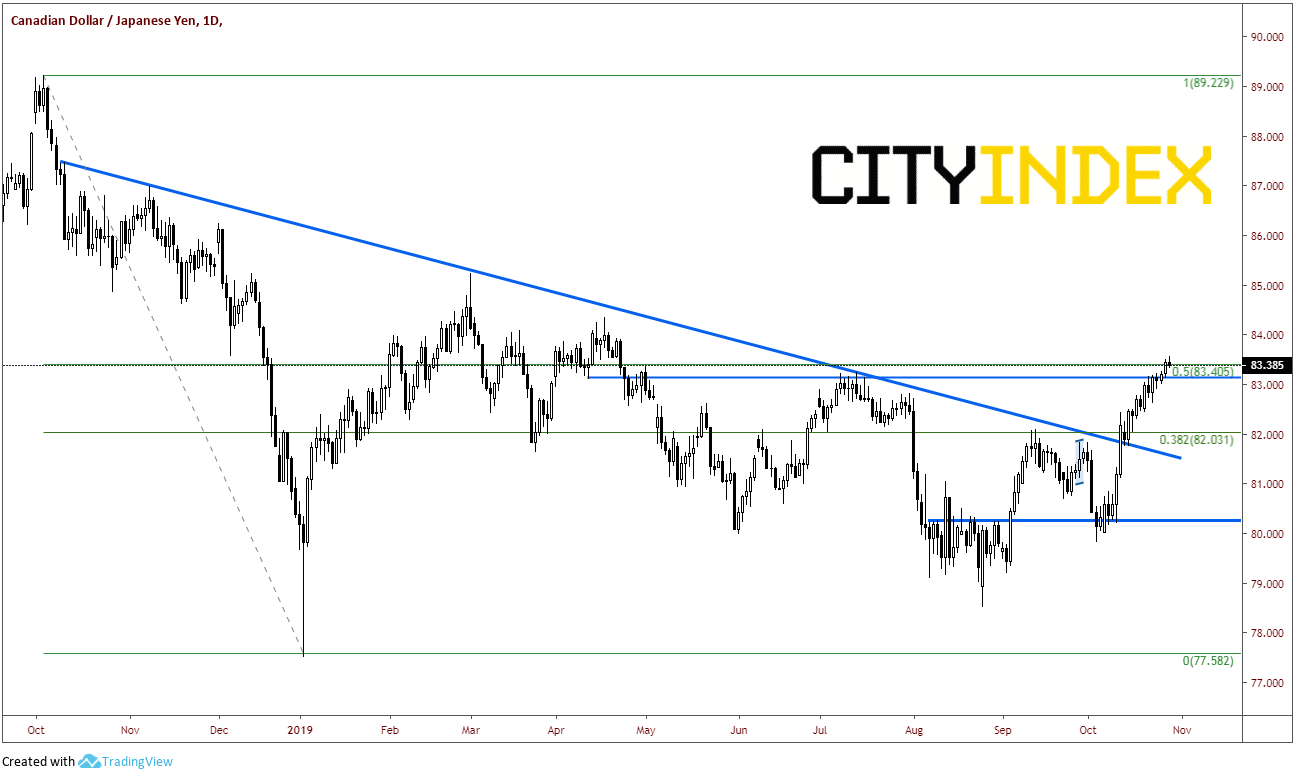
But USD/CAD isn’t the only CAD pair where the Canadian Dollar is strong. CAD/JPY has been on a tear since holding support in early October. The pair then went on to break above the downward sloping trendline from October of last year. CAD/JPY is currently trading near 83.40, which is the 50% retracement from the October 2018 highs to the January 3rd lows.
Source: Tradingview, City Index
EUR/CAD has been moving lower as well, as the ECB has been in easing mode. The pair is currently in a descending triangle and looks like it could break to the downside. The target for a descending triangle is the height of the triangle added to the breakdown point, which in this case would be below 1.4000!
Source: Tradingview, City Index
NZD/CAD has retraced the entire move from the lows of August 2015 to the highs of November 2016. That move was from .9932 down to .8234, almost 1700 pips!! AUD/CAD looks similar.
Source: Tradingview, City Index
If the BOC is hawkish or even remains neutral in their forecast or in the press conference to follow, the Canadian Dollar may continue to strengthen vs countries that have an easing monetary policy. If they turn dovish, watch for a possible reversal.
The Bank of Canada meets tomorrow and must decide whether they need to cut rates or leave them unchanged at 1.75%. The market is expecting the BOC to leave rates unchanged, as inflation is hovering near 2.0% and GDP has been strong. The more important issue the Committee will have to address is how they will revise (if at all) their growth and inflation outlook. With much in the world in a manufacturing slowdown and in rate cutting mode, the Members must determine if they feel the need to follow suit and revise their forecasts lower. It is also possible the United State-Mexico-Canada Agreement (USMCA) may be ratified, as early as this week. Members will need to determine if this should be factored into the BOC forecasts.
Last week we discussed how USD/CAD is breaking, and now consolidating, below a long-term trendline. This breakdown makes sense from a simple fundamental standpoint as the US is in rate cutting mode while Canada is in a holding pattern. The Canadian Dollar should be stronger than the US Dollar, as the market prices in interest rates differentials.
Source: Tradingview, FOREX.com
However, as USD/CAD now appears to be breaking out of a descending wedge pattern, we need to see if bears can hold the market below 1.3100, which is the upward sloping long term trendline. 1.3183 remain strong horizontal resistance as well. If the pair holds below those levels, the price could be down to 1.3000 in a hurry.
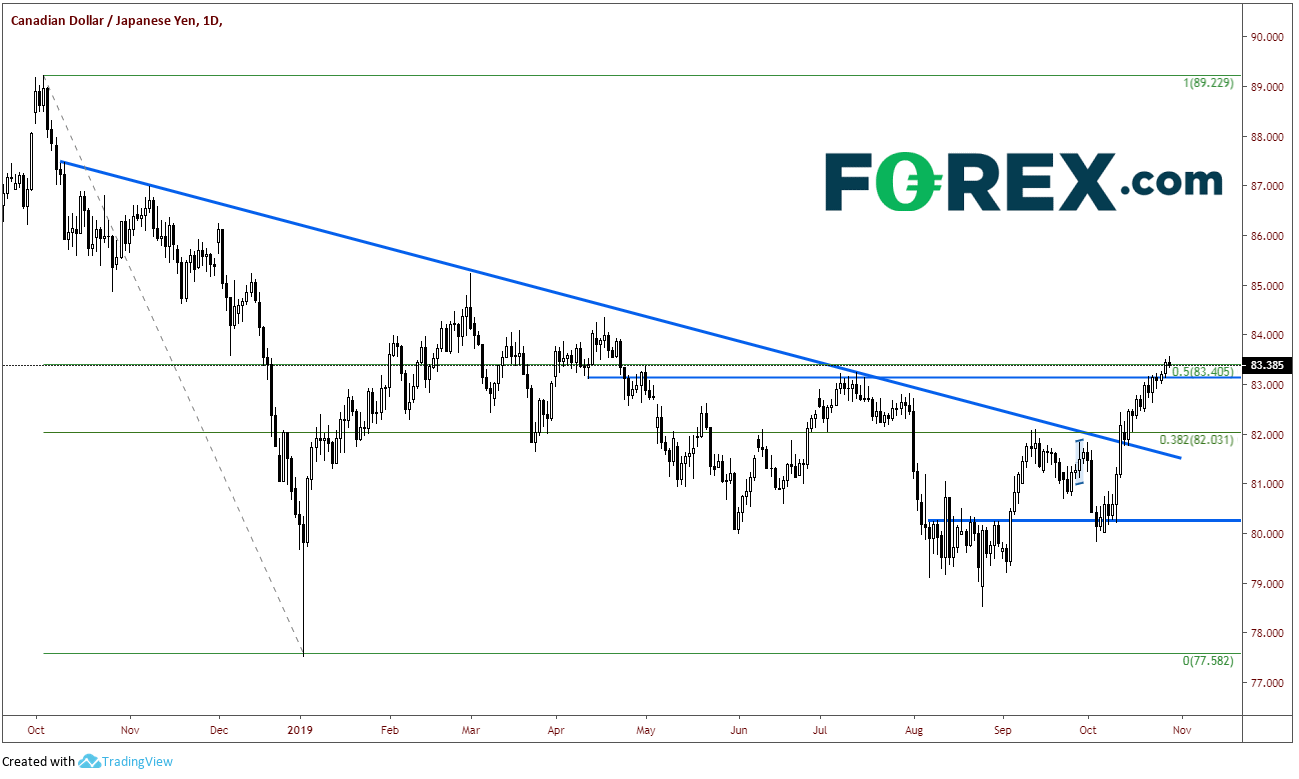
But USD/CAD isn’t the only CAD pair where the Canadian Dollar is strong. CAD/JPY has been on a tear since holding support in early October. The pair then went on to break above the downward sloping trendline from October of last year. CAD/JPY is currently trading near 83.40, which is the 50% retracement from the October 2018 highs to the January 3rd lows.
Source: Tradingview, FOREX.com
EUR/CAD has been moving lower as well, as the ECB has been in easing mode. The pair is currently in a descending triangle and looks like it could break to the downside. The target for a descending triangle is the height of the triangle added to the breakdown point, which in this case would be below 1.4000!
Source: Tradingview, FOREX.com
NZD/CAD has retraced the entire move from the lows of August 2015 to the highs of November 2016. That move was from .9932 down to .8234, almost 1700 pips!! AUD/CAD looks similar.
Source: Tradingview, FOREX.com
If the BOC is hawkish or even remains neutral in their forecast or in the press conference to follow, the Canadian Dollar may continue to strengthen vs countries that have an easing monetary policy. If they turn dovish, watch for a possible reversal.
Latest market news




The complete CFD trading experience
Award-winning platforms, competitive spreads, low commissions and dedicated support.
We live and breathe the markets and are dedicated to helping traders realise their ambitions as we continue to set the industry bar.
Economic calendar
Web Trader platform
Our sophisticated web-based platform is packed with features.
Related articles
EUR/USD weekly outlook: Oil, inflation and NFP in focus
After coming under significant pressure in recent weeks, the EUR/USD came off its lows to finish the week on a positive note on Friday, albeit with only a mild rebound. That was not enough to prevent the exchange rate falling for the third consecutive week, as the US dollar and bond yields rallied across the board.


USD/JPY Weekly Outlook: Payrolls loom as US rates remain the dominant driver
Strong US growth and hawkish Fed pricing continue to support USD/JPY, while intervention risk appears to be kicking in at lower levels

EUR/USD Q4 2026 Outlook: Euro at a Crossroads as Fed, ECB Tighten 9 25 2026
EUR/USD enters Q4 at a pivotal inflection point as competing Fed-ECB policy paths and persistent inflation risks collide with major technical support.

StoneX Europe Ltd may make third party material available on this website which may contain information included but not limited to the conditions of financial markets. The material is for information purposes only and does not contain, and should not be construed as containing, investment advice and/or investment recommendation and/or an investment research and/or an offer of or solicitation for any transactions in financial instruments; any decision to enter into a specific transaction shall be made by the client following an assessment by him/her of their situation.
StoneX Europe Ltd makes no representation or warranty and assumes no liability as to the accuracy or completeness of the information provided, nor any loss arising from any investment based on a recommendation, forecast or other information supplied. You should always seek independent advice as to your suitability to speculate in any related markets and your ability to assume the associated risks, if you are at all unsure. We are not under any obligation to update any such material. Any opinion made may be personal to the author and may not reflect the opinion of StoneX Europe Ltd.