




Turkish lira slides as Erdogan replaces CBRT head
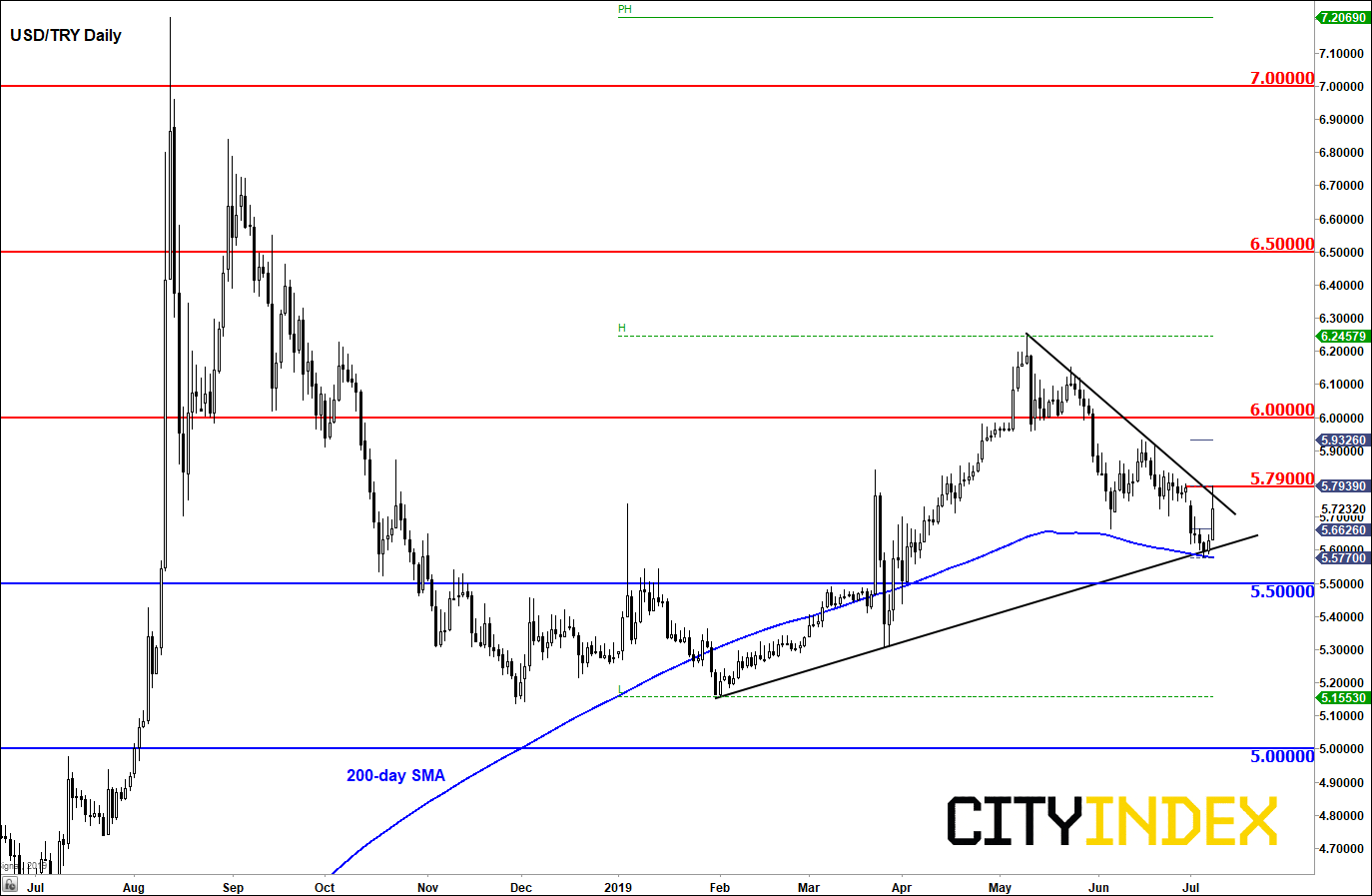
The Turkish lira is sliding once again amid renewed concerns that President Recep Tayyip Erdogan is ruining the nation’s economy, just as inflation was starting to ease back.
Share this:

The Turkish lira is sliding once again amid renewed concerns that President Recep Tayyip Erdogan is ruining the nation’s economy, just as inflation was starting to ease back. His decision to replace the Turkish Central Bank’s Governor over the weekend has backfired with the lira taking a tumble. Undoubtedly, some investors are concerned that monetary policy will now be loosened prematurely, and this could prevent a convincing drop in inflation.
Turkey has been fighting runaway inflation and capital flight for the past few years due to political and economic instability, triggering sharp interest rate hikes by the Turkish central bank and imposition of strict capital controls. Some progress was made as consumer prices eased to 15.7% in June from a year earlier – compared with 18.7% in May and 19.5% in April.
However, Erdogan has long been against interest rate hikes, which he thinks causes inflation despite conventional economic theory suggesting otherwise. So, he took matters into his own hands and decided to replace CBRT’s Governor Murat Cetinkaya on Saturday, undermining in the process the central bank’s independence — just weeks before it is scheduled to decide on monetary policy.
Cetinkaya was criticised by investors for tightening policy too slowly during the height of the currency crisis last summer and then came under pressure from the government for not lowering interest rates again. Last September, under Cetinkaya’s leadership, the CBRT hiked the benchmark interest rate by 625 basis points to 24% and it has stayed at that level since. Cetinkaya had promised earlier in the year to maintain tight monetary policy until a “convincing” fall in inflation was observed.
Clearly, Cetinkaya was not convinced by the recent sharp falls inflation and Erdogan was not convinced the central bank governor was doing his job properly, so he had to go. Investors are concerned that if Erdogan the central bank – now under the leadership of former Deputy Governor Murat Uysal – decides to sharply cut rates on July 25, this will prevent inflation from decelerating further and could cause more economic pain down the line. A reduction in interest rates will make the Turkish lira less attractive for yield-seeking investors in any case. This is also why the lira is falling today.
But Erdogan’s decision to replace the central bank head may not be a bad thing after all. It could be that inflation may ease further anyway with the global economy slowing and with capital controls in place in Tukey. The potential rate cuts by the CBRT could stimulate economic growth rather than lead to inflation in the coming months and years. But for now, traders are selling the lira and will be asking questions later.
Source: eSignal and City Index.
The Turkish lira is sliding once again amid renewed concerns that President Recep Tayyip Erdogan is ruining the nation’s economy, just as inflation was starting to ease back. His decision to replace the Turkish Central Bank’s Governor over the weekend has backfired with the lira taking a tumble. Undoubtedly, some investors are concerned that monetary policy will now be loosened prematurely, and this could prevent a convincing drop in inflation.
Turkey has been fighting runaway inflation and capital flight for the past few years due to political and economic instability, triggering sharp interest rate hikes by the Turkish central bank and imposition of strict capital controls. Some progress was made as consumer prices eased to 15.7% in June from a year earlier – compared with 18.7% in May and 19.5% in April.
However, Erdogan has long been against interest rate hikes, which he thinks causes inflation despite conventional economic theory suggesting otherwise. So, he took matters into his own hands and decided to replace CBRT’s Governor Murat Cetinkaya on Saturday, undermining in the process the central bank’s independence — just weeks before it is scheduled to decide on monetary policy.
Cetinkaya was criticised by investors for tightening policy too slowly during the height of the currency crisis last summer and then came under pressure from the government for not lowering interest rates again. Last September, under Cetinkaya’s leadership, the CBRT hiked the benchmark interest rate by 625 basis points to 24% and it has stayed at that level since. Cetinkaya had promised earlier in the year to maintain tight monetary policy until a “convincing” fall in inflation was observed.
Clearly, Cetinkaya was not convinced by the recent sharp falls inflation and Erdogan was not convinced the central bank governor was doing his job properly, so he had to go. Investors are concerned that if Erdogan the central bank – now under the leadership of former Deputy Governor Murat Uysal – decides to sharply cut rates on July 25, this will prevent inflation from decelerating further and could cause more economic pain down the line. A reduction in interest rates will make the Turkish lira less attractive for yield-seeking investors in any case. This is also why the lira is falling today.
But Erdogan’s decision to replace the central bank head may not be a bad thing after all. It could be that inflation may ease further anyway with the global economy slowing and with capital controls in place in Tukey. The potential rate cuts by the CBRT could stimulate economic growth rather than lead to inflation in the coming months and years. But for now, traders are selling the lira and will be asking questions later.
Source: eSignal and FOREX.com.
Related tags:
Latest market news




The complete CFD trading experience
Award-winning platforms, competitive spreads, low commissions and dedicated support.
We live and breathe the markets and are dedicated to helping traders realise their ambitions as we continue to set the industry bar.
Economic calendar
Web Trader platform
Our sophisticated web-based platform is packed with features.
Related articles
USD/JPY outlook: Hawkish Fed recalibration pressures the yen
Stronger US growth momentum and rising Treasury yields are keeping USD/JPY pointed higher, even as Japanese policymakers try to limit the pressure building across domestic markets.
USD/MXN Forecast: Peso Loses Momentum Ahead of Banxico Decision
Over recent trading sessions, the Mexican peso has started to show signs of losing strength against the U.S. dollar. This can be seen in the performance of USD/MXN, which has gained more than 1.7% over the last three sessions, highlighting the dollar's renewed strength against the peso.

Euro Short-term Outlook: EUR/USD Selloff Nears Critical Yearly Support 9 23 2026
Euro has fallen seven of the past nine sessions, with stretched momentum raising the stakes as EUR/USD closes in on a major inflection zone.

StoneX Europe Ltd may make third party material available on this website which may contain information included but not limited to the conditions of financial markets. The material is for information purposes only and does not contain, and should not be construed as containing, investment advice and/or investment recommendation and/or an investment research and/or an offer of or solicitation for any transactions in financial instruments; any decision to enter into a specific transaction shall be made by the client following an assessment by him/her of their situation.
StoneX Europe Ltd makes no representation or warranty and assumes no liability as to the accuracy or completeness of the information provided, nor any loss arising from any investment based on a recommendation, forecast or other information supplied. You should always seek independent advice as to your suitability to speculate in any related markets and your ability to assume the associated risks, if you are at all unsure. We are not under any obligation to update any such material. Any opinion made may be personal to the author and may not reflect the opinion of StoneX Europe Ltd.