


USD/MXN Forecast: The Mexican peso regains strength after inflation data release
During the session, USD/MXN has shown a decline of around -0.5%, favoring the Mexican peso. The recent strength of the Mexican currency is mainly linked to the release of new inflation data that could eventually point toward a slightly more hawkish tone from Mexico’s central bank.
Share this:

During the session, USD/MXN has shown a decline of around -0.5%, favoring the Mexican peso. The recent strength of the Mexican currency is mainly linked to the release of new inflation data that could eventually point toward a slightly more hawkish tone from Mexico’s central bank in the short term. This has begun to support a consistent recovery in the peso, taking ground away from the US dollar. If a more restrictive stance is confirmed following these data, it could become a relevant fundamental catalyst for stronger selling pressure in USD/MXN in the coming sessions.


Inflation data released in Mexico
During today’s session, according to Mexico’s National Institute of Statistics and Geography (INEGI), annual inflation reached approximately 3.9% in the first half of February, marking three consecutive biweekly increases and the highest level since November 2025. Core inflation (which excludes volatile goods) stood at around 4.52% annually, clearly above Banco de México’s 3% target, which allows a one-percentage-point variation range.
It is important to recall that, according to the latest Banco de México minutes, the benchmark interest rate was held at 7.00% while inflation trends were being evaluated. However, with this new data reflecting persistent pressures, expectations of a firmer stance could begin to consolidate, either through a pause in future rate cuts or even by considering a more restrictive path if inflation fails to ease.
This becomes particularly relevant when comparing Banco de México’s rate (7.00%) with the US Federal Reserve’s rate (3.75%), maintaining a 3.25% rate differential. In a scenario where Banxico has less room to cut and the Fed keeps rates stable in upcoming decisions, this differential could remain in place in the coming months, preserving the relative attractiveness of peso-denominated assets.
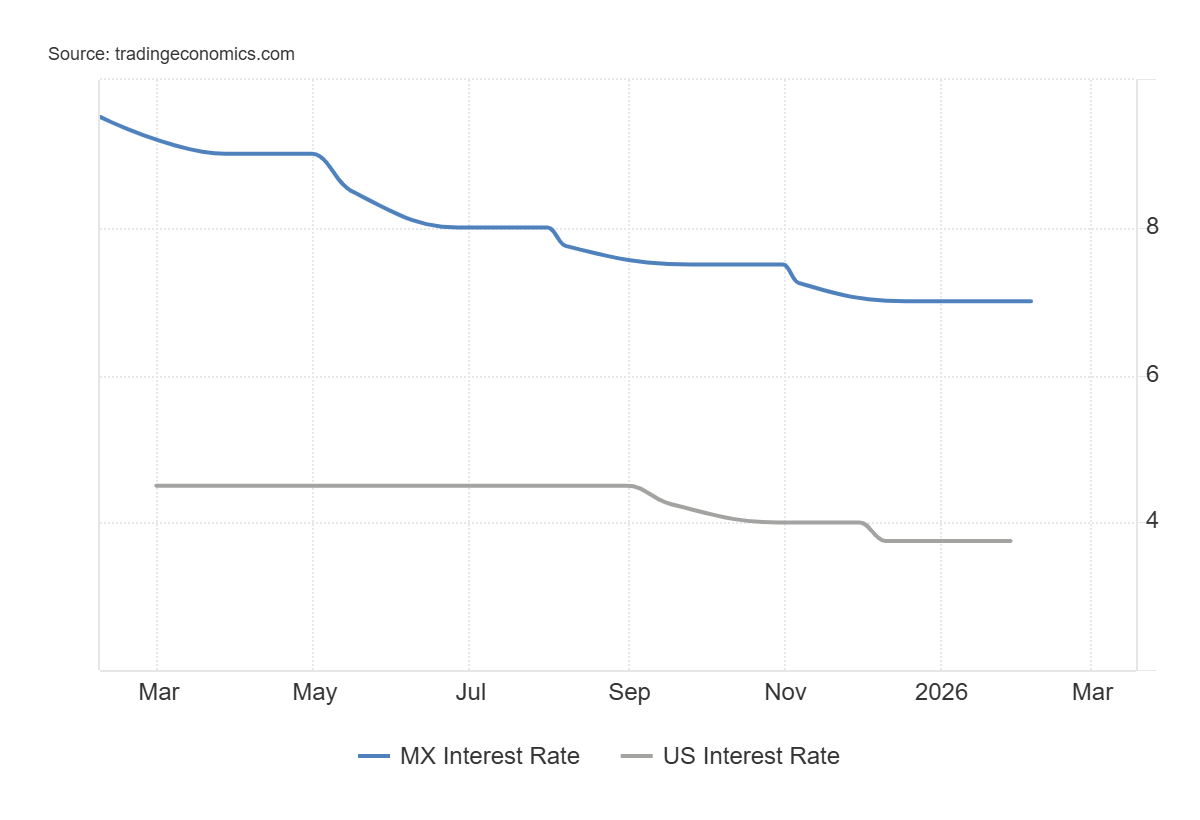
Source: TradingEconomics
Under this context, persistent inflation and the sustained differential could continue supporting demand for Mexican peso assets, especially in the fixed-income market, which offers higher yields compared to the United States. This factor has been key to the peso’s strength in recent months and, if maintained, could continue favoring a structural bearish dynamic in USD/MXN in the short term.
Do potential tariffs pose a risk?
It is also important not to overlook the announcement of potential 15% global tariffs proposed over the weekend by the Trump administration, which has generated renewed trade tensions in international markets. However, no official implementation date has been confirmed, and markets have so far interpreted it as a warning that could eventually be softened.
That said, more than 80% of Mexico’s exports depend on the United States. If these comments materialize into concrete measures, they could significantly affect confidence in Mexico’s trade dynamics. In that scenario, the peso could face a renewed loss of confidence similar to past tariff announcements. In such a case, the attractiveness derived from the rate differential could move to the background, opening the door to renewed buying pressure in USD/MXN in the medium term.
Technical outlook for USD/MXN
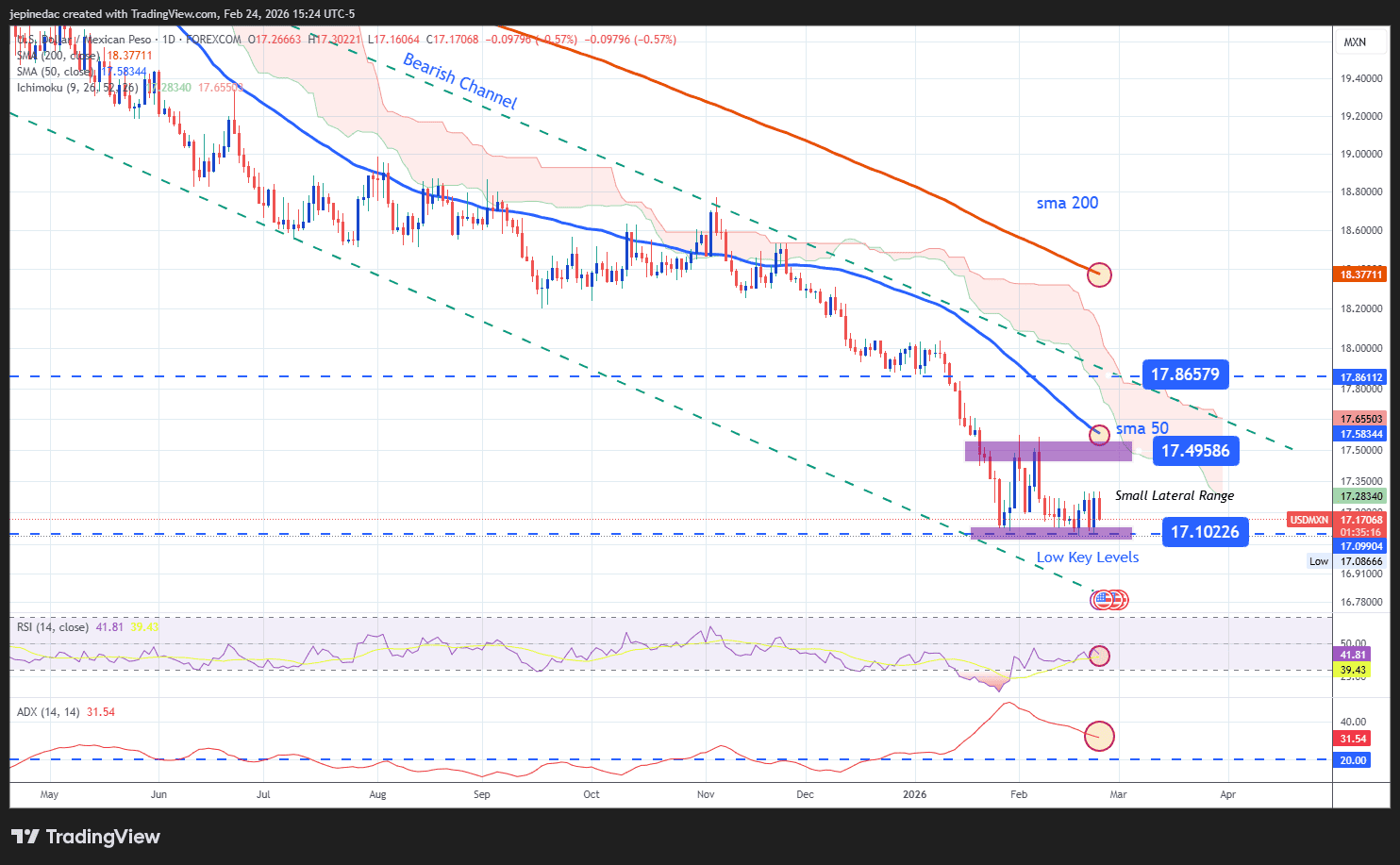
Source: StoneX, Tradingview
- Large bearish channel remains relevant: Over the long term, a broad bearish channel that has prevailed since 2025 remains intact and continues to be the most relevant technical structure. So far, no rebound has been strong enough to threaten this formation. However, recent price action has shown a phase of neutrality, attempting to consolidate a short-term sideways range between 17.50 and 17.10 pesos per dollar. If price fails to define a clearer direction, this lateral channel could gain further relevance in upcoming sessions.
- RSI: The RSI line remains consistently below the 50 level. While this does not confirm absolute selling dominance over the last 14 sessions, it does highlight that downward pressure could remain relevant, especially if the bearish slope of the RSI becomes more pronounced.
- ADX: The ADX line is trending lower, moving closer to the neutral 20 level. Although this does not indicate a lack of movement, it does suggest a loss of directional strength in the short term. In this context, while selling pressure could persist, its intensity may moderate as price approaches key technical barrier levels.
Key levels:
- 17.86 – Main resistance: Level aligned with the long-term bearish trendline. A sustained move toward this zone could put the dominant bearish structure at risk and open space for a more relevant buying bias in the medium term.
- 17.50 – Current barrier: Zone aligned with the 50-period moving average. Moves back toward this level would reinforce the perception of neutrality and could consolidate a more consistent short-term sideways range.
- 17.11 – Relevant support: Level not seen since April 2024. A sustained break below this zone could intensify the bearish channel and reinforce the dominance of the selling bias in USD/MXN.
Written by Julian Pineda, CFA, CMT – Market Analyst
Follow him on: @julianpineda25


The complete CFD trading experience
Award-winning platforms, competitive spreads, low commissions and dedicated support.
We live and breathe the markets and are dedicated to helping traders realise their ambitions as we continue to set the industry bar.
Economic calendar
Web Trader platform
Our sophisticated web-based platform is packed with features.
Related articles

US Core PCE Preview: Stale or Significant for the Fed
Core PCE inflation takes center stage Wednesday, with traders watching for signs of renewed price pressure and clues on whether the Fed could hike again in October.


Australian Dollar Forecast: AUD/USD Four-Week Slide Nears Critical Uptrend Support 9 29 2026
Aussie momentum has deteriorated sharply into quarter-end, with inflation, Core PCE and NFP on tap as AUD/USD closes in on a pivotal technical threshold.


Euro Forecast: EUR/USD Tumbles Towards Yearly Low as Daily RSI Goes Oversold
EUR/USD has been hit hard in the final month of the quarter as USD strength has shown up in a big way. With the pair set to challenge its yearly low as RSI has pushed into oversold territory, is there a chance for a pullback with some big headline risk hitting in the US over the next few days?

StoneX Europe Ltd may make third party material available on this website which may contain information included but not limited to the conditions of financial markets. The material is for information purposes only and does not contain, and should not be construed as containing, investment advice and/or investment recommendation and/or an investment research and/or an offer of or solicitation for any transactions in financial instruments; any decision to enter into a specific transaction shall be made by the client following an assessment by him/her of their situation.
StoneX Europe Ltd makes no representation or warranty and assumes no liability as to the accuracy or completeness of the information provided, nor any loss arising from any investment based on a recommendation, forecast or other information supplied. You should always seek independent advice as to your suitability to speculate in any related markets and your ability to assume the associated risks, if you are at all unsure. We are not under any obligation to update any such material. Any opinion made may be personal to the author and may not reflect the opinion of StoneX Europe Ltd.