






Yen Pairs Test Key Support Whilst Phase One Sits On A Knife Edge
Whilst the constant stream of hot and cold trade headlines risk trade-tease fatigue among market participants it’s possible we’re at an inflection point which could impact risk sentiment, one way or another.
Share this:

Whilst the constant stream of hot and cold trade headlines risk trade-tease fatigue among market participants (for which I am guilty as charged…) it’s possible we’re at an inflection point which could impact risk sentiment, one way or another.
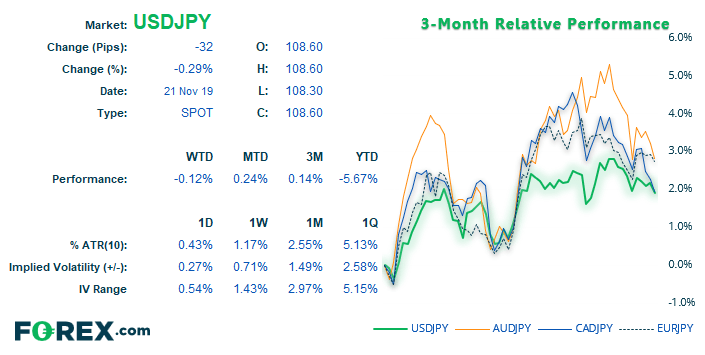
A phase one deal is looking less and less likely and has all but been pushed back into next year. Trump has been quite vocal that he expects to get the deal he wants with China or the tariffs delays will be removed. So, reports today that China isn’t “stepping up” should be taken seriously as it indicates that China aren’t concerned with the tariffs, and are in no rush to sign the phase one trade deal Trump so desperately wants. Add into the mix that Trump is considering signing the Hong Kong peace treaty (which China has condemned yesterday) and we have all the ingredients for the trade deal to fall apart whilst equities remains just off their record highs and JPY pairs are testing key lows.
We noted previously that several JPY pairs pointed towards a ‘risk reversal’, and the anticipated corrections have since come to fruition. Yet now we see that these corrections could turn into something more sinister if key support levels are broken. And perhaps a trade deal, or lack of could be the trigger.
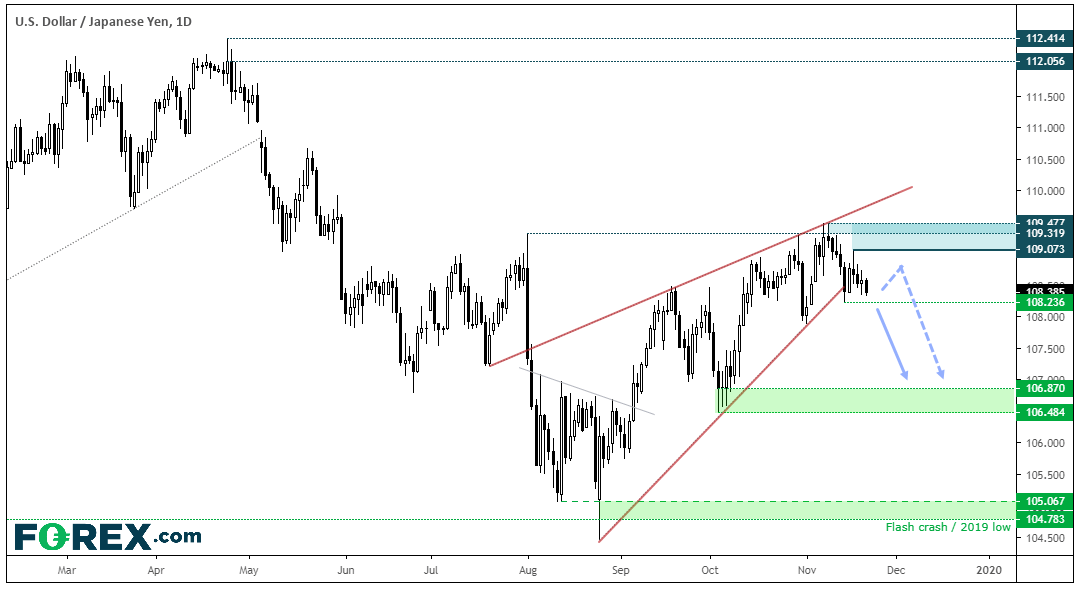
USD/JPY: The bearish wedge remains in play and a lower high has formed to suggest a change in trend is at least trying to occur. Yet we clearly need support to break with momentum (and likely soon) for this scenario to remain alive.
- Near-term bias remains bearish below 109.07, although it would take a break above 109.48 to invalidate the bearish wedge.
- A break below 108.23 assumes a run towards the base of the wedge around 104.50, although interim support levels near 106.50 and 108 can be used as bearish targets.
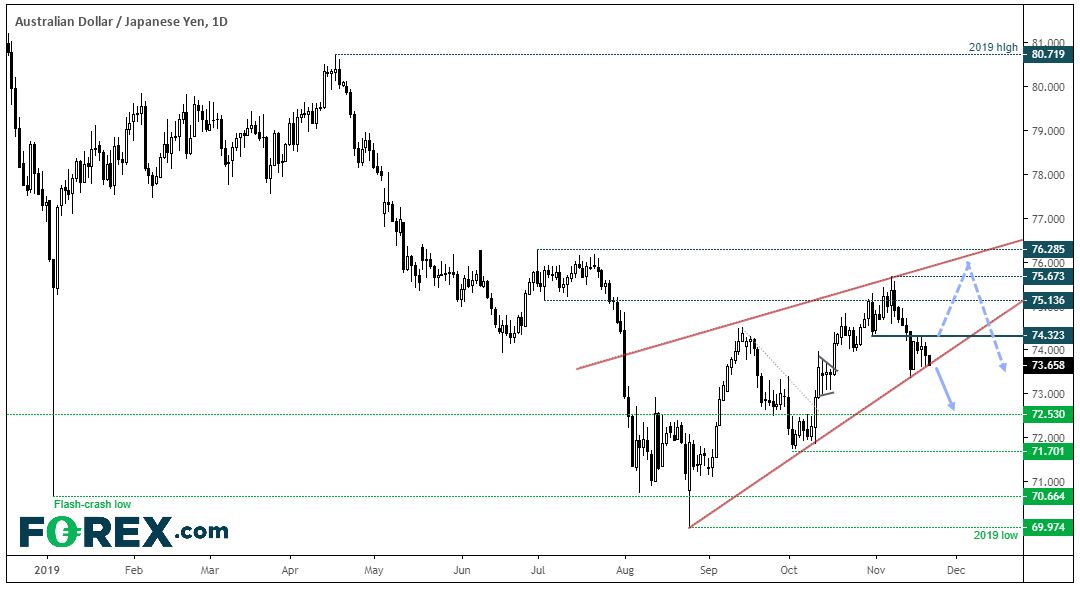
AUD/JPY: There’s potential for a bearish wedge to form, although the pattern is still within its infancy so would require at least one more cycle higher. Besides, price action is already considering a break of the lower trendline and is clearly taking notice of resistance at 74.32.
- Near-term bias remains bearish beneath 74.32.
- A clear break of the trendline assumes and eventual run for the 2019 low, although interim support levels at 72.53, 71.70 and 71.66/71.00 can also be used as targets.
- A break above 74.23 the bearish wedge is till forming, so we’d monitor prices to form another marginal high before turning lower once more. Therefore, a break above 74.32 would switch the bias to near-term bullish.
CAD/JPY: The interesting thing with CAD/JPY is that it’s about to either confirm of invalidate two potential patterns; a bullish and a bullish channel. The bullish channel was flagged in prior analysis and perfectly marked the top of its rally through October, and price action is now testing the lower bounds of the bullish channel and bullish wedge.
- Given the lack of news flow its possible prices may consolidate, yet keep in mind that JPY pairs are sensitive to trade developments (trade optimism would be bullish for xxx/JPY or bearish if talks sour)
- Bias remains neutral until we see momentum invalidate or confirm either pattern.
- However, we we’re bullish on AUD/CAD over the near-term, CAD/JPY could be the better short than AUD/JPY is we see broader JPY strength.
- A clear break of yesterday’s low assumes a run towards 80.00.
- TO consider bullish setups, we’d want to see bullish momentum hold within the bullish channel and break out of the bullish wedge. Under this scenario, bulls could target the base of the wedge around 83.50.
Related Analysis:
Wilkins Lays The Groundwork For BOC To Ease | AUD/CAD, NZD/CAD
A ’Risk Reversal’ Could Finally Be Underway | JPY Pairs
Whilst the constant stream of hot and cold trade headlines risk trade-tease fatigue among market participants (for which I am guilty as charged…) it’s possible we’re at an inflection point which could impact risk sentiment, one way or another.
A phase one deal is looking less and less likely and has all but been pushed back into next year. Trump has been quite vocal that he expects to get the deal he wants with China or the tariffs delays will be removed. So, reports today that China isn’t “stepping up” should be taken seriously as it indicates that China aren’t concerned with the tariffs, and are in no rush to sign the phase one trade deal Trump so desperately wants. Add into the mix that Trump is considering signing the Hong Kong peace treaty (which China has condemned yesterday) and we have all the ingredients for the trade deal to fall apart whilst equities remains just off their record highs and JPY pairs are testing key lows.
We noted previously that several JPY pairs pointed towards a ‘risk reversal’, and the anticipated corrections have since come to fruition. Yet now we see that these corrections could turn into something more sinister if key support levels are broken. And perhaps a trade deal, or lack of could be the trigger.
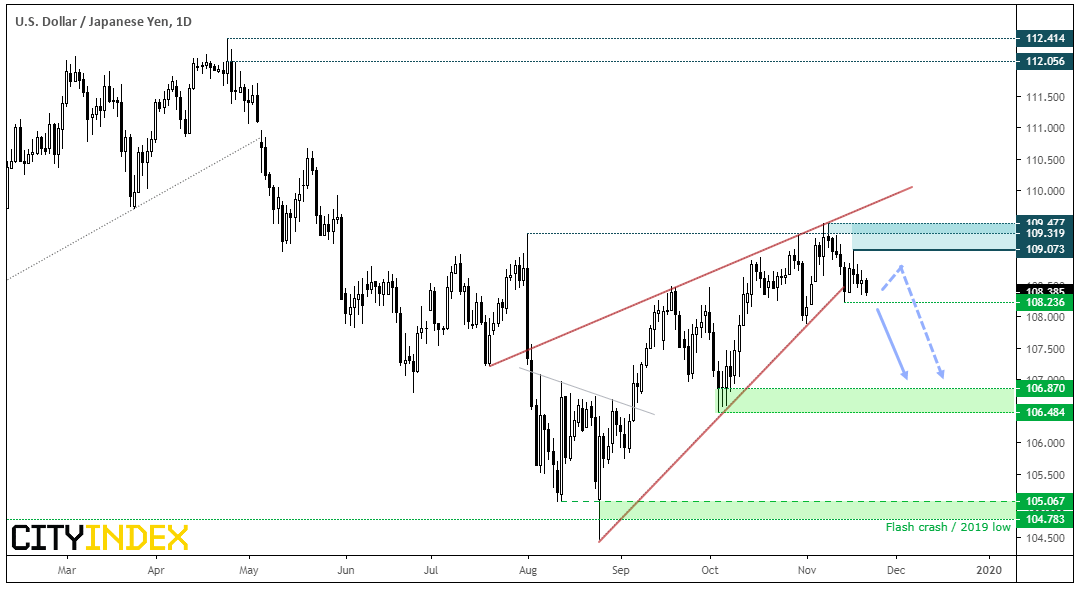
USD/JPY: The bearish wedge remains in play and a lower high has formed to suggest a change in trend is at least trying to occur. Yet we clearly need support to break with momentum (and likely soon) for this scenario to remain alive.
- Near-term bias remains bearish below 109.07, although it would take a break above 109.48 to invalidate the bearish wedge.
- A break below 108.23 assumes a run towards the base of the wedge around 104.50, although interim support levels near 106.50 and 108 can be used as bearish targets.
AUD/JPY: There’s potential for a bearish wedge to form, although the pattern is still within its infancy so would require at least one more cycle higher. Besides, price action is already considering a break of the lower trendline and is clearly taking notice of resistance at 74.32.
- Near-term bias remains bearish beneath 74.32.
- A clear break of the trendline assumes and eventual run for the 2019 low, although interim support levels at 72.53, 71.70 and 71.66/71.00 can also be used as targets.
- A break above 74.23 the bearish wedge is till forming, so we’d monitor prices to form another marginal high before turning lower once more. Therefore, a break above 74.32 would switch the bias to near-term bullish.
CAD/JPY: The interesting thing with CAD/JPY is that it’s about to either confirm of invalidate two potential patterns; a bullish and a bullish channel. The bullish channel was flagged in prior analysis and perfectly marked the top of its rally through October, and price action is now testing the lower bounds of the bullish channel and bullish wedge.
- Given the lack of news flow its possible prices may consolidate, yet keep in mind that JPY pairs are sensitive to trade developments (trade optimism would be bullish for xxx/JPY or bearish if talks sour)
- Bias remains neutral until we see momentum invalidate or confirm either pattern.
- However, we we’re bullish on AUD/CAD over the near-term, CAD/JPY could be the better short than AUD/JPY is we see broader JPY strength.
- A clear break of yesterday’s low assumes a run towards 80.00.
- TO consider bullish setups, we’d want to see bullish momentum hold within the bullish channel and break out of the bullish wedge. Under this scenario, bulls could target the base of the wedge around 83.50.




The complete CFD trading experience
Award-winning platforms, competitive spreads, low commissions and dedicated support.
We live and breathe the markets and are dedicated to helping traders realise their ambitions as we continue to set the industry bar.
Economic calendar
Web Trader platform
Our sophisticated web-based platform is packed with features.
Related articles

USD/CAD Analysis: Is the Canadian Dollar Running Out of Support?
A new trading week is underway, and the Canadian dollar continues to show signs of weakening momentum. This can be seen in recent USD/CAD price action, with the pair gaining nearly 0.7% over the last four trading sessions.


USDCAD Forecast Canadian Dollar Remains Under Pressure Amid Trade Tensions
The start of the trading week has not been particularly favorable for the Canadian dollar. Over the last two trading sessions, USD/CAD has gained more than 0.6% in favor of the U.S. dollar, reflecting a loss of momentum for the CAD in the short term.

USDJPY Update Japanese yen struggles to recover ahead of NFP
The trading week is almost over, and one of the main factors still standing out is the lack of strength in the Japanese yen. So far, USD/JPY has remained mostly neutral, moving by only around 0.1% over the last two sessions, without showing a clear recovery from the Japanese currency.
StoneX Europe Ltd may make third party material available on this website which may contain information included but not limited to the conditions of financial markets. The material is for information purposes only and does not contain, and should not be construed as containing, investment advice and/or investment recommendation and/or an investment research and/or an offer of or solicitation for any transactions in financial instruments; any decision to enter into a specific transaction shall be made by the client following an assessment by him/her of their situation.
StoneX Europe Ltd makes no representation or warranty and assumes no liability as to the accuracy or completeness of the information provided, nor any loss arising from any investment based on a recommendation, forecast or other information supplied. You should always seek independent advice as to your suitability to speculate in any related markets and your ability to assume the associated risks, if you are at all unsure. We are not under any obligation to update any such material. Any opinion made may be personal to the author and may not reflect the opinion of StoneX Europe Ltd.