


USD/CAD Analysis: Is the Canadian Dollar Running Out of Support?
A new trading week is underway, and the Canadian dollar continues to show signs of weakening momentum. This can be seen in recent USD/CAD price action, with the pair gaining nearly 0.7% over the last four trading sessions.
Share this:

A new trading week is underway, and the Canadian dollar continues to show signs of weakening momentum. This can be seen in recent USD/CAD price action, with the pair gaining nearly 0.7% over the last four trading sessions. Buying pressure around the pair has been supported primarily by two factors: expectations of a more aggressive Federal Reserve and an ongoing trade dispute that still shows few signs of resolution. Both developments appear to be weighing on the Canadian dollar's relative attractiveness and, as long as these conditions remain in place, buying pressure around USD/CAD could continue to play a relevant role in the sessions ahead.

Is the USD Becoming a Threat?
Since last week, expectations of a more aggressive Federal Reserve have continued to gain traction. This perception is largely driven by persistent inflationary pressures in the United States, a backdrop that could justify additional rate increases over the coming months. In fact, CME Group's probability tracker still assigns more than a 50% chance that interest rates will rise another 0.25% to the 4.25% area at the October 28 meeting.
The situation looks somewhat different at the Bank of Canada. Although policymakers continue to acknowledge inflation risks, there have not yet been equally strong signals pointing toward a more aggressive policy stance. Market expectations for the October 28 meeting remain broadly split between another rate hike and an unchanged decision, highlighting a greater degree of uncertainty surrounding the bank's next move. As a result, the Federal Reserve continues to stand out as the institution with the greatest potential to maintain a restrictive monetary policy over the coming months.
This divergence also has important implications for bond markets. Although 10-year bond yields in both countries have moved higher recently, the yield differential continues to favor the United States. While U.S. Treasury yields remain around the 5.00% area, Canadian bond yields continue to trade below 4.00%. This gap remains important because it supports the relative attractiveness of U.S. assets and could widen further if the Federal Reserve maintains a more aggressive stance than the Bank of Canada.
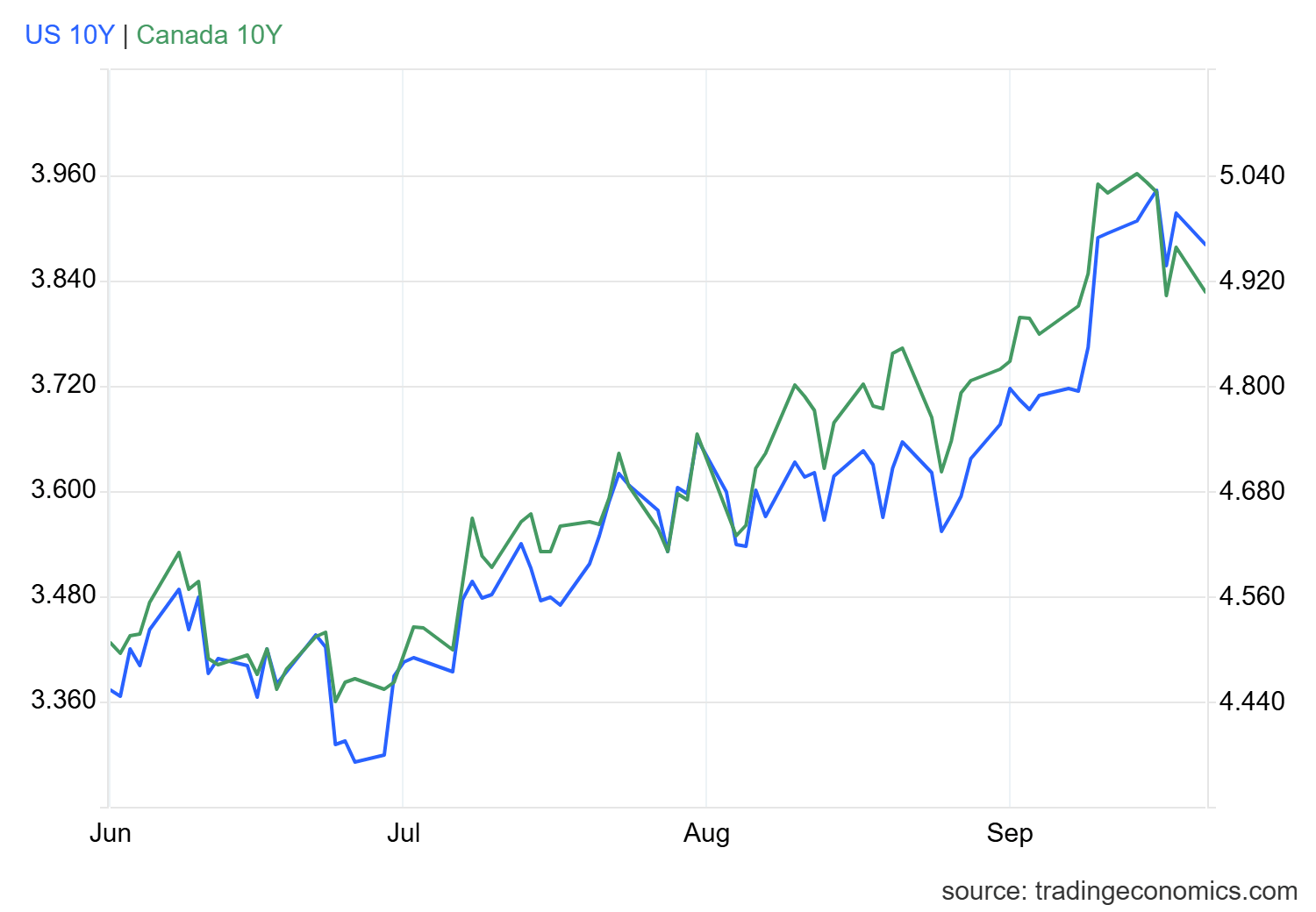
Source: TradingEconomics
This advantage is already beginning to show up in the performance of the U.S. dollar. Recent movements in the DXY, the index that measures the dollar against its main rivals, continue to reflect strength above the 100-point level. This suggests that demand for the U.S. dollar remains well supported, backed both by the appeal of the bond market and expectations of a more restrictive monetary policy. As a consequence, the Canadian dollar continues to struggle to regain lost ground consistently.
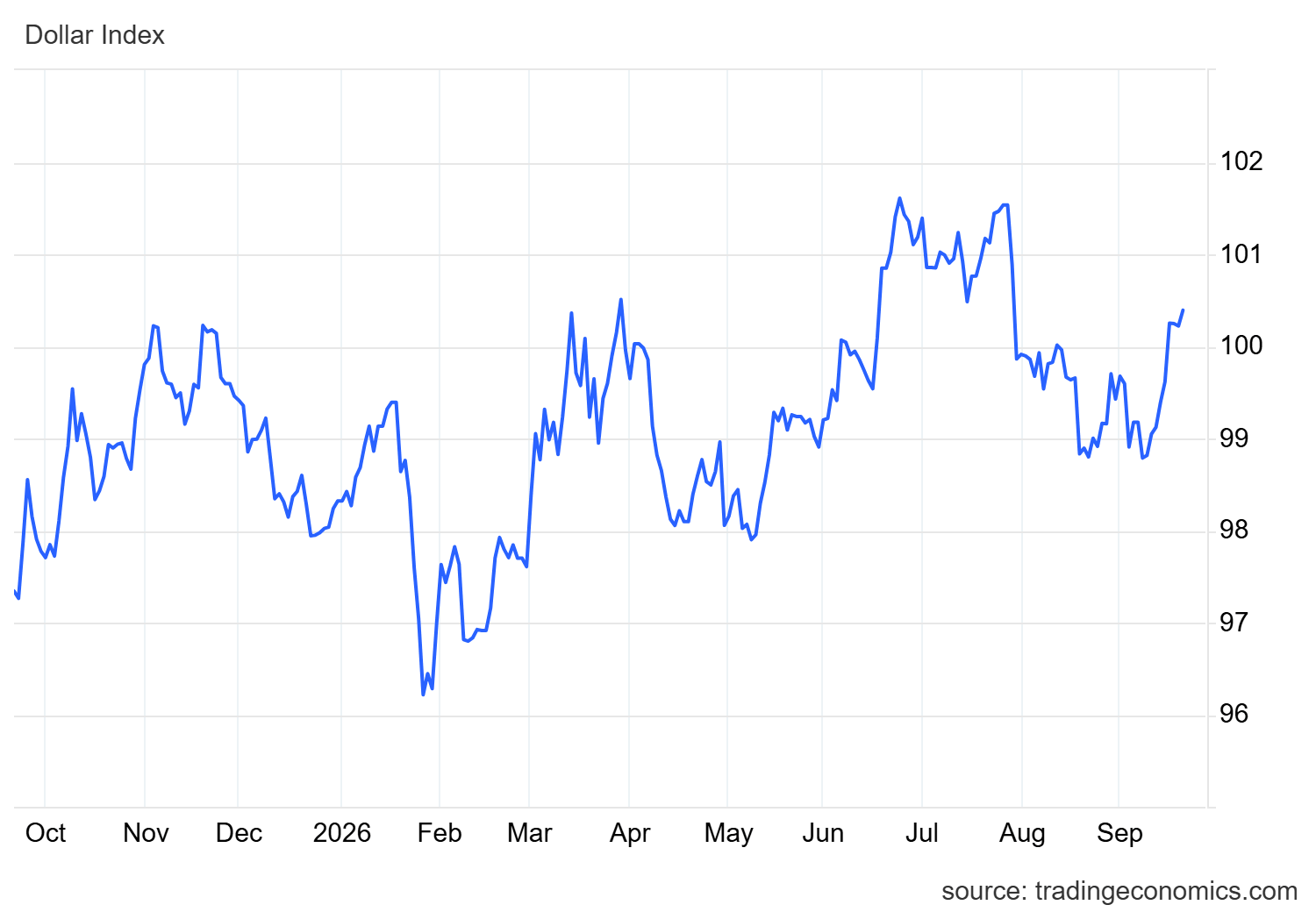
Source: TradingEconomics
Taking all of this into account, the difference in outlook between the two central banks continues to favor the U.S. dollar. As long as markets continue to price in a more aggressive Federal Reserve than the Bank of Canada, capital flows may continue to favor USD-denominated assets and limit a stronger recovery in the Canadian dollar. Under this scenario, buying pressure around USD/CAD could remain relevant during the coming sessions.
Is There Still No Progress in the Trade Dispute?
Since September 15, when revised 50% tariffs on selected Canadian products came into effect, there have been no significant developments pointing toward a quick resolution of the trade conflict. In addition, beginning on September 29, the United States may start applying import restrictions on products from sectors such as automobiles and dairy. On the Canadian side, the countermeasures announced on September 8 remain in place, including tariffs ranging from 15% to 50% on U.S. goods. So far, both countries have maintained firm positions, and negotiations have failed to alter the overall direction of the dispute.
This situation remains highly relevant for the Canadian dollar because the currency has repeatedly shown weakness whenever trade tensions escalate. Moreover, the conflict directly affects an economy where more than 70% of exports are destined for the United States, creating uncertainty around future growth prospects. Until more meaningful diplomatic progress emerges, caution is likely to remain a dominant theme around the CAD and could continue supporting buying pressure in USD/CAD over the coming weeks.
USD/CAD Technical Forecast
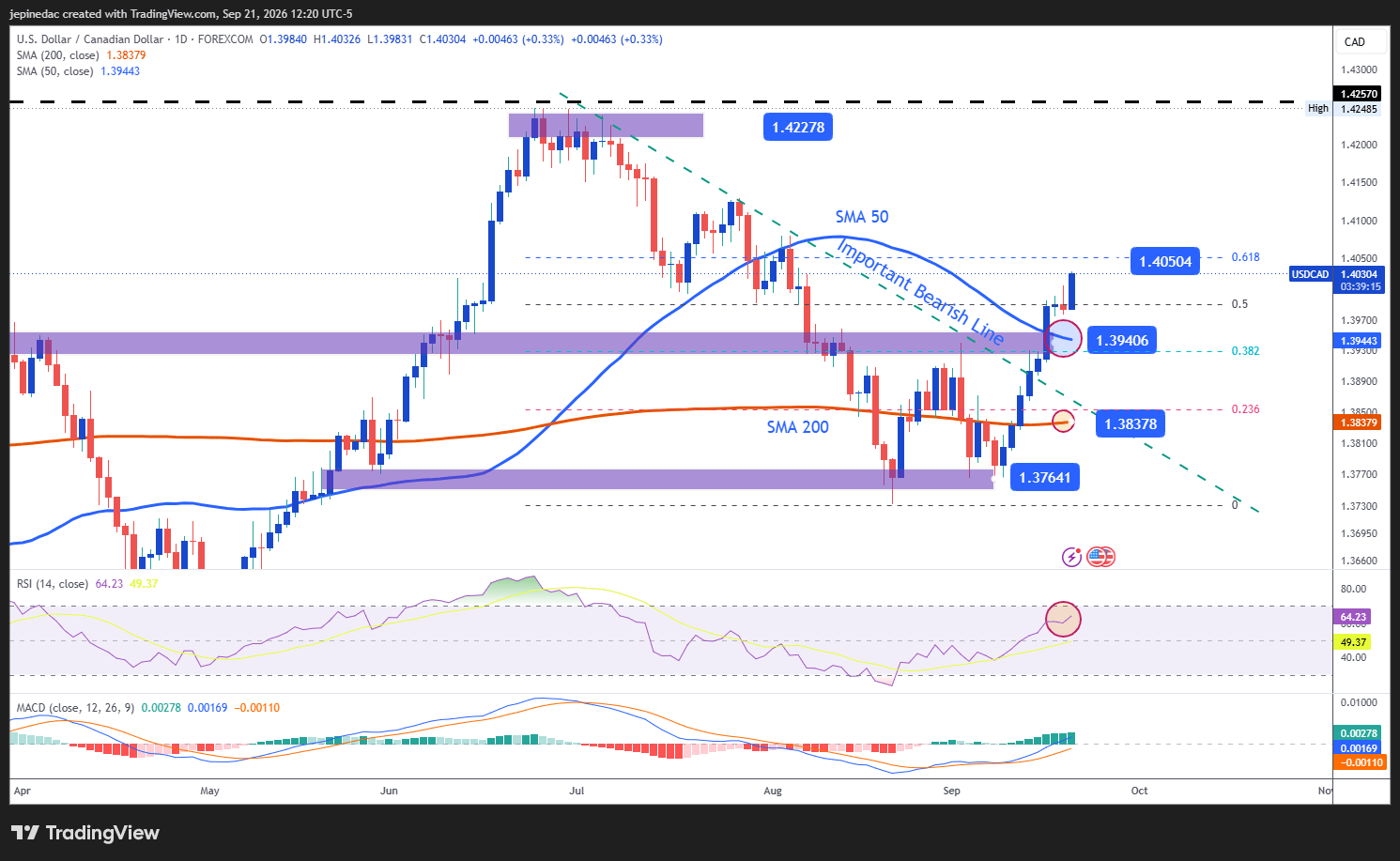
Source: StoneX, Tradingview
- Bullish momentum starts to emerge: Over recent months, USD/CAD had been developing a medium-term downtrend that became one of the chart's most important technical structures. However, the recent recovery has already generated a meaningful break above this trendline. If buying pressure remains in place over the coming sessions, a more established bullish structure could begin to emerge in the short term.
- RSI: The RSI remains above the 50 neutral level, a reading that reflects growing bullish momentum within the chart. As long as this dynamic remains intact, the bullish bias may continue strengthening over the coming sessions.
- MACD: A similar picture can be observed in the MACD, whose histogram continues to trade above the 0 neutral line. This reading suggests that short-term moving averages continue to favor bullish price action and supports the possibility that the current upward bias remains relevant.
Key Levels:
- 1.40504 – Key Resistance: The last major upside barrier on the chart, coinciding with the most relevant 61.8% Fibonacci retracement level. Price action that manages to consolidate above this area could signal stronger bullish control and open the door to a more developed upward structure in the weeks ahead.
- 1.39406 – Near-Term Barrier: A level that coincides with the 50-period moving average and the 38.2% Fibonacci retracement zone. It remains the most important reference to monitor in the event of short-term bearish corrections.
- 1.38378 – Critical Support: This level represents the most important downside barrier on the chart as it coincides with the 200-period moving average. A move back toward this area could undermine the credibility of the recent recovery, revive concerns about a lack of direction, and favor the development of a broader consolidation range.
Written by Julian Pineda, CFA, CMT – Market Analyst
Follow him on: @julianpineda25
Latest market news




The complete CFD trading experience
Award-winning platforms, competitive spreads, low commissions and dedicated support.
We live and breathe the markets and are dedicated to helping traders realise their ambitions as we continue to set the industry bar.
Economic calendar
Web Trader platform
Our sophisticated web-based platform is packed with features.
Related articles
AUD/USD Analysis: Australian Dollar Holds Steady Ahead of Inflation Data and the Fed
As the trading week progresses, a cautious tone is becoming increasingly evident around the Australian dollar. This can be observed in the recent performance of AUD/USD, where price action has remained largely unchanged over the last three trading sessions, recording a move of barely 0.1%. This behavior highlights a clear lack of direction within the market.
Canadian Dollar Technical Outlook: USD/CAD Plunge Tests Critical Support Ahead of BoC, Fed 10 27 2026
USD/CAD has surrendered much of its October rally after reversing from yearly highs, with bears threatening to unravel the broader recovery.


AUD/USD, NZD/USD face explosive CPI, RBNZ doubleheader
Aussie and Kiwi have gone remarkably quiet ahead of Australian inflation data and RBNZ decision. With substantial tightening priced and both events capable of generating major FX swings, Wednesday could deliver a volatility eruption in the antipodes.

StoneX Europe Ltd may make third party material available on this website which may contain information included but not limited to the conditions of financial markets. The material is for information purposes only and does not contain, and should not be construed as containing, investment advice and/or investment recommendation and/or an investment research and/or an offer of or solicitation for any transactions in financial instruments; any decision to enter into a specific transaction shall be made by the client following an assessment by him/her of their situation.
StoneX Europe Ltd makes no representation or warranty and assumes no liability as to the accuracy or completeness of the information provided, nor any loss arising from any investment based on a recommendation, forecast or other information supplied. You should always seek independent advice as to your suitability to speculate in any related markets and your ability to assume the associated risks, if you are at all unsure. We are not under any obligation to update any such material. Any opinion made may be personal to the author and may not reflect the opinion of StoneX Europe Ltd.