
Australian GDP growth remained modest in Q2, but did little to challenge expectations for further RBA tightening. With AUD/USD already retracing alongside a firmer US dollar, attention now turns to ISM and NFP for the next directional catalyst.
View related analysis:
- AUD/USD, ASX 200: Household Spending Bolsters RBA Hike Bets
- AUD/USD Shorts Bear the Brunt of Hot CPI, Renewed RBA Hike Bets
- Australian Housing Supply Loses Momentum as Approvals Slide
- Australian Business Profits Rebound Ahead of Q2 GDP
Australian GDP Leaves RBA Hike Bets Intact as AUD/USD Eyes US Data
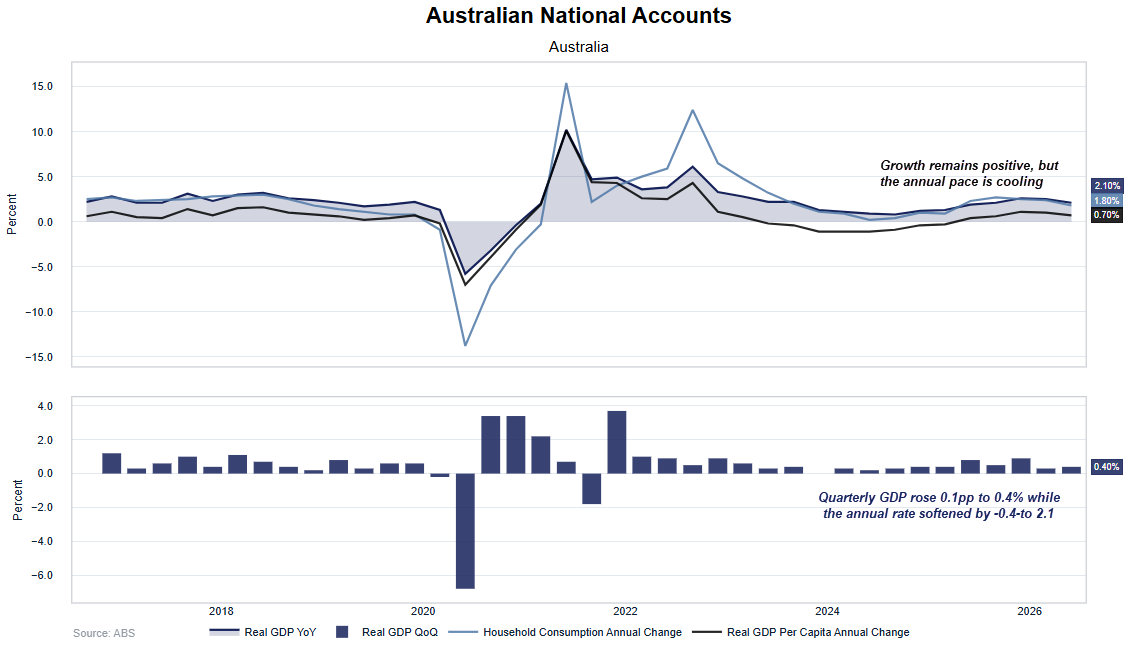
Australian GDP growth remained modest in Q2, but the details and more recent data do little to rule out another RBA hike.
Australia’s economy grew 0.4% q/q in Q2 and 2.1% over the year, a modest pace which hardly screams overheating. Household consumption rose 0.4% q/q and 1.8% y/y, while GDP per capita was effectively flat for the quarter but remained 0.7% higher over the year. Domestic final demand contributed 0.3 percentage points to growth, with household consumption contributing 0.2 points. Discretionary consumption increased 1.4%, while net trade added 0.1 percentage points and inventories subtracted 0.1.
Source: ABS
GDP Keeps RBA Hike Risk in Play
On its own, the GDP report probably does little to force the RBA’s hand. But it also provides little reason to dismiss another hike when viewed alongside more recent data. July household spending accelerated 1.1% m/m and 7% y/y, while trimmed mean inflation rose 0.5% m/m and remained at 3.6% y/y. There were also signs of domestic price pressure within the national accounts, with the domestic final demand deflator rising 0.8% q/q and real unit labour costs increasing 0.9%.
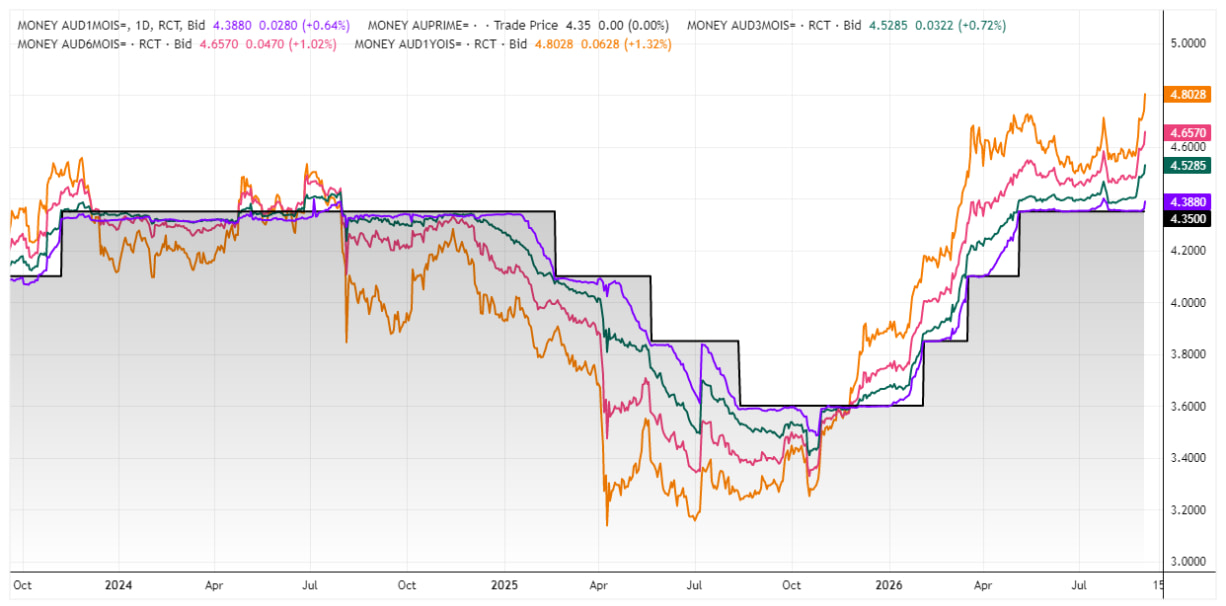
Money markets have continued to reprice toward two additional RBA hikes over the coming year, with one-year OIS rising to around 4.80% against the current 4.35% cash rate. That leaves the market increasingly aligned with the view that policy may need to become more restrictive if the recent strength in spending and inflation persists.
With the July data suggesting momentum strengthened after the June quarter ended, the broader data flow continues to keep another RBA hike firmly in play — and that remains a supportive backdrop for the Australian dollar.
Source: LSEG
AUD/USD Technical Analysis: Australian Dollar vs US Dollar
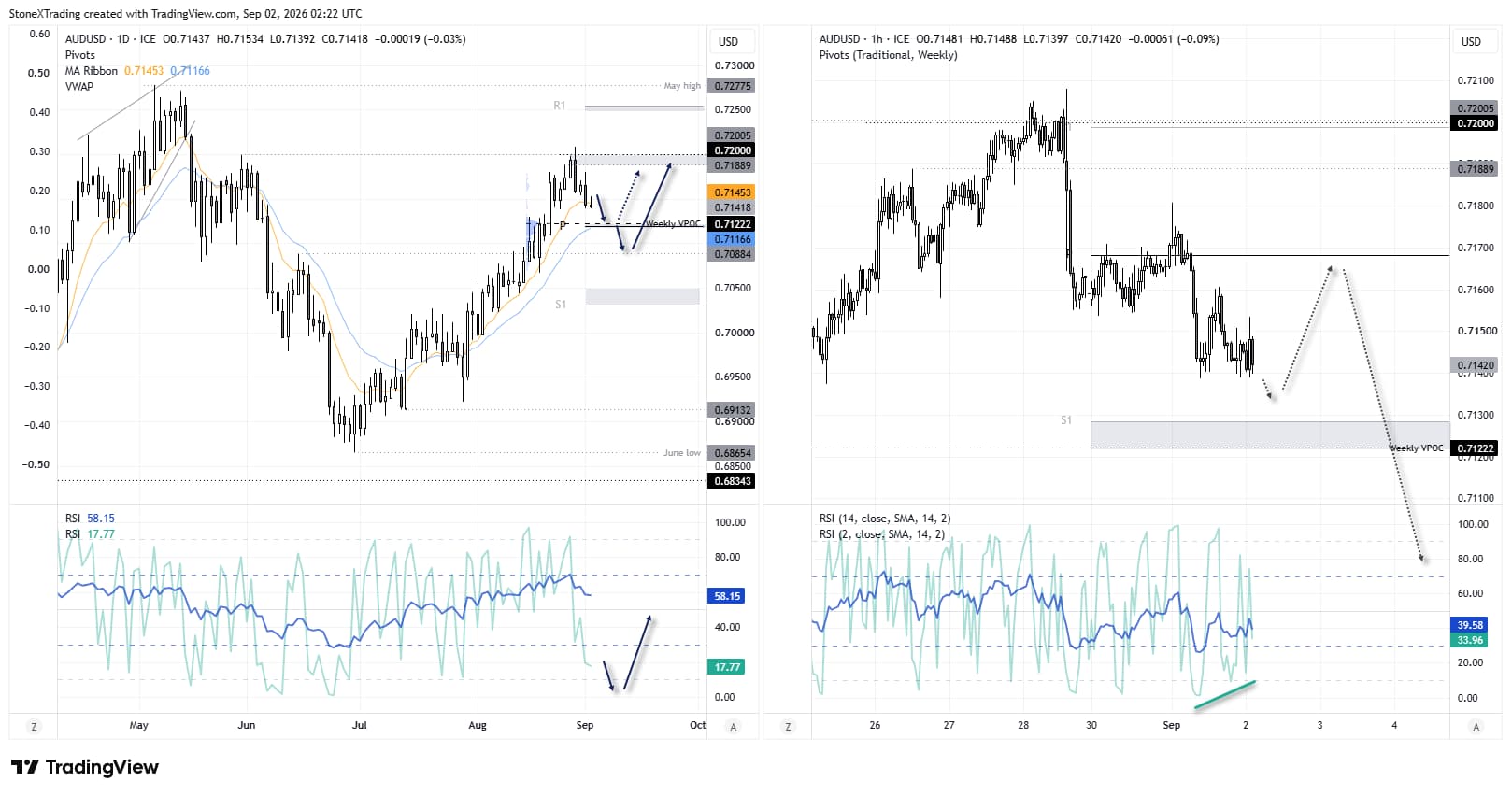
Despite growing calls for an RBA hike, the Aussie has continued to retrace in line with my bias, thanks to the rebound in the US dollar. But that is no major issue when you consider that AUD/USD rallied for eight weeks before the US dollar rebound saw 72c cap gains. AUD/USD is now sitting just beneath its 10-day EMA, although we could also allow for a move down to its 20-day EMA (0.7116), near last week’s VPOC (volume point of control).
Whether it can break down to 71c or the 0.7088 high may come down to the ISM and NFP reports. But for now, I suspect bulls are seeking evidence of swing lows around support to rejoin the dominant trend, which could leave the intraday charts better suited to bears in the near term.
Note the slight bullish divergence on the 1-hour chart on the RSI (2), so perhaps a cheeky bounce towards the weekly pivot point (0.7168) could be in order)
Source: ICE, TradingView
AUD/USD NFP Volatility Outweighs Directional Bias
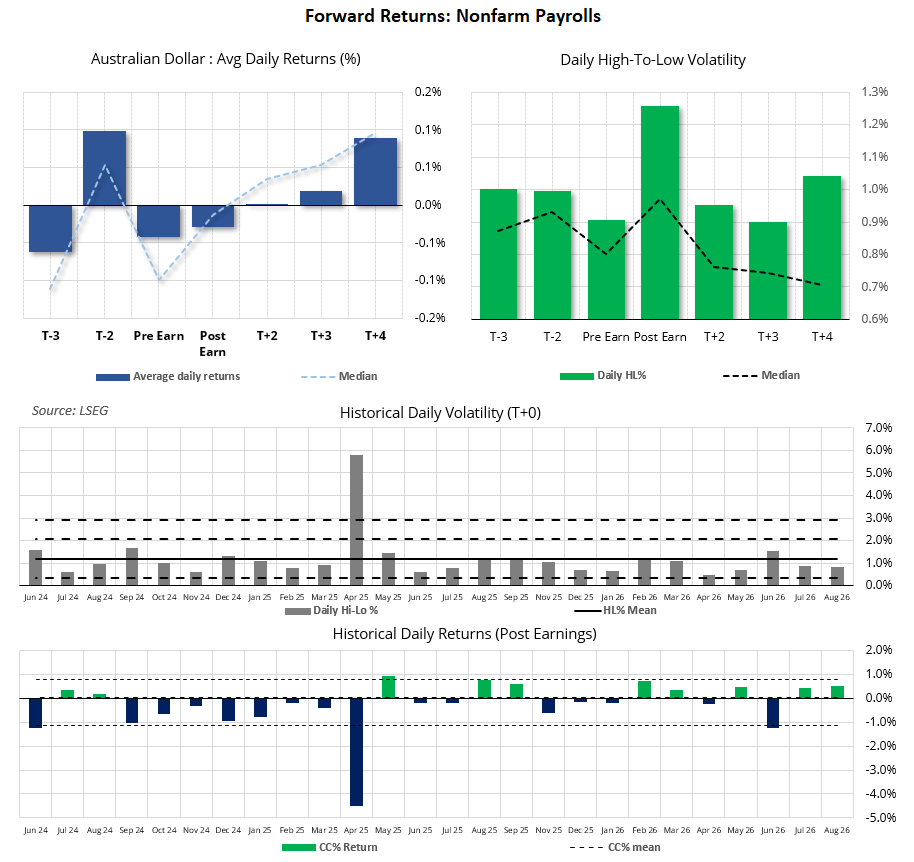
A quick look at AUD/USD around NFP shows that volatility, rather than direction, is the clearer historical tendency. The pair has averaged a 1.25% high-to-low range on NFP day, although the median is lower at around 0.97%, suggesting the extreme April 2025 move has skewed the average higher. Volatility also tends to remain relatively elevated in the sessions immediately following the release.

Source: LSEG
Average and median returns themselves are generally small and mixed either side of NFP, providing little evidence of a reliable directional bias. That is useful information in itself: historically, NFP has been more dependable as a volatility event for AUD/USD than a directional one. The unusually large decline in April 2025 also stands out as an obvious tail event, so I would be wary of drawing too much from the average return alone.