


AUD forecast: Is the Aussie dollar warning of a major Asia FX shift?
The Aussie dollar has long been a way to express a view on emerging Asia. That may be changing as the region's currencies begin moving in the same direction against the US dollar.
Share this:

- Yen no longer diverging from broader Asia FX
- AUD/NZD breaks below key technical support
- Aussie may underperform despite stronger Asia outlook
- Falling energy prices add Asia FX tailwind
- US labour data now the key catalyst
A different Asia FX story?
Whether it's to help smooth volatility in the long end of the US Treasury market, improve US competitiveness through a weaker dollar, or something else entirely, US involvement in supporting the yen alongside Japan over recent days may have implications extending well beyond USD/JPY. While it's far too early to draw firm conclusions, the price action suggests broader Asia emerging market FX may be starting to outperform after years of sustained underperformance, potentially altering where investors choose to deploy capital across the region.
The last major outlier has finally turned
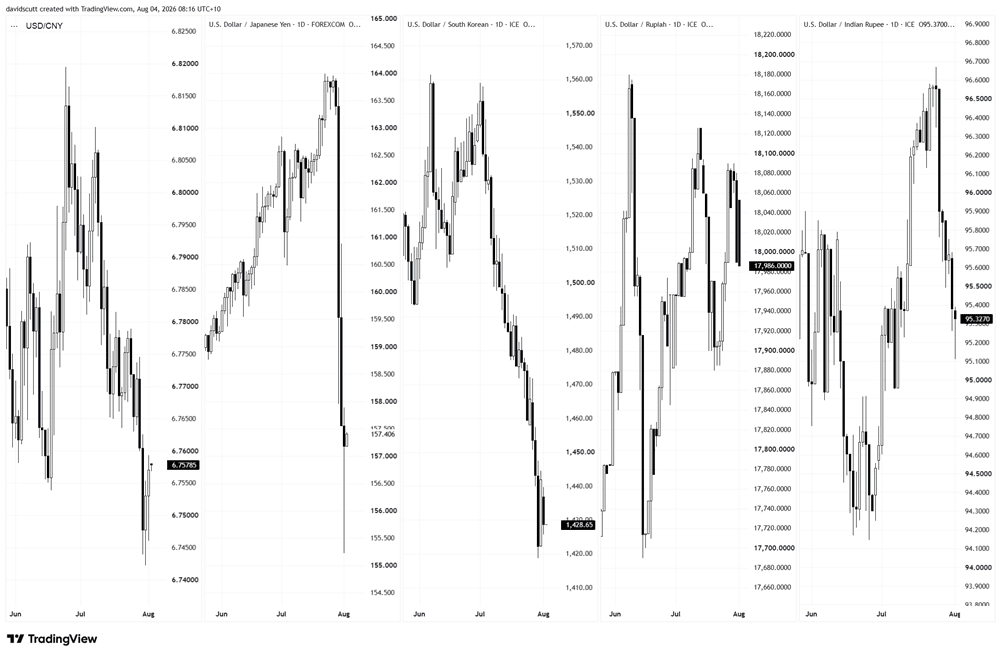
One thing that stands out on the chart below is that the yen was becoming increasingly disconnected from the rest of Asia FX this year. The offshore yuan has been appreciating against the US dollar for months, while the Indonesian rupiah and Indian rupee have also started to strengthen. Yet USD/JPY just kept grinding higher.
Source: TradingView
The joint US-Japan intervention has now removed that divergence. Whether by coincidence or not, the currencies of Asia's largest economies are once again moving in the same direction against the greenback. It's a very short observation window, but it raises an interesting question: does that increase the scope for broader Asia FX outperformance?
Australia's role as Asia's FX proxy
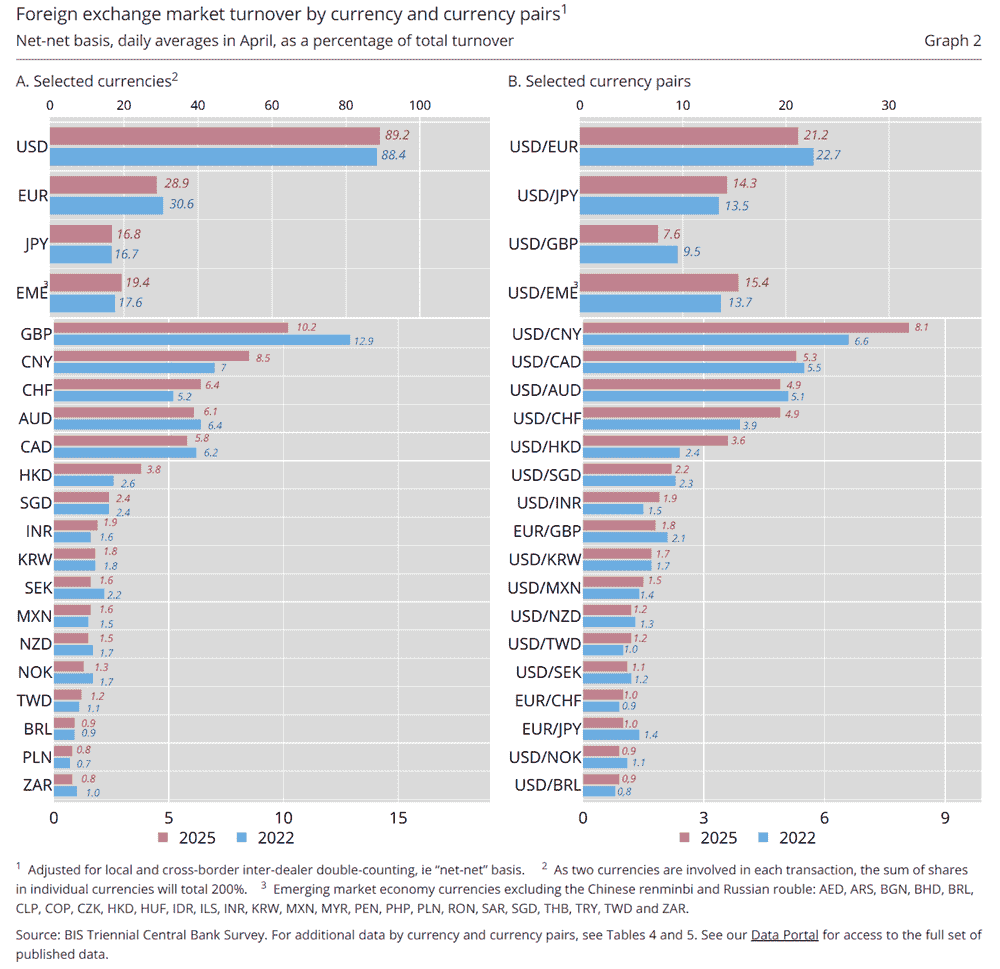
That brings us to the Australian dollar. According to the latest BIS Triennial Survey, the Aussie is the world's seventh most actively traded currency, accounting for just over 6% of global FX turnover. While the yen dominates the region, the Australian dollar has long been one of the preferred ways to express a view on emerging Asia. Australia's status as a commodity superpower leaves it deeply intertwined with the region's manufacturing economies, while its liquidity and free floating status make it an attractive alternative to many EM currencies.
Source: BIS
In an environment where the US dollar had been appreciating relentlessly, the Australian dollar offered investors a logical way to maintain exposure to Asia without taking on the additional risks associated with emerging market currencies. Its deep liquidity, freely floating exchange rate and close economic links to the region have long made it a preferred proxy for Asia.
It's therefore not unreasonable to think some capital preferred to hide out in the Australian dollar rather than venture directly into emerging Asia FX. But if the relative return equation is now starting to change, so too might where investors choose to deploy capital across the region. The joint intervention, alongside falling energy prices on hopes of a lasting peace deal in the Middle East, provides another tailwind for many of Asia's manufacturing economies, most of which remain heavily reliant on imported energy.
If investors believe the relative outlook for emerging Asia FX is improving, some of the capital that had been using the Australian dollar as a liquid proxy may begin rotating back into those markets. That doesn't necessarily mean AUD/USD has to weaken. Instead, it may simply mean the Aussie starts to underperform against regional currencies as investors redeploy capital across Asia.
US economy remains the deciding factor
Whether this evolves into something more sustainable ultimately comes back to the US economy. The joint intervention may have effectively backstopped the yen near-term, but intervention alone is unlikely to reverse the broader forces that have driven US dollar outperformance. It still comes back to US economic exceptionalism.
Monday's ISM manufacturing PMI reinforced that narrative, surging to 55.6 in July, the highest reading in more than four years, with strength extending beyond the headline measure into new orders and employment.
For broader Asia emerging market FX to outperform on a sustained basis, the US dollar probably doesn't need to fall off a cliff. In fact, that would likely be a sub-optimal outcome, pointing to a negative economic shock that saps demand for Asian manufactured goods. But equally, the dollar can't continue appreciating at a pace that keeps drawing capital away from the rest of the world. A moderation in US economic exceptionalism, rather than an outright deterioration, may prove to be the optimal backdrop for a sustained rally in Asia FX.
AUD/NZD may be the cross to watch
If the capital redeployment thesis holds any merit, AUD/NZD may prove the cross to watch. While there are clearly domestic factors at play, that may not be the entire story. Australia is the larger and far more liquid market of the two, meaning it would likely have attracted a disproportionate share of investors looking to express views on Asia through the Australian dollar rather than emerging market currencies themselves.
If some of that capital is now beginning to rotate back into the region, the Australian dollar would also be expected to bear a disproportionate share of the adjustment.
Source: TradingView
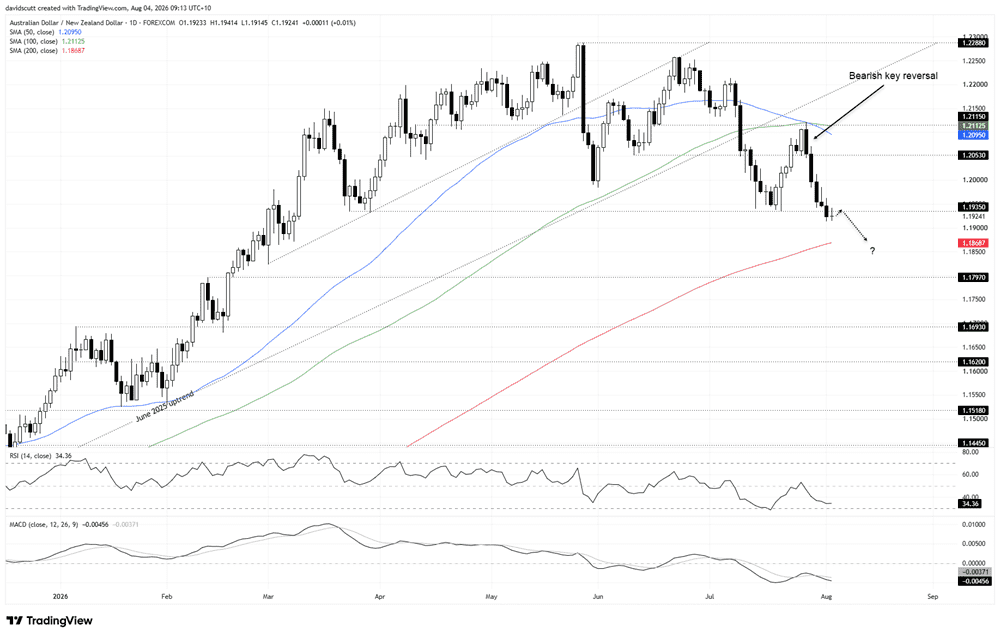
Looking at the daily chart above, the corrective rebound from support at 1.1935 stalled last week at the confluence of the 50 and 100-day moving averages along with overhead resistance at 1.2115. The rejection produced a bearish key reversal candle, triggering follow-through selling that has now taken the pair beneath where the rebound began.
The break below 1.1935 opens the door for fresh bearish setups. Traders may look to establish shorts beneath the level with a tight stop above for protection, initially targeting the 200-day moving average at 1.1869. Beyond that, the former breakout zone around 1.1797 is the next downside area of note.
A move back above 1.1935 that holds would invalidate the bearish break, pointing instead to a false downside move and increasing the risk of a return to the sideways range that's dominated trade over the past month.
Momentum indicators continue to favour selling rallies over buying dips. RSI (14) has slipped back below the neutral 50 level and now sits at 34. While a bullish divergence has emerged between RSI and price, MACD continues to deteriorate and remains consistent with downside momentum building. Until that changes, the technical bias continues to favour shorts.
It's now over to the data
The focus beyond technicals now shifts to the economic calendar. In Australia, June household spending data will be released at 11:30 am AEST. While not normally considered a top-tier release, it's still important given the RBA has repeatedly indicated it wants to see evidence that domestic demand is slowing before it can become more confident that domestic inflationary pressures are easing.
Beyond Australia, attention this week will be on the US labour market. Job openings kick things off with the JOLTS report on Tuesday, followed by ADP private sector employment, the ISM non-manufacturing PMI and weekly jobless claims, before Friday's nonfarm payrolls report. If those releases point to a moderation in labour market strength, it may provide the catalyst needed for this tentative shift in Asia FX to develop into something far more meaningful. If not, the theory of capital redeployment will likely be taken to the woodshed and chopped up into little pieces.


Open an account in minutes
Experience award-winning platforms with fast and secure execution.
Economic calendar
Web Trader platform
Our sophisticated web-based platform is packed with features.
Related articles
Gold coils for potential breakout as US CPI looms
Gold's ascending triangle is putting $4,140 firmly in focus ahead of US CPI. With traditional macro relationships offering few clues, the price action may prove more useful for traders.

USD/CAD Outlook: Loonie left behind as US CPI looms
USD/CAD's sharp rebound has coincided with widening US–Canada interest rate differentials. With US CPI approaching and bullish momentum building, another breakout may be on the cards.

Japanese Yen Outlook: EUR/JPY and GBP/JPY Outbid USD/JPY
The Japanese yen starts the week mixed, with EUR/JPY and GBP/JPY showing bullish potential while USD/JPY remains stuck in a rut.

The information on this web site is not targeted at the general public of any particular country. It is not intended for distribution to residents in any country where such distribution or use would contravene any local law or regulatory requirement. The information and opinions in this report are for general information use only and are not intended as an offer or solicitation with respect to the purchase or sale of any currency or CFD contract. All opinions and information contained in this report are subject to change without notice. This report has been prepared without regard to the specific investment objectives, financial situation and needs of any particular recipient. Any references to historical price movements or levels is informational based on our analysis and we do not represent or warranty that any such movements or levels are likely to reoccur in the future. While the information contained herein was obtained from sources believed to be reliable, author does not guarantee its accuracy or completeness, nor does author assume any liability for any direct, indirect or consequential loss that may result from the reliance by any person upon any such information or opinions.
Futures, Options on Futures, Foreign Exchange and other leveraged products involves significant risk of loss and is not suitable for all investors. Losses can exceed your deposits. Increasing leverage increases risk. Spot Gold and Silver contracts are not subject to regulation under the U.S. Commodity Exchange Act. Contracts for Difference (CFDs) are not available for US residents. Before deciding to trade forex, commodity futures, or digital assets, you should carefully consider your financial objectives, level of experience and risk appetite. Any opinions, news, research, analyses, prices or other information contained herein is intended as general information about the subject matter covered and is provided with the understanding that we do not provide any investment, legal, or tax advice. You should consult with appropriate counsel or other advisors on all investment, legal, or tax matters. References to FOREX.com or GAIN Capital refer to StoneX Group Inc. and its subsidiaries. Please read Characteristics and Risks of Standardized Options.