
- Hawkish RBA messaging reinforces a live tightening bias
- Yield spreads move further in the Aussie’s favour
- Rampant risk appetite keeps cyclical FX well supported
- US payrolls now the key near-term risk
Summary
Hawkish remarks from Australia’s deputy central bank chief, combined with buoyant risk appetite and broader US dollar weakness, have pushed AUD/USD back to fresh multi-year highs ahead of key US jobs data later in the session. With the technical picture continuing to point to upside as the path of least resistance, there could be more room for the Aussie to run, especially if speculation around a sharp slowdown in US payrolls growth materialises.
RBA hawks reassert control as inflation risks linger
Speaking at a business lunch in Sydney, Andrew Hauser, the Reserve Bank of Australia’s deputy governor, reinforced the message from last week’s rate hike that inflation remains too high and cannot be allowed to persist. His focus on domestic capacity constraints was the key takeaway, echoing the RBA’s February shift toward viewing it as a driver of inflation rather than a risk, and reinforcing why the Bank signalled it is prepared to tighten further if price pressures fail to lessen.
Hauser’s remarks sent spreads between Australian and US two-year government bond yields back towards the highs set last week, with the Australian dollar’s advantage now the widest since late 2016. With traders expecting the RBA to hike at least once more this year while the Fed is expected to ease at least twice over the same period, it has helped propel the Aussie higher.
Risk appetite and rates drive AUD/USD rally
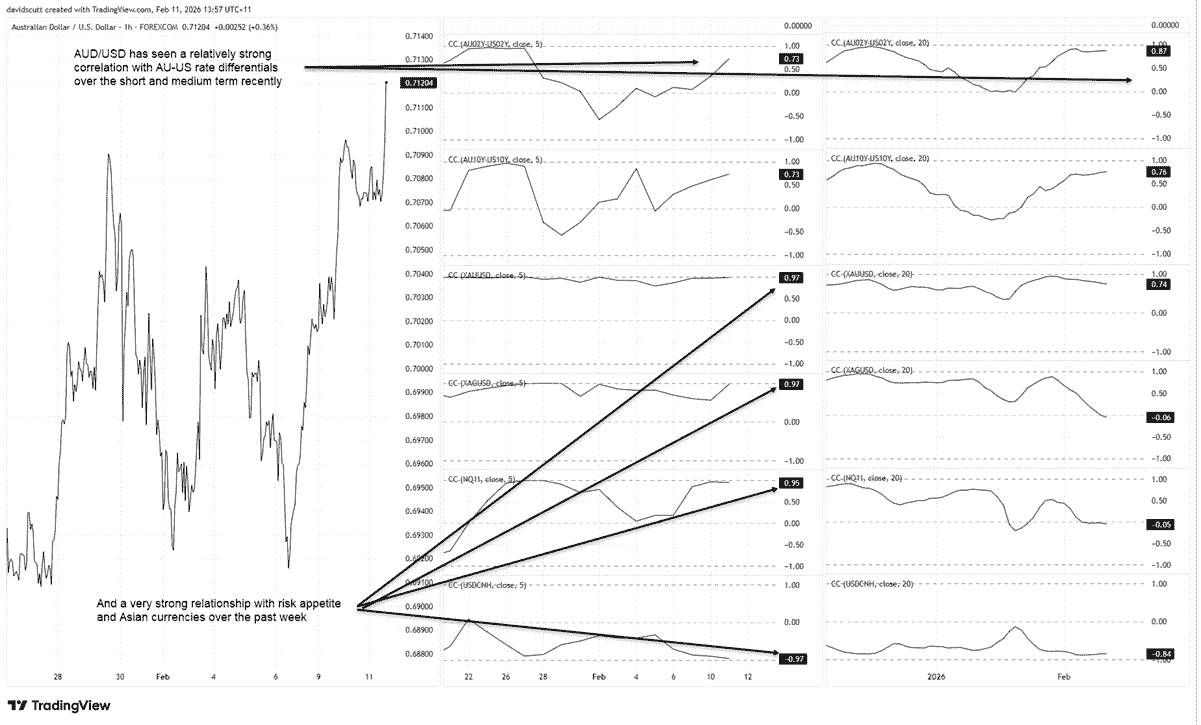
We can see the relationship clearly in the graphic below, which tracks correlation coefficients between AUD/USD and a range of market indicators over the past week (middle pane) and month (right pane). At 0.75 and 0.87 respectively, there has been a strong and sustained relationship between the Aussie and short-dated yield differentials recently.
Rampant risk appetite has also helped fuel the move, with correlations between AUD/USD with gold, silver and Nasdaq 100 futures sitting between 0.95 and 0.97 over the past week. That is effectively lockstep when it comes to directional movement. Strength in other Asian currencies is similarly relevant to the Aussie, as seen with the correlation coefficients at the bottom with USD/CNH.
Source: TradingView
While the factors underpinning the Aussie’s surge are easy to identify, they will matter for little later in the session when risk appetite and broader US dollar weakness face the ultimate test with the release of January nonfarm payrolls in the United States, including revisions to prior payrolls data that could be hundreds of thousands lower than initially reported.
Fed easing bets build as payroll risks grow
Speculation around a weak report has swirled this week following comments from Kevin Hassett, the Director of the National Economic Council and one of the White House’s most senior economic officials, who flagged the risk of smaller payroll gains ahead. Hassett argued that slowing population growth and stronger productivity mean softer jobs numbers should not be read as a deterioration in underlying economic momentum.
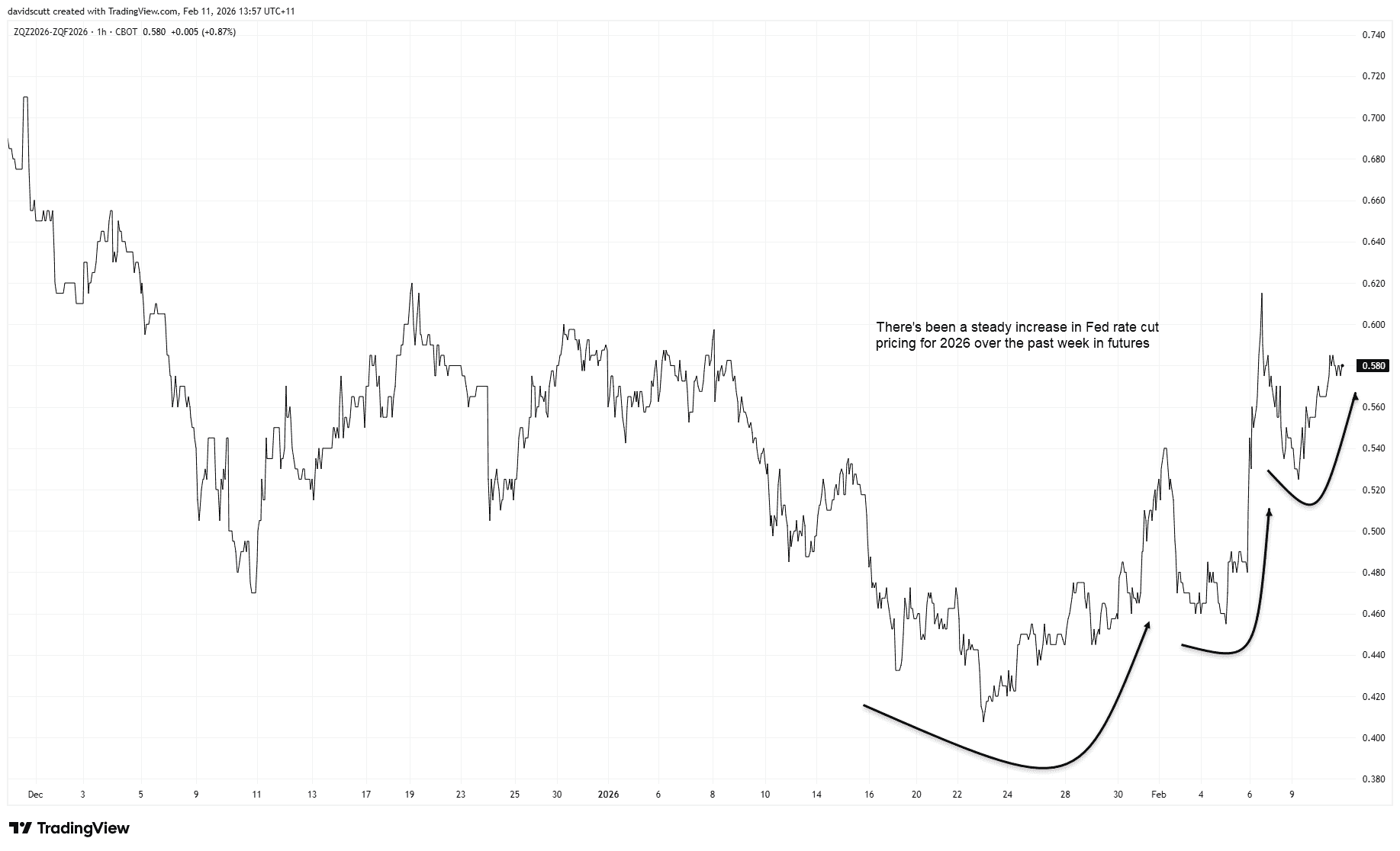
The remarks have been viewed by some market participants as softening expectations ahead of the data, contributing to a slide in the US dollar and a steady increase in pricing for how many rate cuts the Fed is expected to deliver this year.
Source: TradingView
Fed funds futures now price 58 basis points of easing in 2026, implying at least two full 25bp reductions with around a one-in-three chance of a third. Only last week, less than 46 basis points of cuts were being priced, with Hassett’s remarks combining with soft retail sales and wages data to spark a dovish repricing.
Markets expect payrolls to increase by 70,000, although the whisper number is now likely lower following Hassett’s comments. Unemployment is tipped to remain steady at 4.4%, a figure likely to provide the cleanest read on overall labour market conditions. Revisions to payrolls in the 12 months to March 2025 will likely grab headlines, but their relevance to more up-to-date data remains debatable.
If the data beats consensus, it will likely spark a modest bid in the US dollar. Should it miss on the downside, a weaker outcome would likely spur further gains in cyclical currencies such as the Aussie. However, a true horror show could revive fears around the global outlook, an outcome that may ultimately weigh on risk appetite and see the Aussie underperform against the USD and major crosses such as the JPY and EUR.
AUD/USD technicals favour upside, for now
Source: TradingView
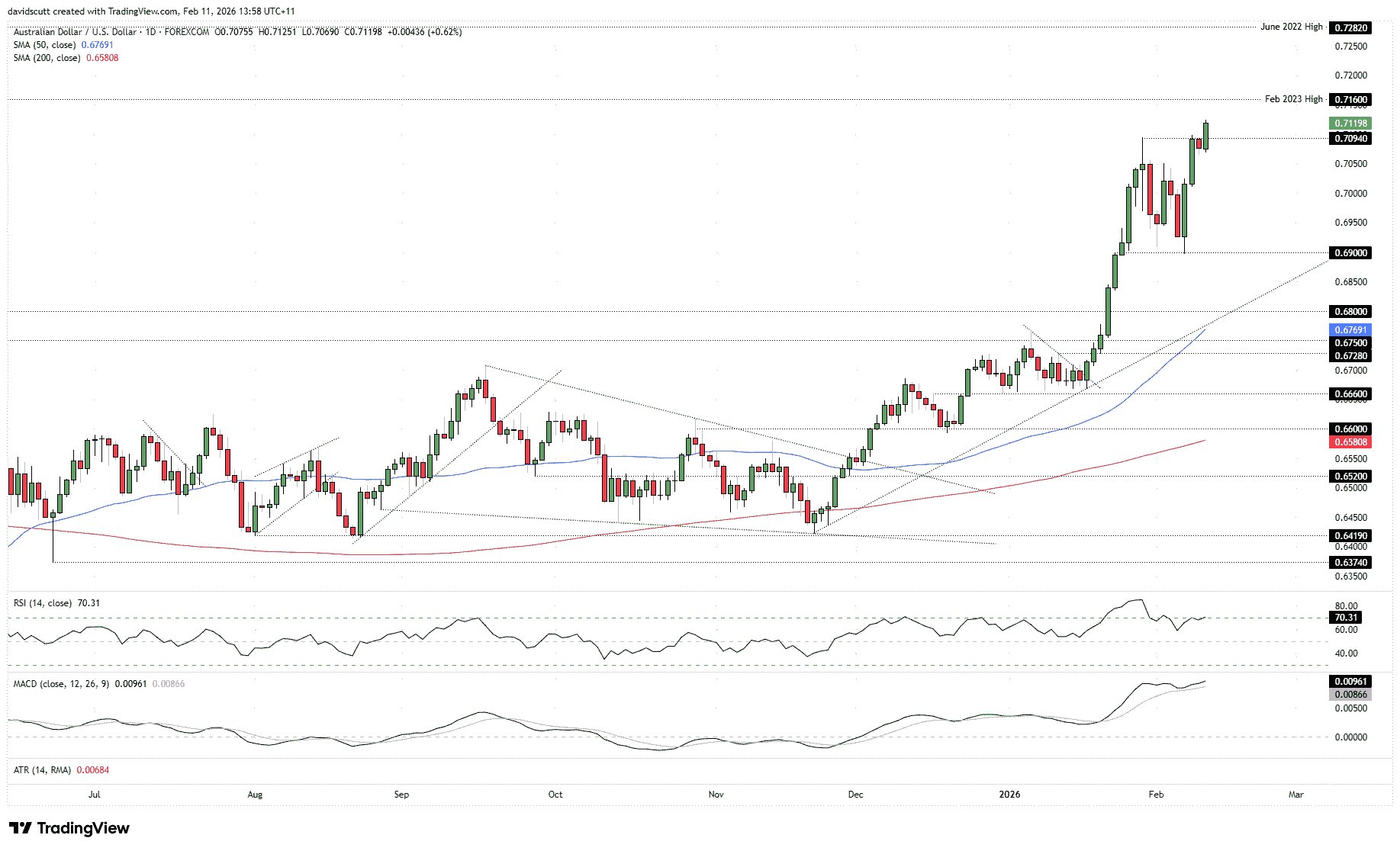
Looking at AUD/USD on the daily chart, the pair has broken cleanly above the January high at .7094 on the combination of Hauser’s hawkish remarks and continued yen strength, leaving it trading just beneath the February 2023 high at .7160. A clear break above that level would put .7282 in focus, the swing high set in June 2022. On the downside, .7094 may now flip to support, with .7050 a minor level below that before more meaningful support emerges around .6900.
Even with some question marks around whether RSI (14) can set fresh highs to confirm the move in price, the broader signal from the oscillators remains bullish, favouring long setups over shorts in the near term.