


The commotion has certainly been in other markets like USD/JPY of late but in GBP/USD, the pair has continued a consistent rally after building a clean falling wedge formation just two weeks ago. I looked at this as one of the more attractive venues for USD-weakness and as the Dollar has broken down, that bullish structure in GBP/USD has played out.
Last week even saw a clean hold of support at the 1.3414 Fibonacci level, leading to a rally up to a fresh high in a breakout that continues into this week.
GBP/USD Four-Hour Price Chart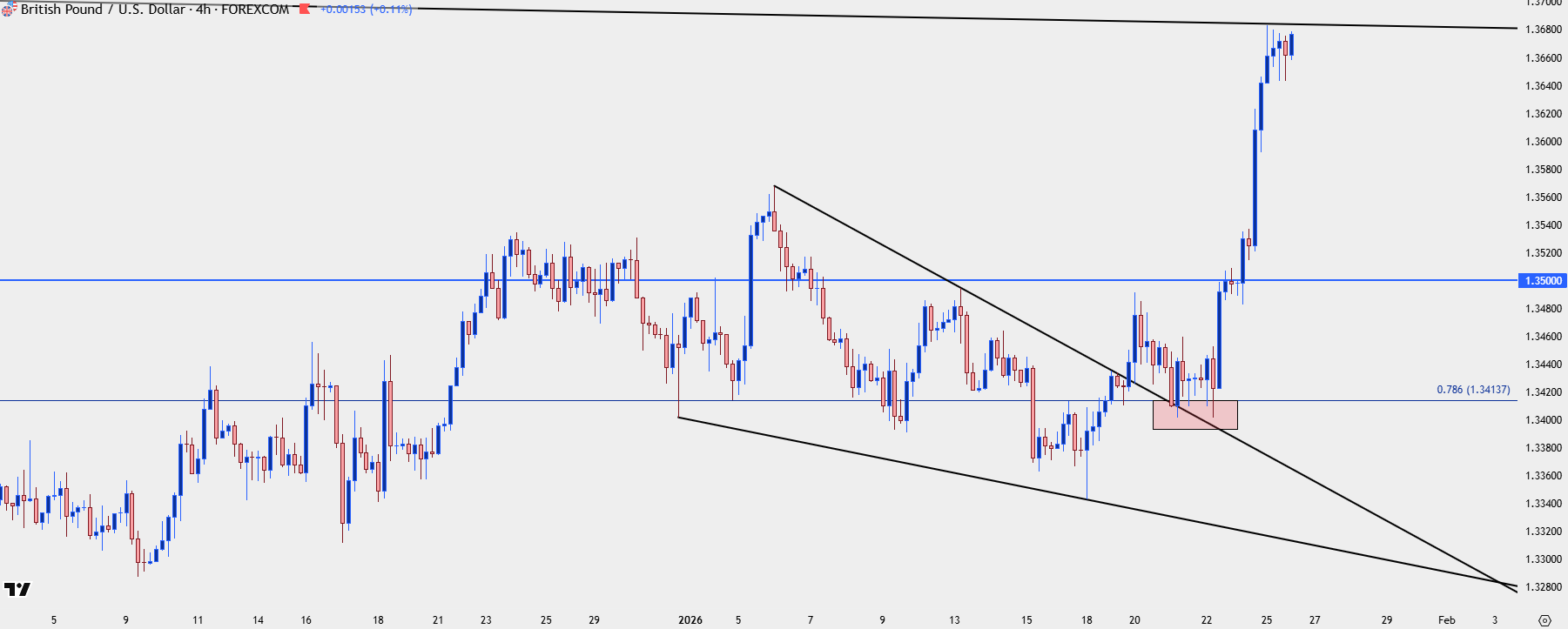
Chart prepared by James Stanley; data derived from Tradingview
GBP/USD: The Road Ahead
At this point it seems like a lot of the drive in the major pair is coming from dynamics in the US Dollar. Just two weeks ago, the USD was holding strong near monthly highs. But the weekend brought more tariff threats from President Trump and that reversed the currency last week, which helped Cable to breakout from the falling wedge formation. And then the late week USD/JPY sell-off drove another round of USD-weakness against both GBP and the Euro and that further helped to drive the rally.
At this point, both GBP/USD and DXY are in a stretched state so the bigger question probably drives back to the Yen and whether there’s more carry unwind left to be seen. For GBP/USD, there’s two significant points of resistance sitting overhead at 1.3727 and 1.3789 as these lower-highs posted in the second-half of last year. If bulls can take both out, we’ll be at fresh four-year highs and there will be an open door to run up to the 1.4000 level, or perhaps even the 1.4250 level that marked the highs back in 2021.
GBP/USD Weekly Price Chart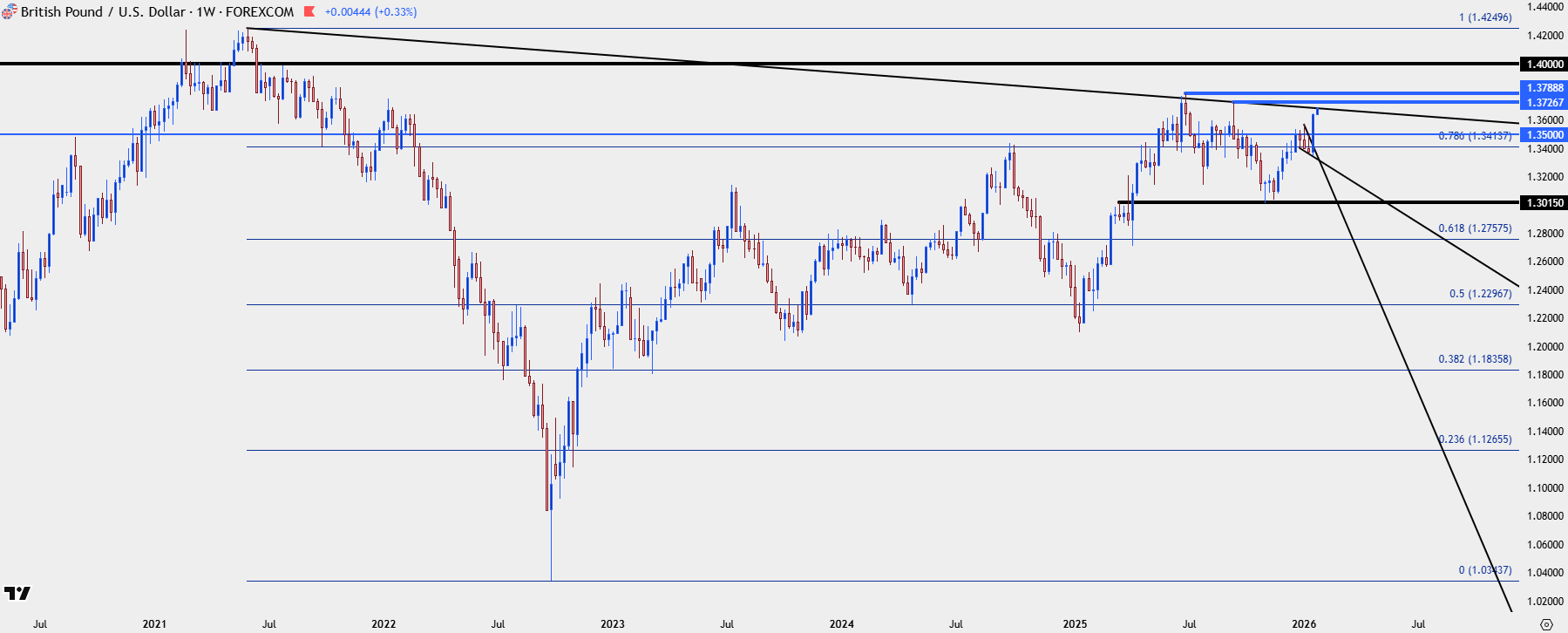
Chart prepared by James Stanley; data derived from Tradingview
GBP/JPY
While GBP/USD has remained in a clean trend JPY pairs have been showing heightened volatility, especially in USD/JPY with the fear or thought that perhaps even more unwind may be seen after highly suspected intervention.
This is a messy scenario usually as it takes time to confirm whether actual intervention took place and at this stage it’s still impossible to tell whether it was fear driving carry unwind into last week’s close and through last week’s open or whether there was, in fact, some form of swap-line arrangement between Japan and the U.S.
Like I talked about in last week’s webinar it seems that both sides wanted to see a lower USD/JPY spot rate and that’s something that can explain at least part of the move. But perhaps the more important question is whether that shot of Yen-strength has run its course or whether there’s more unwind to go.
On the unwind argument, JPY-weakness trades had become incredibly one-sided since Japanese elections in early October, and that had helped to drive-up Japanese Yen government bond yields, which would seemingly make it more difficult for the Japanese government to continue driving fiscal stimulus, as more debt would become more and more expensive. And in the Friday BoJ meeting, the bank highlighted the prospect of more rate hikes which sent an initial shockwave into Yen markets.
If you’re a hedge fund holding hedges from an ongoing carry trade and you’re factoring in higher rates from the BoJ and, eventually, lower rates from the Fed, and price in the USD/JPY pair just stalled again at the 160.00 level that’s highly thought to elicit intervention, closing down to those trades doesn’t seem to be the worst idea in the world. The question now is whether bulls get back on the long side of Yen-pairs and that’s something we have to wait and evaluate this week.
In GBP/JPY, the pair is back down to range support, re-testing the 210.00 level, the same that was in-play in late-December. Prior range resistance at 211.42-211.59 is the next spot of resistance on the chart, followed by 212.60.
This seems to be a derivative factor of the larger Yen carry unwind episode that’s a battleground in USD/JPY, at the moment, but if we do see Yen-weakness coming back, this is an attractive backdrop, perhaps even more so than the major pair.
GBP/JPY Four-Hour Price Chart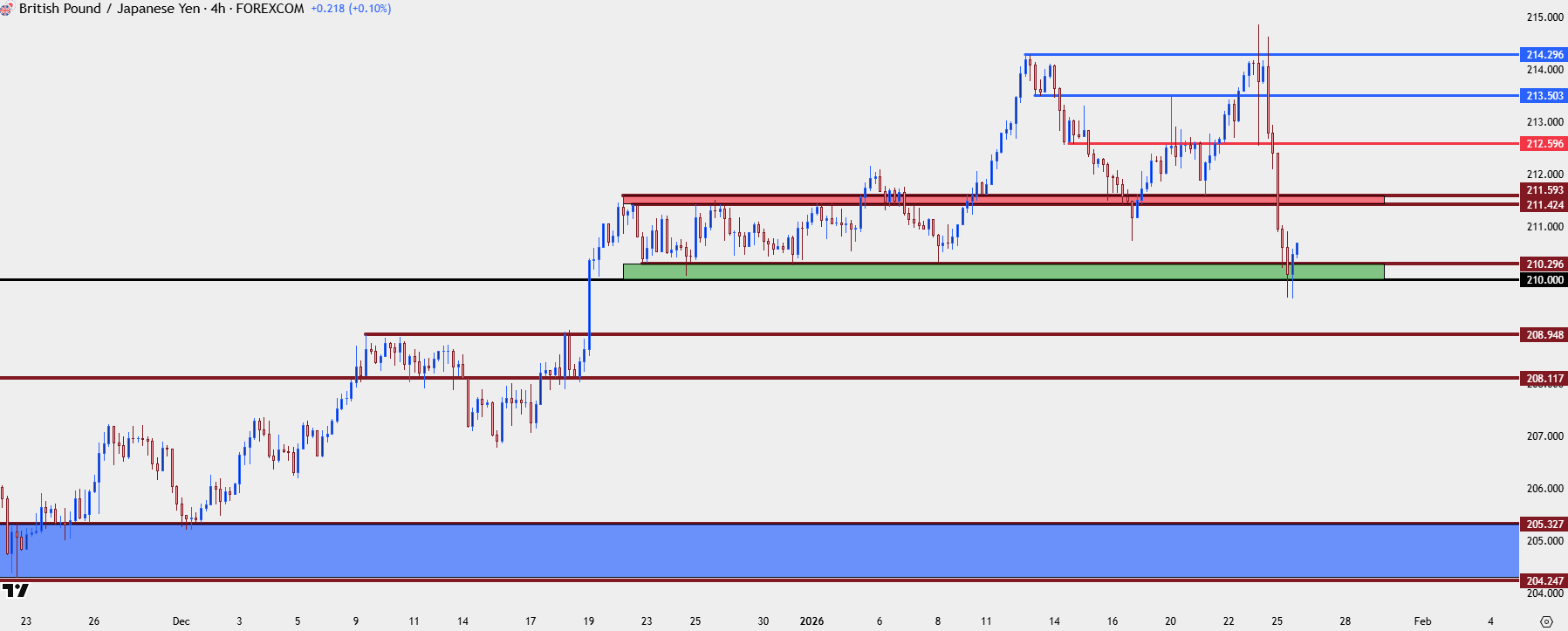
Chart prepared by James Stanley; data derived from Tradingview
--- written by James Stanley, Senior Market Analyst, Global Macro