

With the conclusion of the second week of February, one of the dominant themes in the cryptocurrency market has been risk aversion and a sustained loss of appetite. Despite the release of relevant U.S. employment and inflation data, these figures have not been enough to reactivate activity in the crypto market. The absence of clear fundamental catalysts—such as a less aggressive stance from central banks or stronger growth signals—has limited the recovery in risk appetite in the short term. As long as this macroeconomic backdrop persists, indecision is likely to continue dominating upcoming sessions.

A Week of Key Data Releases
The week was marked by high-impact economic releases. U.S. Non-Farm Payrolls (NFP) came in at 130K versus a forecast of 70K, reflecting a stronger recovery in the labor market. Toward the end of the week, annual CPI inflation stood at 2.4% versus 2.5% expected, showing a moderate slowdown in price pressures.
However, these data points failed to generate a clear recovery in crypto market confidence. The Federal Reserve continues to maintain a neutral rate stance near 3.75%, as employment does not currently pose a short-term threat to the economy and, although inflation has eased, it remains above the central bank’s 2.00% target. CME probabilities currently show a 90.3% and 69.7% likelihood that rates will remain unchanged in the next two policy meetings.
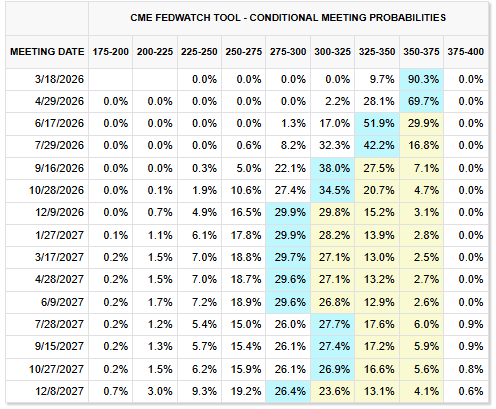
Source: CMEGROUP
This context is important because a lower-rate environment typically reduces borrowing costs, stimulates consumption, and increases liquidity available for risk assets, including cryptocurrencies. Until a rate-cut scenario materializes, demand for this asset class may remain constrained.
The lack of sustained interest is also visible in Bitcoin’s network indicators. Although open interest, which measures total outstanding institutional positions, has recovered toward the $21.8B level, it remains below the $30B observed in January. Combined with Bitcoin’s recent price neutrality, this suggests that there has not been a consistent inflow of new long positions in the short term.
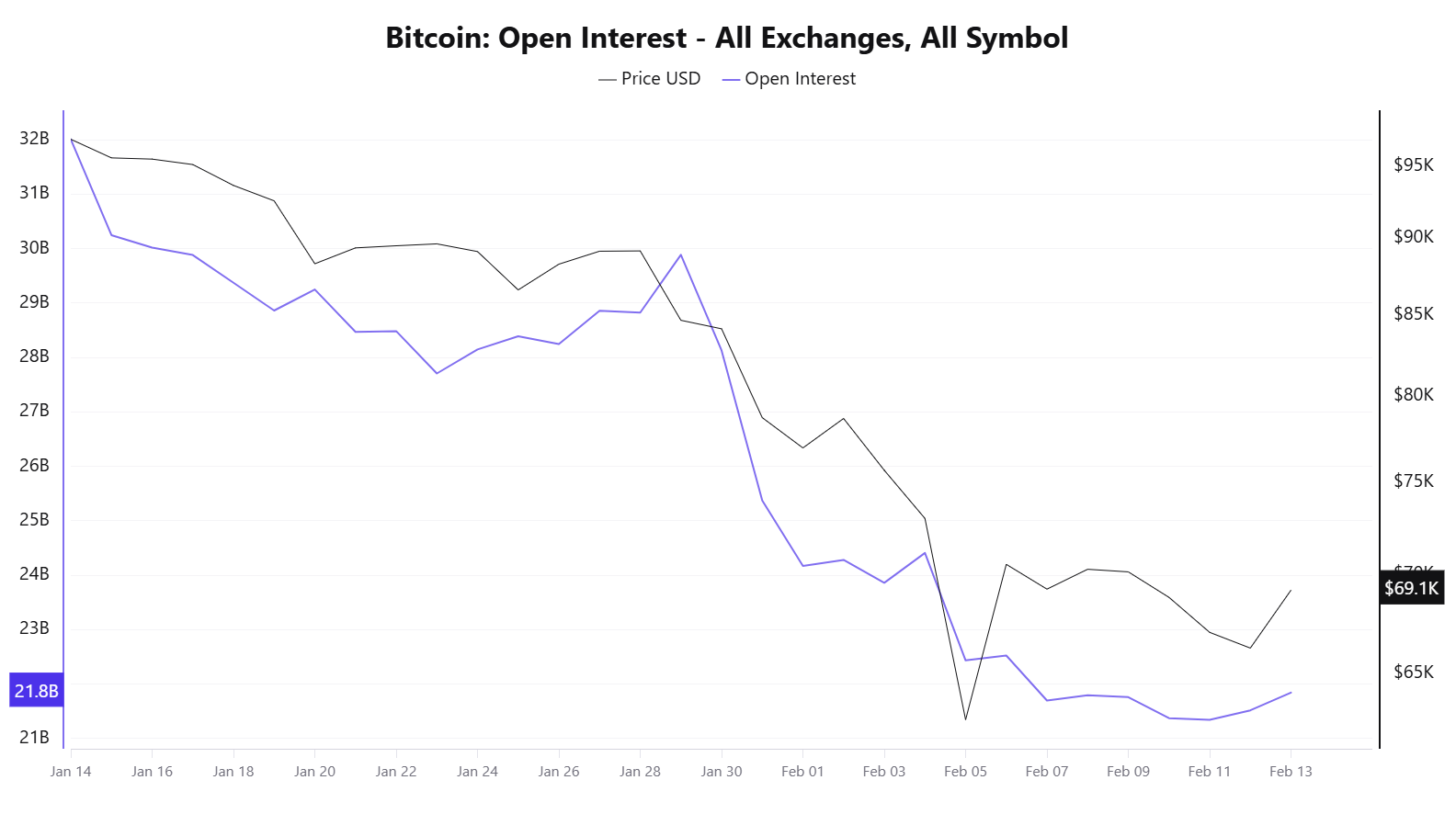
Source: Cryptoquant
In this environment, as long as expectations for lower interest rates fail to consolidate and risk appetite remains limited, the sense of weakness and indecision may continue shaping crypto market behavior.
Bitcoin Compared to Other Markets
Bitcoin has begun to show a decline in its positive correlation with the U.S. equity index SPX, which had previously been stronger. The correlation coefficient is now approaching zero level, reflecting a loss of synchronization over the last 50 sessions. This indicates that while the SPX has attempted to hold near recent highs, Bitcoin has not mirrored that renewed confidence. It is important to note that correlation coefficients can change over time.
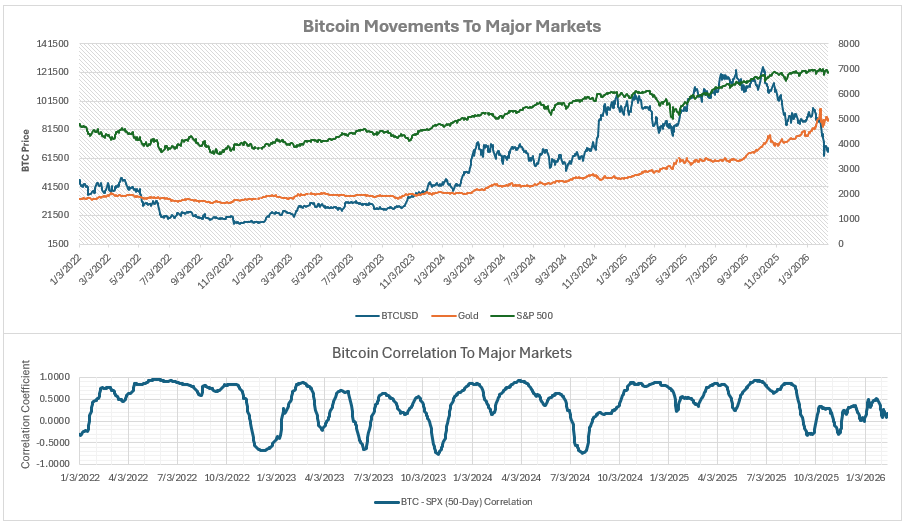
Source: Data – TVC, StoneX, Tradingview
This dynamic reinforces persistent indecisive bias. Bitcoin has not successfully positioned itself as either a traditional risk asset or a short-term haven, highlighting a lack of clear investor positioning.
From a relative volatility perspective, major cryptocurrencies are showing lower oscillations compared to their weekly and monthly averages, reflecting a sustained contraction in price variation. This environment typically weighs on confidence, as it reduces speculative appeal and suggests that part of capital flows may be shifting toward assets such as gold, equities, or even bonds.
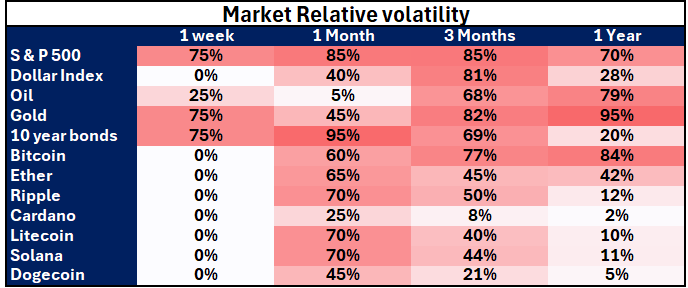
Source: Data – TVC, StoneX, Tradingview
Taken together, the combination of macroeconomic uncertainty, weak demand, and low volatility creates a challenging environment for cryptocurrencies. As long as these factors persist, the dominant neutral bias is likely to continue defining short-term market behavior.
Confidence Fails to Recover
The Fear and Greed Index remains around the 8-point level, firmly in “extreme fear” territory. These readings have not been seen in several months and indicate that market confidence remains near lows, with no clear signs of short-term recovery.
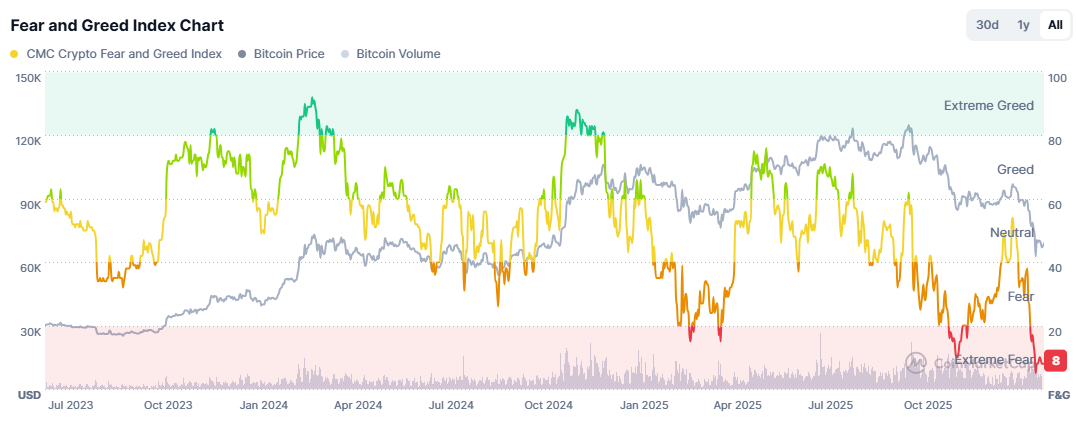
Source: Coinmarketcap
In this context, weak sentiment makes it difficult to sustain consistent demand. Until sentiment indicators show meaningful improvement, indecision and weakness are likely to continue dominating crypto market price action in the coming sessions.
Written by Julian Pineda, CFA, CMT – Market Analyst
Follow him on: @julianpineda25