
The US dollar has found some mild amid the tech rout in recent days, most visibly against risk sensitive and commodity dollars. Today, we have so far seen a bit of a recovery in global indices from their overnight lows. Investors will be watching the markets to see whether fresh losses will be on the again once Wall Street gets going. Ahead of that, we have just seen the release of the October US non-farm payrolls report – and it was much stronger at 165K than expected.
Jobs report beats -but does it matter?
Today’s October US employment report was not going to be too big a focus compared to normal times, with investors clearly more concerned about the tech rout than anything else right now. For what it is worth, markets were pricing in a stronger print today after various second-tier labour market indicators released earlier this week had generally surprised on the upside. Expectations were for a reading of 65K which would have been an improvement from the 29K print we saw the month before, although the market whisper number was a bit higher than that following those stronger pre-NFP leading indicators.
As it turned out, the jobs report was much stronger at 165K on the headline front while the previous reading was revised sharply higher, too, to 60K from 29K reported initially. What’s more, the unemployment rate fell unexpectedly to 4.1% from 4.2%, while average hourly earnings were stronger at +0.4% m/m vs. +0.3% eyed.
This solid employment report should reinforce the Federal Reserve’s assessment that the labour market remains solid, potentially stabilising front-end yields and providing some support for the dollar.
With the jobs data coming in strong, any defensive positioning is more likely to be expressed through commodity currencies such as the AUD/USD or cross-currency pairs, such as a weaker AUD/JPY, or rather than outright dollar buying.
Tech sell-off keeps dollar supported
Given the big tech sell-off, it has been somewhat of a surprise to see the relatively muted reaction in foreign exchange markets. So far, currency investors appear to be treating the technology sell-off as a specific repricing of the sector rather than evidence of a more serious deterioration in the global economic outlook. But should other sectors of the equity market start to drop sharply as well, then we could see a more meaningful FX market reaction.
Within the G10, the Australian and New Zealand dollars have come under modest pressure, while the traditional defensive currencies like the Japanese yen and Swiss franc have weakened only modestly against the US dollar, but they have found good support against other currencies. All told, the FX moves have been relatively contained, suggesting that investors are not yet positioning for a broader macroeconomic shock.
The key question for the dollar is whether the equity weakness eventually prompts a more fundamental reassessment of the US growth and inflation outlook. US short-dated yields have already fallen quite a bit, narrowing the dollar’s yield advantage somewhat. A further decline in rate expectations could eventually become a more meaningful headwind for the currency.
But for now, and in light of the strong jobs report, the dollar remains supported.
US CPI among the data highlights next week
Looking ahead, Tuesday will see the release of US inflation data, which could arguably have a larger impact on the dollar than today’s jobs report. That’s because the Fed is on inflation watch and so far, it is not very concerned about the labour market, which has been doing okay so far – or more than okay given today’s jobs print.
The recent tech selling and pullback in oil prices following the Democratic blue wave at the midterms has reduced market expectations of Fed tightening. But inflation remains sticky and any overshoots either in CPI or PPI (due should boost expectations of a December hike.
Dollar forecast: AUD/USD key levels to watch
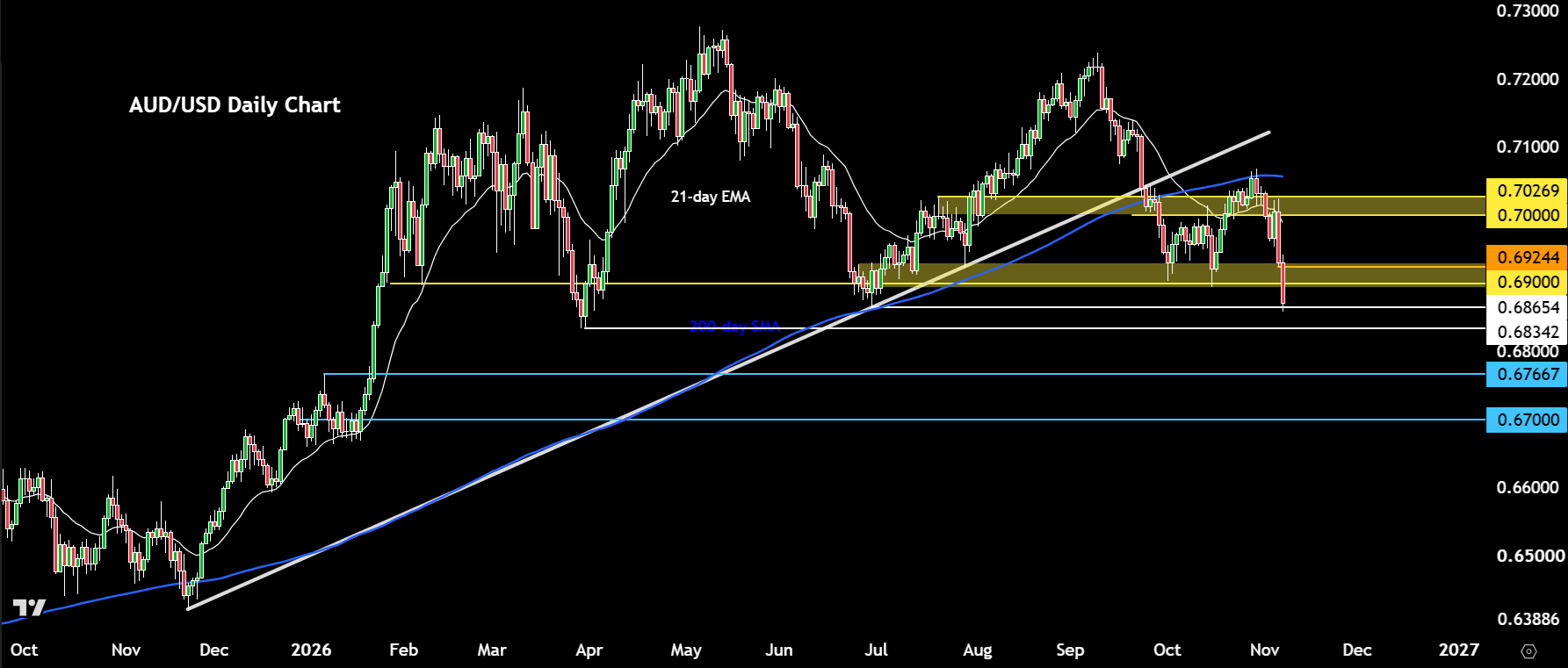
With the AUD/USD having created a few lower highs and now below the key 0.3900-0.6925 support area, the path of least resistance remains to the downside. From here, the next downside targets are the June and March lows at 0.6865 (tagged) and 0.6835, respectively. Below these levels, 0.6765 and then 0.6700 are additional near-term downside targets. Bullish if the pair breaks 0.6925 resistance on a closing basis.