Regarding the US-Iran situation, the main news on Saturday was that Trump cancelled Special Envoy Steve Witkoff and Jared Kushner's trip to Pakistan for peace talks with Iran. That came after Iran’s Foreign Minister Araghchi departed Islamabad without meeting with the US. This means that stalemate continues, Strait of Hormuz remains shut, and this should keep oil prices supported. European indices like the DAX are likely to continue underperforming their US counterparts in the week ahead, barring a surprise resolution. Meanwhile, big tech earnings will be in focus on Wall Street, while a plethora of central bank meetings should come to pass without causing too much volatility. Make no mistake about it, the main focus will once again be on the Middle East situation in the week ahead, which is keeping the DAX outlook in a bit limbo.
US-Iran stalemate continues
Straight from the horse’s mouth, this is what Trump posted on Truth Social on Saturday;
"I just cancelled the trip of my representatives going to Islamabad, Pakistan, to meet with the Iranians. Too much time wasted on traveling, too much work! Besides which, there is tremendous infighting and confusion within their “leadership.” Nobody knows who is in charge, including them. Also, we have all the cards, they have none! If they want to talk, all they have to do is call!!! President DONALD J. TRUMP"
As you can probably tell, things aren’t going in the right direction regarding peace talks and end to the Strait of Hormuz situation. However, stock markets have largely shrugged off the renewed escalation in the rhetoric between the two sides. In the US, the S&P and Nasdaq closed at fresh record highs on Friday while Germany’s DAX also closed higher. But, unlike the US markets, European indices have been far less buoyant, with sentiment here staying on the cautious side as oil prices continued their march higher. Ahead of the weekend investors were understandably reluctant to take on too much risk, even if there’s still a lingering sense that some positive headlines could emerge before too long.
Crude oil and Strait of Hormuz situation remains front and centre
Crude has been the dominant driver for markets since the start of the conflict at the end of February, start of March. After three weeks of declines on hopes of de-escalation, oil prices turned sharply higher last week to end about 15-16 percent higher. That rebound proved difficult for European equities to digest, particularly given how sensitive the region is to energy costs.
That said, it has not been a full-blown risk-off mood globally. Over in the US, the S&P 500 and Nasdaq 100 both pushed into record territories, boosted by strong earnings and AI euphoria. The US economy, of course, is also less exposed to Middle Eastern supply shocks than Europe, which helps explain the divergence. But it wasn’t all doom and gloom in Europe either. The relative resilience in Europe compared to about a month ago when markets were falling more aggressively on any signs of re-escalation, also suggests European investors haven’t entirely lost faith — more that they’re waiting to see how events unfold.
Oil pushes higher as US–Iran tensions drag on
Looking ahead to the upcoming week and with Tehran unwilling to engage while the naval blockade remains in place, while the US decides against sending its negotiators to Pakistan, markets are again left in limbo — and oil should continue to grind higher as a result, barring any further twists by Monday’s open.
By Friday’s close, Brent oil was hovering around $107 per barrel, underpinned by ongoing disruption in the Strait of Hormuz. Recent incidents in the region — from tanker seizures to military activity — have only reinforced the risk premium currently baked into prices.
If tensions were to escalate further, particularly into open conflict, there’s a clear risk of a sharper spike. For now though, as long as shipping through the Strait remains constrained, that premium is unlikely to fade. Until there’s a credible breakthrough, the path of least resistance still looks higher, with a move beyond $110 appearing increasingly plausible.
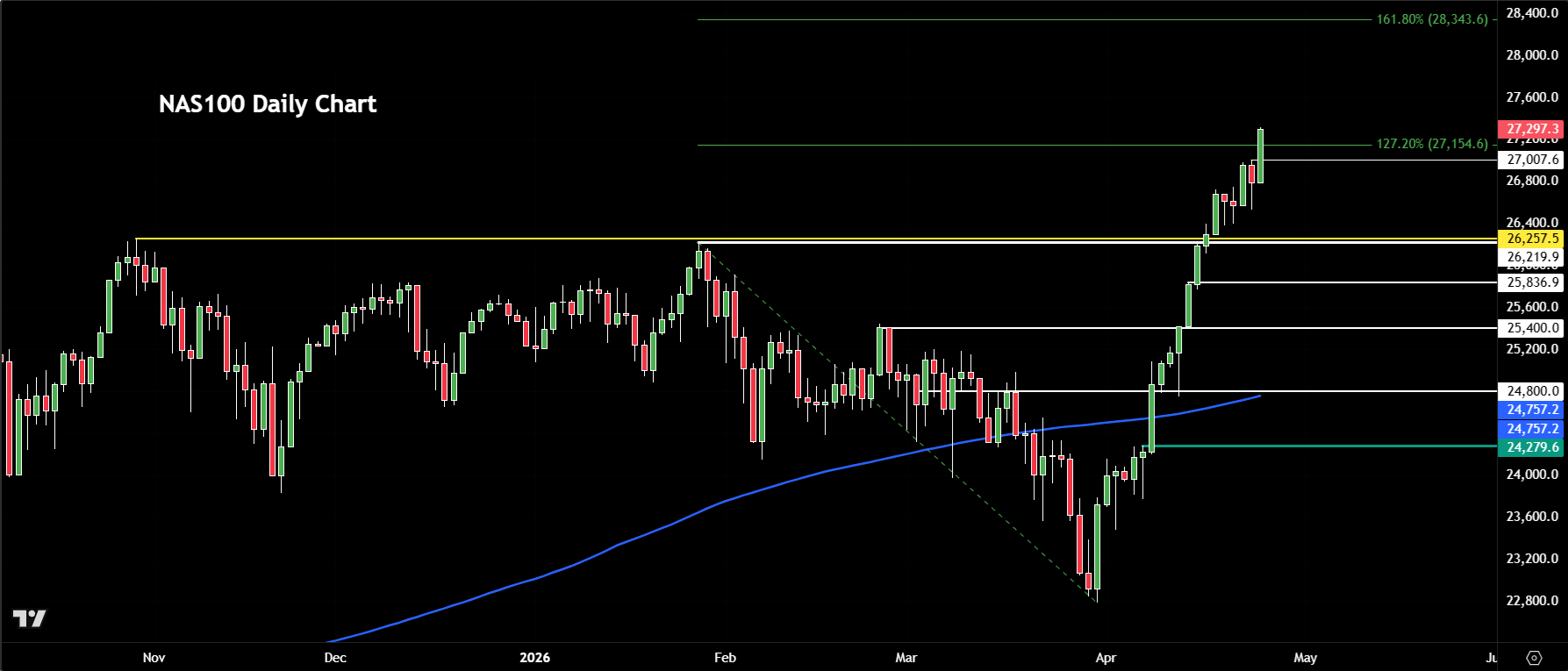
Can Nasdaq hold ground at record highs?
Big US tech earnings: A wave of earnings reports from major US technology firms, including companies like Apple, Amazon, and Microsoft, will heavily influence market direction. These firms carry significant weight in global indices, meaning their results can sway overall investor sentiment. Particular attention will be paid to AI investments, revenue growth, and forward guidance. Strong earnings could sustain the recent equity rally, while disappointments may trigger a correction. Given elevated valuations and geopolitical uncertainty, this earnings season is seen as a key test of whether markets can justify current pricing levels, and whether indices like the Nasdaq 100 can stay at these record highs.
Central Bank policy decisions: Will they matter?
For US markets and the dollar, there is the Federal Reserve meeting and some key US data releases to watch this week. While markets expect interest rates to remain unchanged, investors will closely analyse forward guidance, especially around inflation risks and geopolitical shocks. The meeting coincides with major US data releases this week, including GDP growth and the PCE inflation index—both critical indicators for future policy direction. Together, these will shape expectations for rate cuts or prolonged hold. But with uncertainty tied to global conflict and energy prices at the forefront, any shift in tone from policymakers may only trigger mild volatility.
Meanwhile, the European Central Bank’s upcoming meeting is another major focal point, but no change is expected. Policymakers will weigh persistent inflation risks against weakening economic sentiment and markets will be debating whether rate hikes could follow in June or later in the year if energy-driven inflation remains elevated. Investors will scrutinise comments from President Christine Lagarde and other officials for signals on timing and magnitude of future moves. The decision could influence the DAX outlook as well as eurozone bond yields and the euro.
DAX could feel the strain from energy prices
For European equities, and the DAX in particular, the rise in oil is proving a significant headwind. Germany’s reliance on imported energy leaves the index especially exposed.
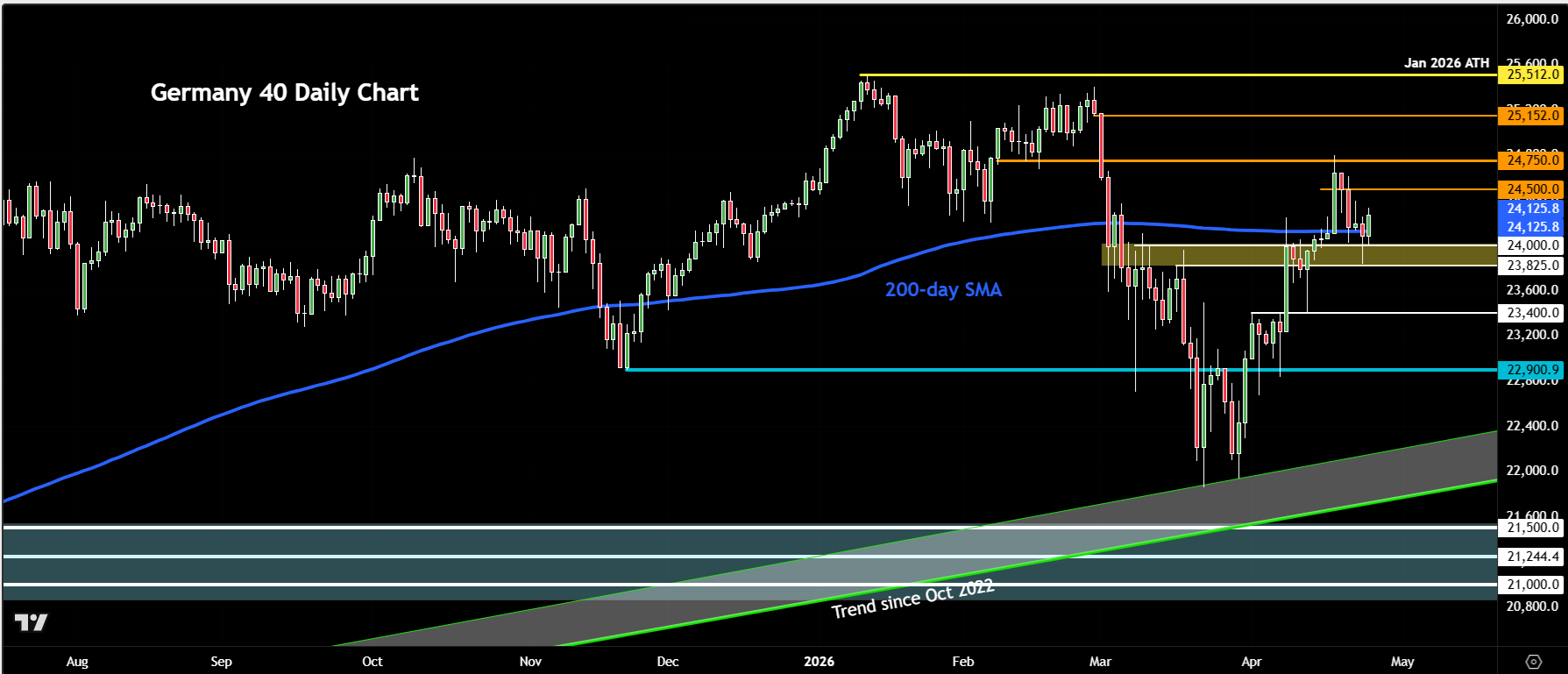
Key support zone in the 23,825 to 24,000 region held firm on Friday. This is an area that previously acted as resistance before the recent breakout. We saw a bit of a bounce from there Friday, but questions remain as to whether we will see any further follow-through in buying once the week gets underway.
A potential break below that support zone would likely shift the near-term DAX outlook in a more bearish direction. That could open the door to a move towards 23,400, with a deeper pullback potentially targeting the 22,900 area.
On the upside, 24,500ish, 24,750ish and then the psychologically important 25,000 are among the short term levels to watch.
For now, much depends on oil. As long as prices remain elevated, it’s hard to see the DAX making a sustained push higher.

-- Written by Fawad Razaqzada, Market Analyst
Follow Fawad on Twitter @Trader_F_R