


New Zealand Dollar Forecast: Weak Labour Market Signals Risk for NZD/USD
New Zealand’s unemployment rate edged up to 5.2%, beating market expectations but softer details highlight growing slack and limited wage pressures.
Share this:

- New Zealand unemployment up to 5.2%, matching RBNZ forecasts
- Employment, participation drop
- Underutilisation rises to 12.8%, youth unemployment steady
- NZD firms slightly, but mid‑2% cash rate still a risk
NZD/USD Outlook Summary
New Zealand’s Q2 jobs report showed further signs of labour market weakness, even as the unemployment rate marginally undershot market expectations. Falling employment, softer participation, rising underutilisation and elevated youth unemployment point to a weak backdrop that should keep wage pressures contained. The Kiwi firmed slightly on the headline unemployment beat, but with swaps still treating 2.75% as a floor for the cash rate, we see scope for deeper cuts should these trends persist. That may limit upside for NZD/USD over the medium to longer term.
Q2 Jobs Report: Soft Underlying Detail
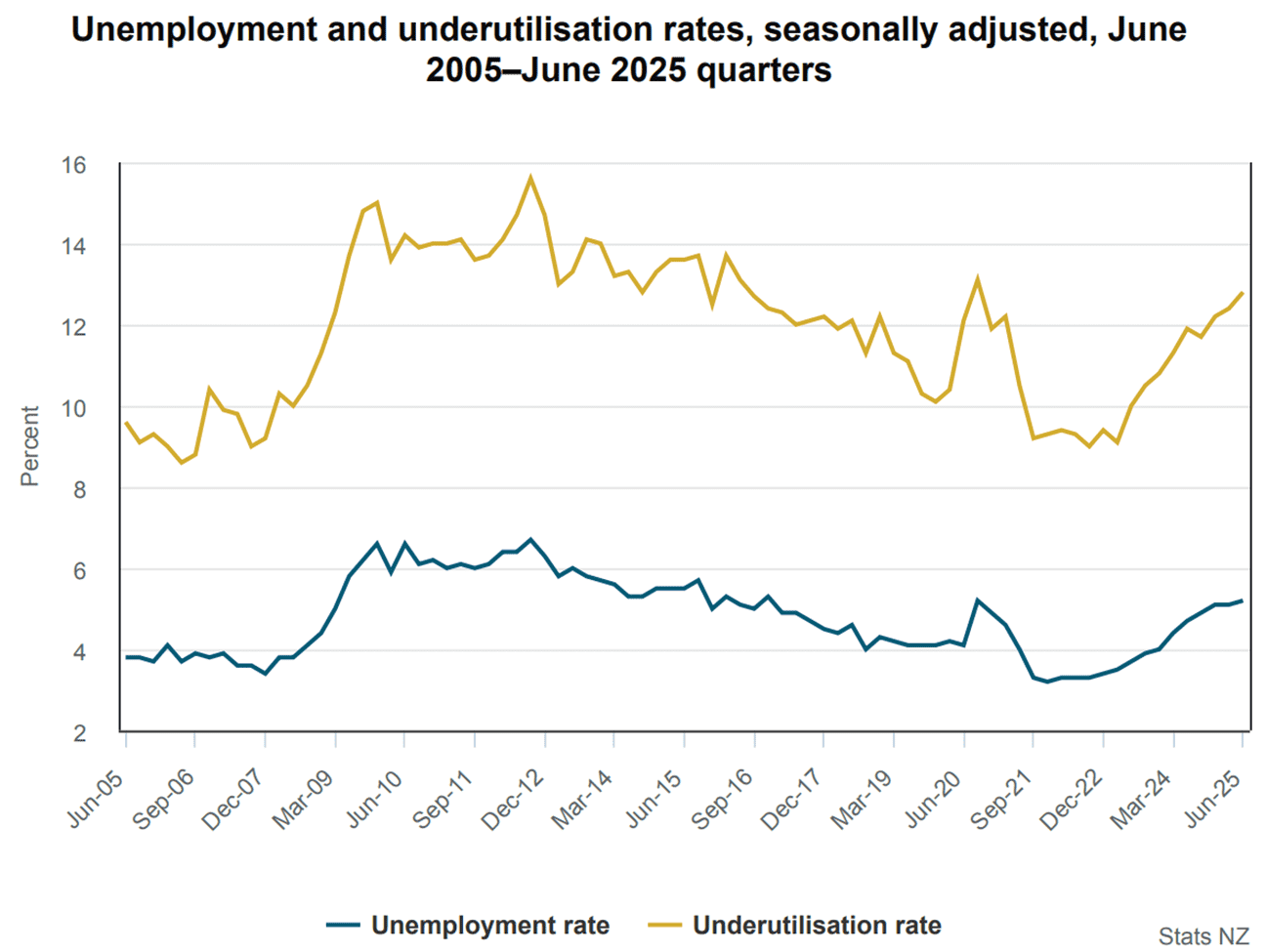
New Zealand’s Q2 employment data delivered another soft set of underlying details despite the headline unemployment rate coming in slightly better than markets expected. Seasonally adjusted unemployment rose to 5.2% from 5.1% in Q1, matching the RBNZ’s forecast but below the 5.3% rate expected by markets.
Employment fell 0.1% versus the RBNZ’s projected 0.2% rise, while participation eased to 70.5%, undershooting the bank’s 70.8% forecast. Weaker participation helped limit the rise in unemployment but points to ongoing softness in labour market conditions. The employment rate fell to 66.8%, down from 67.1% in Q1 and three-tenths below what the RBNZ anticipated.
Source: StatsNZ
Despite lower participation, labour market slack continued to build with underutilisation climbing to 12.8% from 12.4% in Q1. This figure combines both unemployed and underemployed workers, along with potential labour market participants.
Youth unemployment remained elevated, holding at 12.9%. This underlines how the most responsive parts of the labour market continue to feel the pressure from weaker economic growth.
Private sector wages excluding bonuses rose 2.2% from a year earlier, a touch below the 2.3% pace expected, reinforcing that wage pressures remain contained. Despite the marginal beat on the headline unemployment rate, the details signal a labour market that is loosening further, limiting the risk of a renewed pickup in domestic-driven inflation.
Markets Favour 2.75% RBNZ Cash Rate Floor
Despite the soft underlying detail, traders are focusing on the small undershoot in unemployment relative to expectations, helping the Kiwi to strengthen against the USD. There has been little movement in swaps markets with traders continuing to favour 2.75% as the floor for the RBNZ cash rate this cycle.
Given trends in underutilisation and wage growth, and with a sizeable proportion of the working-age population not even participating in the labour market, that comes across as too optimistic in our book. To get the private sector firing, policy settings need to be stimulatory, not neutral, pointing to the potential for the cash rate to be reduced to the mid-2s or lower. That’s the risk we continue to see.
NZD/USD Technical Analysis
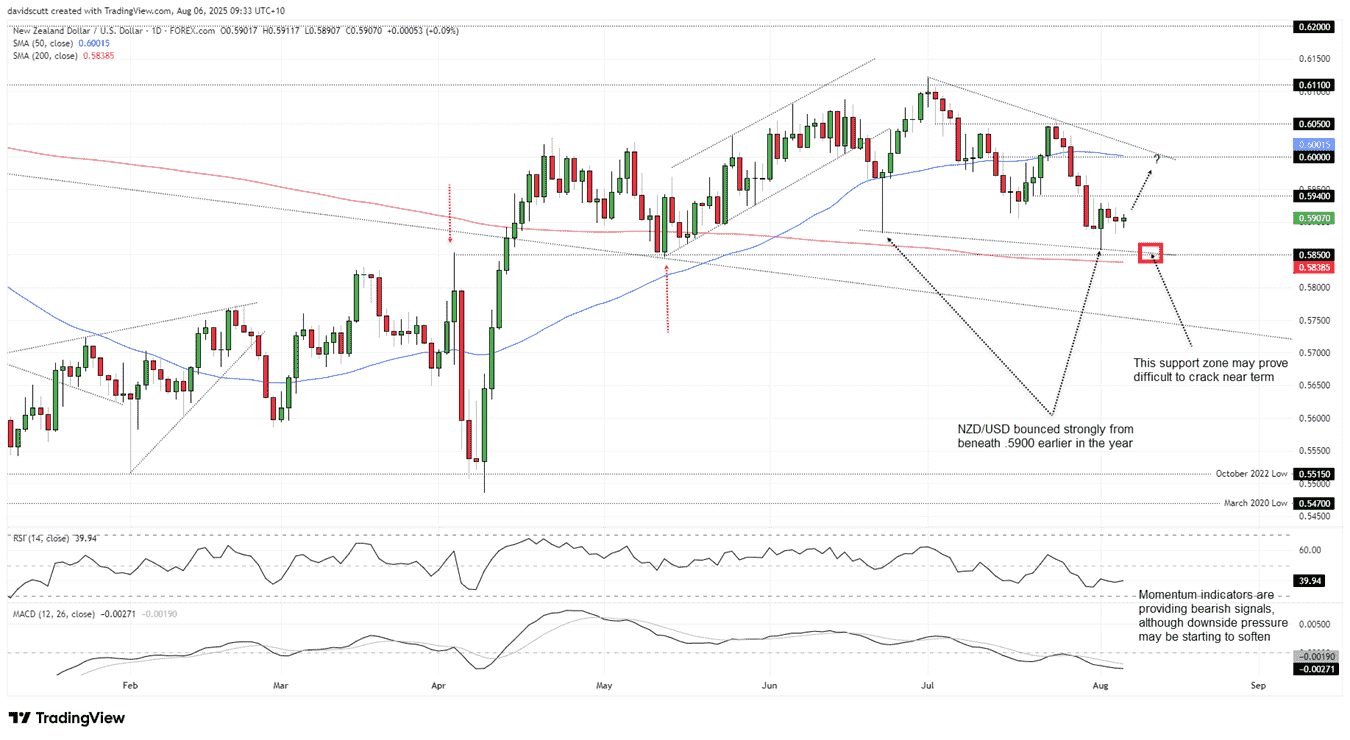
Looking at NZD/USD, the pair trades towards the lower end of the post-Liberation Day range established in May, recording a series of lower highs and lower lows over the past month since a brief foray above .6100 in early July.
Source: TradingView
While RSI (14) sits below 50 with MACD continuing to push lower in negative territory, having crossed the signal line from above in late July—two momentum signals that favour playing the Kiwi from the short side—with known support at .5850 and the key 200-day moving average just below, it’s difficult to get too bearish right now unless there’s a clean downside break of both levels. Zooming out, the pair may be in the process of forming a falling wedge, providing another warning that downside may be hard won over the medium to longer term.
For now, buyers have been nibbling away on dips beneath .5900, likely noting the bullish price action seen on deeper probes below the level earlier in the year. For those contemplating countertrend longs, positions could be established around .5900 with a stop order beneath for protection. Depending on the desired risk-reward, this could extend down to beneath the 200-day moving average.
.5940 is a minor resistance level above, providing an early test for bulls. If it’s cleared, .6000 and the 50-day moving average loom as a potential target. Wedge resistance, .6050 and .6110 are other possibilities if the Kiwi really gets a wriggle on.
On the downside, .5883 was the low set on Tuesday, making that an initial level of note. Below, wedge support, .5850 and the 200-day moving average are the key levels to watch. If the latter is broken cleanly, there’s little visible support until the long-running downtrend established in January 2021.
Related tags:


Open an account in minutes
Experience award-winning platforms with fast and secure execution.
Economic calendar
Web Trader platform
Our sophisticated web-based platform is packed with features.
Related articles
USD/JPY Weekly Outlook: Fed Hikes, AI Volatility and a Sleeping Yen
USD/JPY is tracking the direction of US rates without responding with its usual magnitude. Can Jensen Huang and the payrolls lottery wake the pair from its slumber?

USD/MXN Forecast: Mexican Peso Weakness Persists as Year-End Approaches
These continue to be challenging sessions for the Mexican peso. The currency has remained under pressure in recent weeks, a trend clearly reflected in USD/MXN, which has now posted seven consecutive bullish sessions, gaining more than 7.0% over that period.


Bitcoin forecast: BTC/USD steadies as risk appetite returns for now
Bitcoin has steadied around 60,000 after a November slide driven by ETF outflows, weaker liquidity and regulatory doubts. Fawad Razaqzada explains why 65,000 is now the line in the sand.

The information on this web site is not targeted at the general public of any particular country. It is not intended for distribution to residents in any country where such distribution or use would contravene any local law or regulatory requirement. The information and opinions in this report are for general information use only and are not intended as an offer or solicitation with respect to the purchase or sale of any currency or CFD contract. All opinions and information contained in this report are subject to change without notice. This report has been prepared without regard to the specific investment objectives, financial situation and needs of any particular recipient. Any references to historical price movements or levels is informational based on our analysis and we do not represent or warranty that any such movements or levels are likely to reoccur in the future. While the information contained herein was obtained from sources believed to be reliable, author does not guarantee its accuracy or completeness, nor does author assume any liability for any direct, indirect or consequential loss that may result from the reliance by any person upon any such information or opinions.
Futures, Options on Futures, Foreign Exchange and other leveraged products involves significant risk of loss and is not suitable for all investors. Losses can exceed your deposits. Increasing leverage increases risk. Spot Gold and Silver contracts are not subject to regulation under the U.S. Commodity Exchange Act. Contracts for Difference (CFDs) are not available for US residents. Before deciding to trade forex, commodity futures, or digital assets, you should carefully consider your financial objectives, level of experience and risk appetite. Any opinions, news, research, analyses, prices or other information contained herein is intended as general information about the subject matter covered and is provided with the understanding that we do not provide any investment, legal, or tax advice. You should consult with appropriate counsel or other advisors on all investment, legal, or tax matters. References to FOREX.com or GAIN Capital refer to StoneX Group Inc. and its subsidiaries. Please read Characteristics and Risks of Standardized Options.