


NZD/USD Forecast: China tariff shift adds twist to outlook
The US Supreme Court ruling has shifted China’s tariff backdrop just as New Zealand retail spending surprises again. With NZD/USD consolidating near key levels, CNH is back on the radar.
Share this:

- New Zealand retail spending surprises to the upside
- US Supreme Court ruling shifts China tariff backdrop
- CNH back on the watchlist for Kiwi traders
Summary
New Zealand’s household sector continues to impress, even before the economy feels anything close to the full impact of the RBNZ’s 325bps easing cycle. If that resilience proves broader, it keeps the prospect of an earlier policy pivot from the RBNZ firmly in play.
Externally, the US Supreme Court ruling last Friday has complicated the tariff narrative, ultimately lowering China’s average tariff burden despite the announcement of a fresh 15% global levy. Given China’s importance to the New Zealand economy, that shift may carry more constructive implications for the Kiwi than headlines alone suggest.
Discretionary strength signals demand recovery
Source: StatsNZ
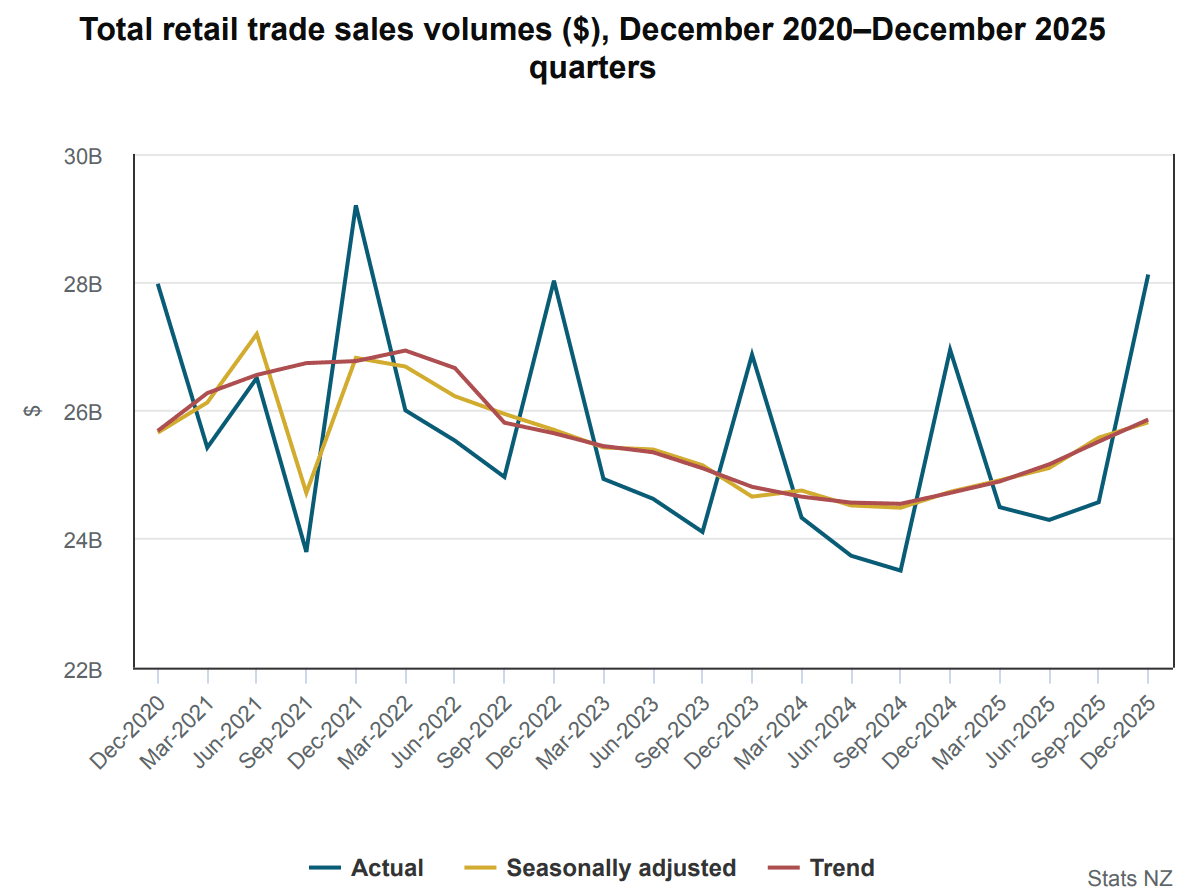
New Zealand retail sales surprised to the upside again in Q4, with volumes rising 0.9% against expectations closer to 0.6%. That marked a fifth consecutive quarter of gains, leaving the volume of goods sold more than 4% higher than a year ago. Nominal spending remained firm too, climbing 1.4% over the quarter and nearly 5% annually, reinforcing that households are buying more, not simply paying higher prices.
The composition of growth tells the more important story. Discretionary categories drove the strength, including electronics, furniture, hardware, clothing and recreational goods, areas typically most responsive to shifts in interest rate dynamics. Hospitality spending also continued to expand.
Earlier RBNZ tightening risks creep back
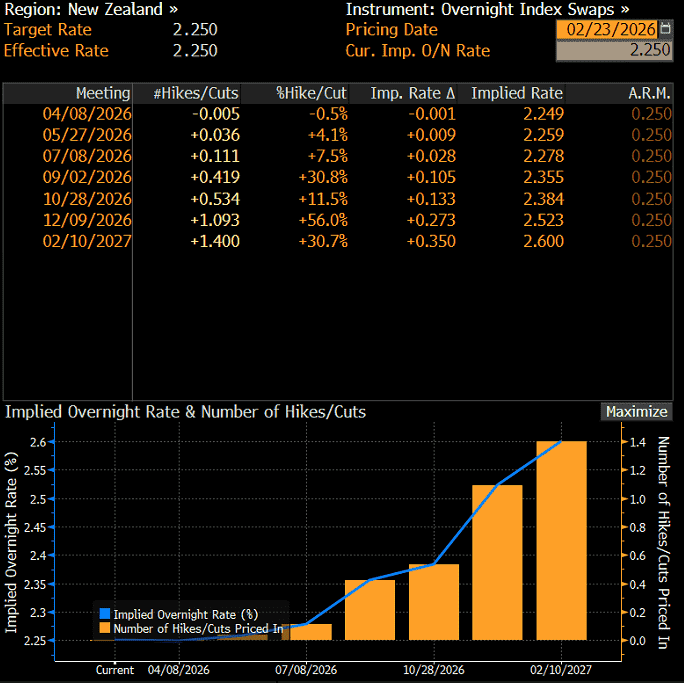
While few would dispute that ample slack remains within New Zealand’s labour market, something that should help contain wage and domestic price pressures near term, the policy outlook becomes less straightforward if household demand continues to strengthen as fixed-rate mortgages progressively roll into a far lower interest rate environment. Should that trend persist, the RBNZ may find itself leaning towards tightening earlier than the Q4 timing flagged in last week’s updated rate track.
Source: Bloomberg
Swaps traders remain reluctant to fully price a hike ahead of the general election in early November. Even so, expectations for an earlier move are quietly building, with October currently priced a little above 50%. That timing sits awkwardly close to the election, leaving September as the more realistic candidate should incoming data continue to surprise on the upside.
China adjustment carries Kiwi implications
Externally, the US Supreme Court ruling last Friday has added an interesting twist to the China narrative. While Donald Trump announced a fresh 15% global tariff over the weekend, the broader effect of the ruling is a reduction in China’s average tariff burden compared to the structure previously in place. Given China remains the world’s largest export engine, even marginal shifts in its trade environment carry global implications.
For New Zealand, that adjustment matters. China is easily the country’s largest trading partner, meaning any stabilisation or improvement in Chinese activity has direct spillover effects for growth, sentiment and the currency. While tariff uncertainty may still inject bouts of volatility into broader risk assets, the underlying impulse from a potentially less restrictive China backdrop may prove less negative for the Kiwi than headlines alone might suggest.
Yuan back on the Kiwi watchlist
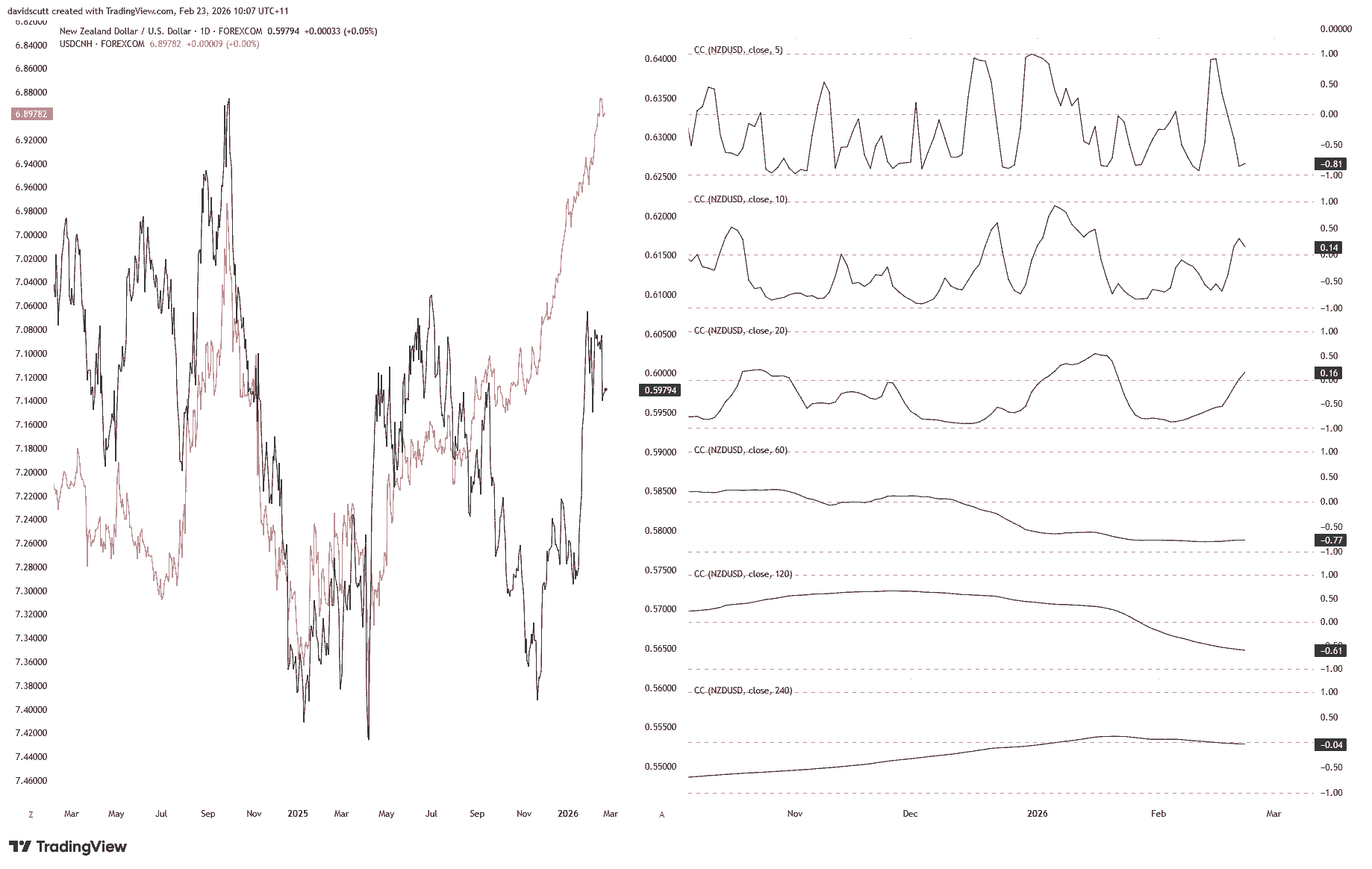
The chart below highlights the shifting relationship between NZD/USD and USD/CNH over time. In the left pane, NZD/USD is shown in black overlaid against USD/CNH in light red, with the scale of the latter inverted to provide a clearer read on relative performance against the US dollar. While the visual co-movement is often apparent, the correlation profile on the right tells a more nuanced story.
Source: TradingView
At times, the relationship tightens meaningfully, with negative correlations emerging that imply both currencies are moving in a similar direction against the dollar. In other periods, however, the linkage fades, offering little reliable signal. For traders, the takeaway is straightforward. Yuan performance deserves a place on the watchlist as a guide to directional risks for the Kiwi, but it should not be treated as a mechanical trading signal.
Kiwi finds buyers on dips
We can see in Asia trade that the US dollar is back on the defensive, extending the selling pressure that emerged late Friday following the tariff ruling. As seen in April last year after Liberation Day, abrupt shifts in US trade policy have again been met with dollar selling, hinting at the risk of renewed capital flows out of USD assets. With prior tariffs ruled illegal, the broader question for markets is why the rest of the world should simply accept the revised measures.
Source: TradingView
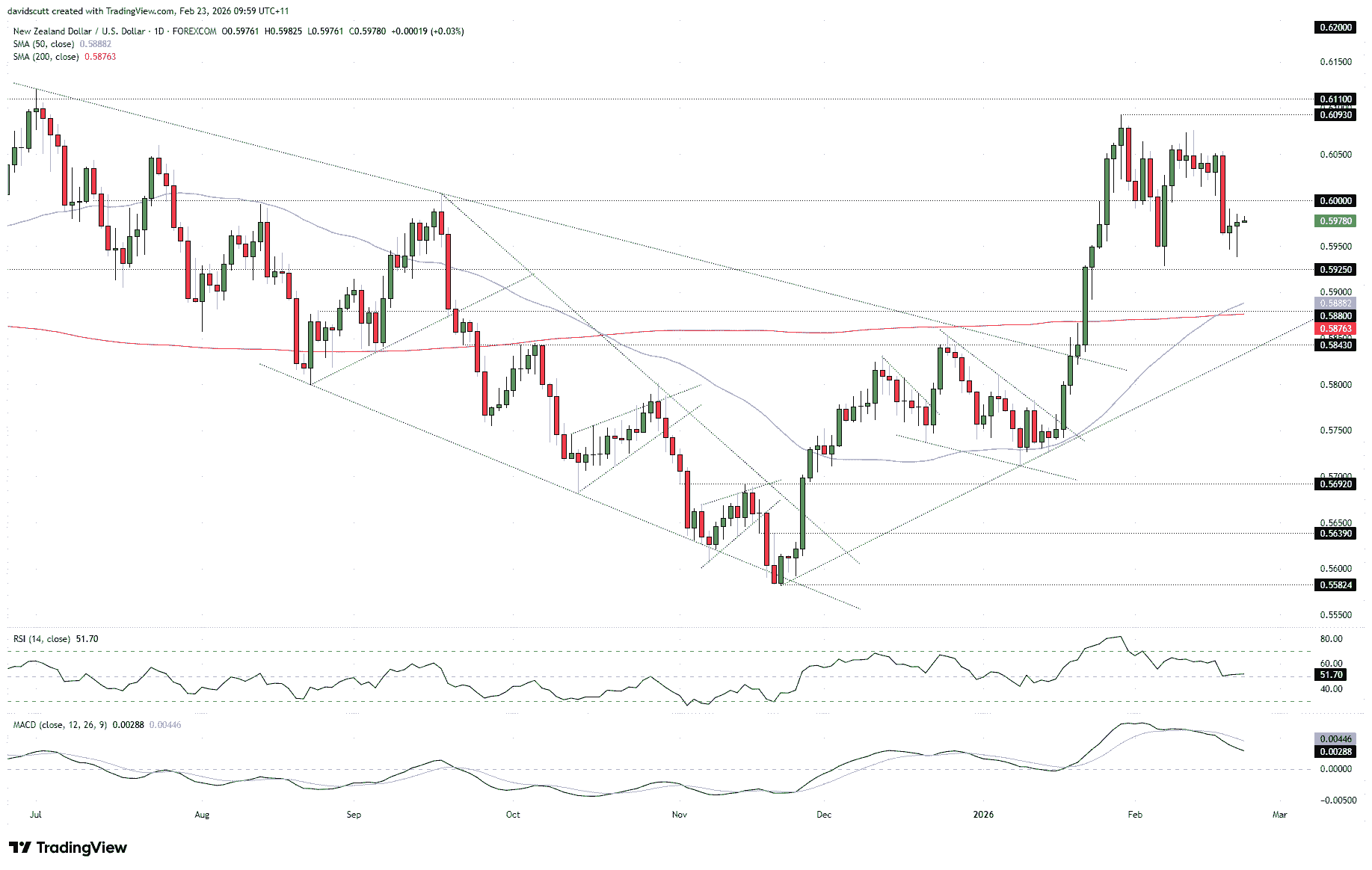
For NZD/USD, having drifted back towards the lower end of its recent sideways range following the RBNZ last week, the balance of risks may now be tilting higher. That view is consistent with the hammer candle printed on Friday, suggesting demand is emerging on dips. On the topside, attention remains on .6000 and .6093, the latter marking the January peak. On the downside, pullbacks beneath .5950 have regularly found buyers, with demand emerging ahead of .5925 support.
Given the increasingly headline-driven backdrop, less weight is being placed on oscillators for directional guidance, though RSI (14) and MACD are largely neutral anyway. Price action continues to resemble consolidation following the bullish breakout earlier this year rather than the start of a deeper retracement. With the pair still holding above both the 50 and 200DMA, the preference remains to buy dips for now. That bias would come under pressure on a sustained break beneath the key moving averages.
Related tags:


Open an account in minutes
Experience award-winning platforms with fast and secure execution.
Economic calendar
Web Trader platform
Our sophisticated web-based platform is packed with features.
Related articles
USD/JPY Weekly Outlook: Fed Hikes, AI Volatility and a Sleeping Yen
USD/JPY is tracking the direction of US rates without responding with its usual magnitude. Can Jensen Huang and the payrolls lottery wake the pair from its slumber?

USD/MXN Forecast: Mexican Peso Weakness Persists as Year-End Approaches
These continue to be challenging sessions for the Mexican peso. The currency has remained under pressure in recent weeks, a trend clearly reflected in USD/MXN, which has now posted seven consecutive bullish sessions, gaining more than 7.0% over that period.


USD/JPY Forecast: Is Market Uncertainty Limiting Direction?
One of the developments that has become increasingly evident in recent weeks is the growing neutrality surrounding the Japanese yen. This can be clearly seen in USD/JPY price action, which has moved by barely 0.5% over the last four trading sessions, highlighting that neither the dollar nor the yen has managed to build enough momentum to establish a clear direction for the pair.
The information on this web site is not targeted at the general public of any particular country. It is not intended for distribution to residents in any country where such distribution or use would contravene any local law or regulatory requirement. The information and opinions in this report are for general information use only and are not intended as an offer or solicitation with respect to the purchase or sale of any currency or CFD contract. All opinions and information contained in this report are subject to change without notice. This report has been prepared without regard to the specific investment objectives, financial situation and needs of any particular recipient. Any references to historical price movements or levels is informational based on our analysis and we do not represent or warranty that any such movements or levels are likely to reoccur in the future. While the information contained herein was obtained from sources believed to be reliable, author does not guarantee its accuracy or completeness, nor does author assume any liability for any direct, indirect or consequential loss that may result from the reliance by any person upon any such information or opinions.
Futures, Options on Futures, Foreign Exchange and other leveraged products involves significant risk of loss and is not suitable for all investors. Losses can exceed your deposits. Increasing leverage increases risk. Spot Gold and Silver contracts are not subject to regulation under the U.S. Commodity Exchange Act. Contracts for Difference (CFDs) are not available for US residents. Before deciding to trade forex, commodity futures, or digital assets, you should carefully consider your financial objectives, level of experience and risk appetite. Any opinions, news, research, analyses, prices or other information contained herein is intended as general information about the subject matter covered and is provided with the understanding that we do not provide any investment, legal, or tax advice. You should consult with appropriate counsel or other advisors on all investment, legal, or tax matters. References to FOREX.com or GAIN Capital refer to StoneX Group Inc. and its subsidiaries. Please read Characteristics and Risks of Standardized Options.