
The Mexican peso continues to face a difficult environment in the short term. This can be seen in the recent performance of USD/MXN, which has gained more than 1.1% over the last three trading sessions, highlighting increasingly persistent weakness in the Mexican currency.
Buying pressure around the pair continues to be driven primarily by expectations of a more flexible Bank of Mexico over the coming months, along with the recent decline in Mexican bond yields. This dynamic remains relevant ahead of tomorrow's inflation release and, as long as markets continue to perceive a more cautious central bank, buying pressure around USD/MXN could remain a dominant theme in the sessions ahead.

What Is Expected From Mexico's Inflation Data?
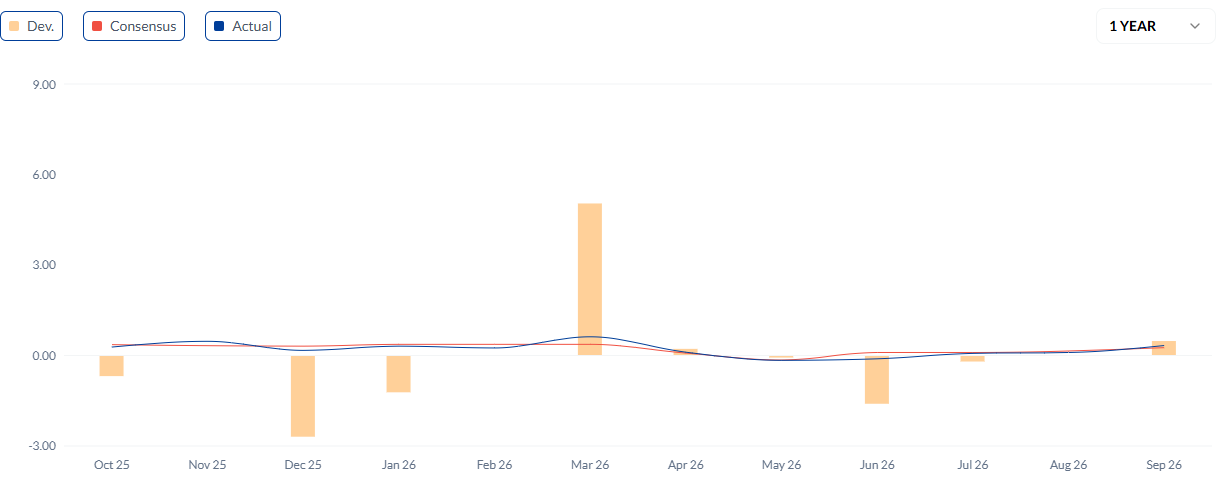
Tomorrow's session will bring the release of inflation figures for the first half of October in Mexico. For now, markets expect a reading of 0.37%, slightly above the 0.33% recorded in the previous report.
These expectations remain important because they continue to point toward a relatively controlled inflation environment, with no clear signs of a significant acceleration in the short term. Forecasts have also remained fairly accurate in recent months. Since March, there have been no major deviations between market expectations and the final inflation readings, reinforcing expectations of a relatively stable inflation backdrop.
This continues to support the view that inflation does not currently represent a major threat to Mexican monetary policy, leaving room for the Bank of Mexico to adopt a more flexible stance over the coming months without the need to maintain exceptionally high interest rates.
Source: FXstreet
This remains particularly relevant because several members of the central bank's board have recently suggested there is less urgency to maintain an aggressive monetary policy stance. In fact, recent developments show that three of the five board members have expressed openness to discussing potential rate cuts, highlighting an increasingly cautious approach and a reduced level of concern over short-term inflation risks.
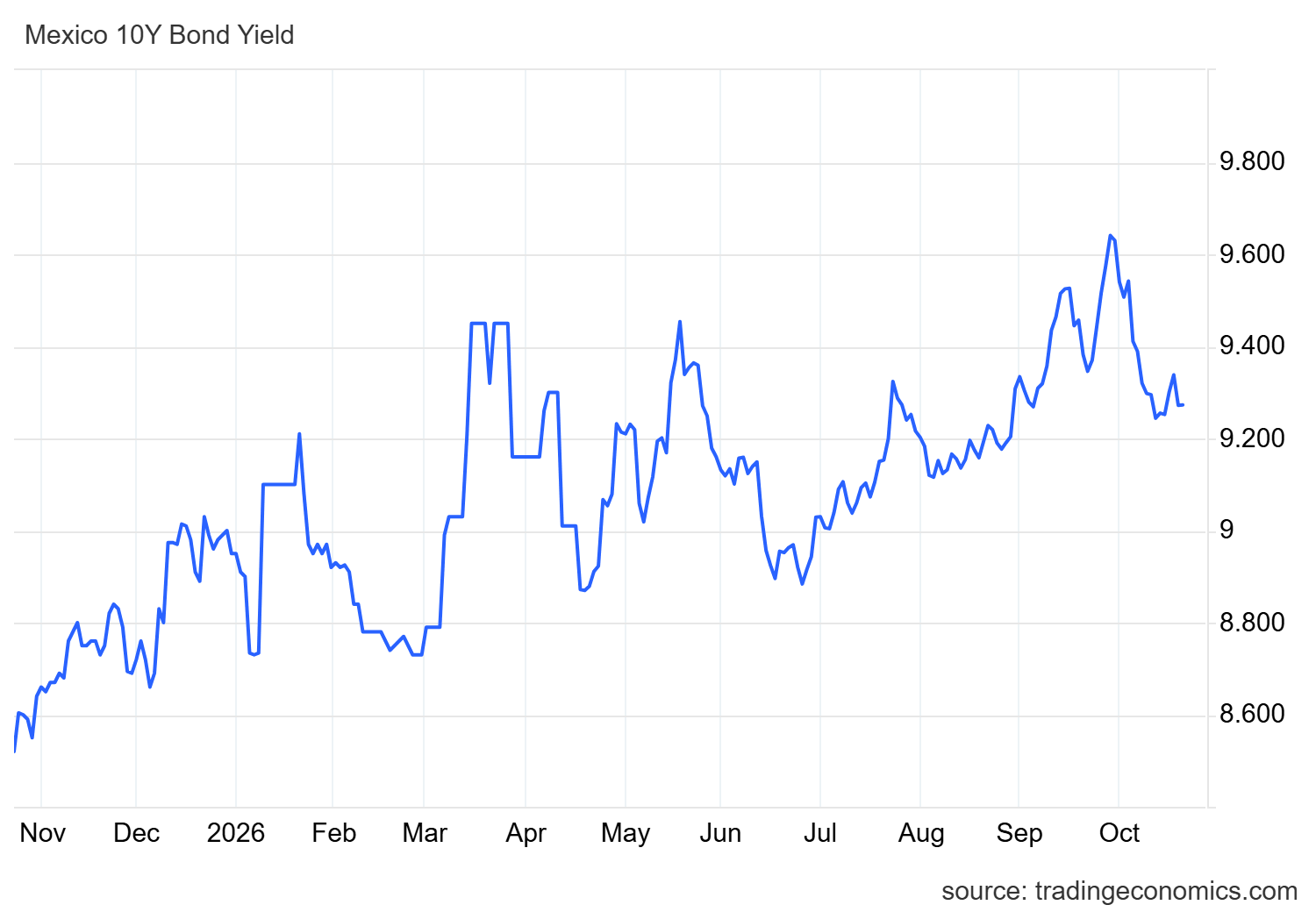
Most importantly, expectations of a more flexible central bank have already begun to affect Mexico's bond market. Over recent sessions, 10-year government bond yields have continued to decline, moving closer to the 9.2% area and pulling away from the highs observed several weeks ago.
This is significant because lower yields tend to reduce the attractiveness of peso-denominated investments while also weakening the appeal of the currency for international investors seeking high interest-rate differentials. As a result, demand for the Mexican peso could continue to soften in the short term.
Source: TradingEconomics
Taking all of this into account, expectations of a more cautious Bank of Mexico appear to be reducing the relative attractiveness of Mexico's fixed-income market and remain an important factor behind the peso's recent weakness. If tomorrow's inflation figures come in close to expectations and continue to show limited inflationary pressures, the perception of a more flexible central bank could gain even more relevance. Under that scenario, the peso may continue to struggle to recover ground, allowing buying pressure around USD/MXN to remain an important feature of the market.
USD/MXN Technical Forecast
Source: StoneX, Tradingview
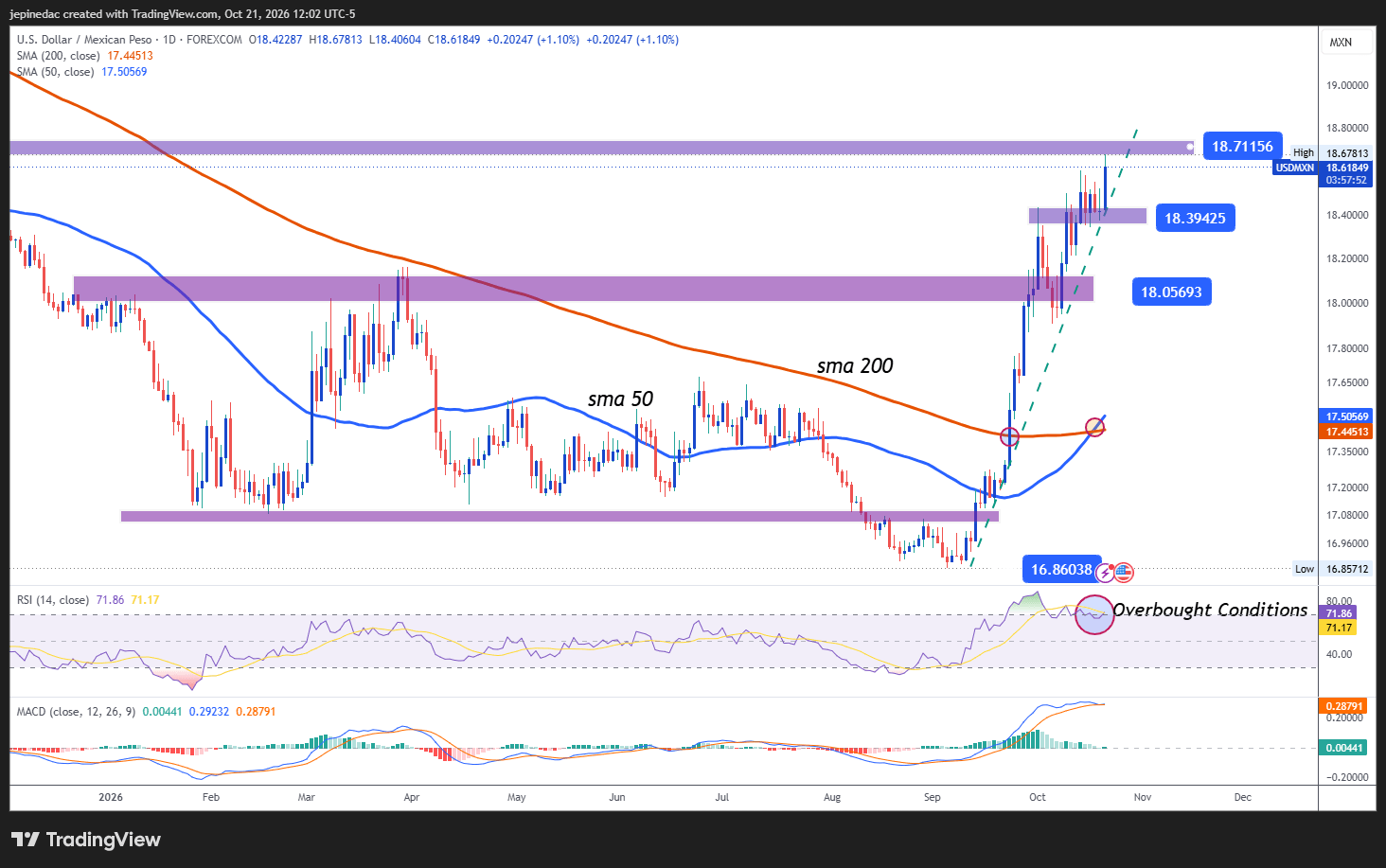
- The bullish trend is becoming the dominant structure:: Over recent weeks, USD/MXN has developed an increasingly aggressive bullish structure. The formation of higher highs and higher lows has reinforced a short-term uptrend, while a recent golden cross has emerged as the 50-period moving average moved above the 200-period moving average. This reading supports an increasingly constructive outlook for buyers and, as long as price continues breaking through key resistance levels, the current bullish trend could gain further strength in the weeks ahead.
- MACD: The MACD histogram continues to trade very close to the 0 neutral line, reflecting a relatively balanced dynamic in short-term moving-average momentum. This reading suggests that despite the broader bullish structure, a degree of market indecision remains present.
- RSI: The RSI remains particularly relevant as the indicator continues to trade close to the 70 overbought threshold. While this supports the strong bullish momentum seen in recent sessions, it also warns that buying pressure may be becoming stretched, potentially creating room for short-term technical pullbacks.
Key Levels:
- 18.70 – Key Resistance: A major resistance zone observed during previous months that remains the most important upside barrier on the chart. A sustained move above this level could reinforce bullish control, strengthen the sequence of higher highs, and support a more established uptrend over the coming weeks.
- 18.40 – Current Barrier: A level that aligns with important recent retracements and remains the main reference to monitor in the event of short-term bearish corrections.
- 18.00 – Key Support: A significant support zone observed during previous weeks that also coincides with an important psychological level for the market. A move back toward this area could place the current bullish trendline at risk and favor a more evident phase of consolidation in the short term.
Written by Julian Pineda, CFA, CMT – Market Analyst
Follow him on: @julianpineda25