
Over the past four trading sessions, the USD/MXN has posted a decline of nearly 1%, favoring the Mexican peso, as a bearish bias begins to strengthen toward the end of the week. For now, downward pressure remains firm, driven mainly by weakness in the U.S. dollar and recent comments from the Bank of Mexico, suggesting that future rate cuts may not be as consistent as previously anticipated. These factors have allowed the peso to gain moderate ground in the short term, and as long as these catalysts persist, selling pressure on USD/MXN could remain relevant in the sessions ahead.

What Are the Bank of Mexico’s Perspectives?
This week, the Deputy Governor of the Bank of Mexico emphasized a message of prudence in monetary policy, noting that while the institution has continued a gradual rate-cutting cycle, this process might not extend much further. The official highlighted that inflation data in Mexico has not shown a meaningful decline, which could pose an additional risk in the coming months.
Indeed, recent reports confirm that headline inflation has remained on a steady upward trend over the last three months. As of September, the figure stood at 3.76%, still within the Bank of Mexico’s target range (3% ± 1 point), though increasingly close to the upper limit — a development that could become problematic if the trend persists. Meanwhile, core inflation — which excludes energy and food prices — was reported at 4.28%, signaling a potential structural increase in price pressures within the Mexican economy.

Source: TradingEconomics
In this context, the Bank of Mexico may consider that an overly accommodative monetary policy could rekindle inflationary pressures, prompting the institution to move toward a tactical pause in its rate-cutting cycle. Although markets still expect a 25-basis-point cut in the upcoming November 6 meeting, recent comments may indicate that such a trend could pause toward year-end as the central bank seeks to contain renewed inflationary risks.
In conclusion, the Bank of Mexico’s recent statements, reflecting heightened caution toward inflation, point to a potential neutral stance in monetary policy. It is worth noting that the current rate of 7.5% remains among the highest in the region, and if the bank decides to keep rates around this level, the differential with the U.S. Federal Reserve (currently at 4.25%) could remain wide. This would make Mexican bonds more attractive as capital-preservation instruments, a scenario that could continue strengthening demand for the peso and sustain bearish pressure on USD/MXN in the short term.
What About the U.S. Dollar’s Strength?
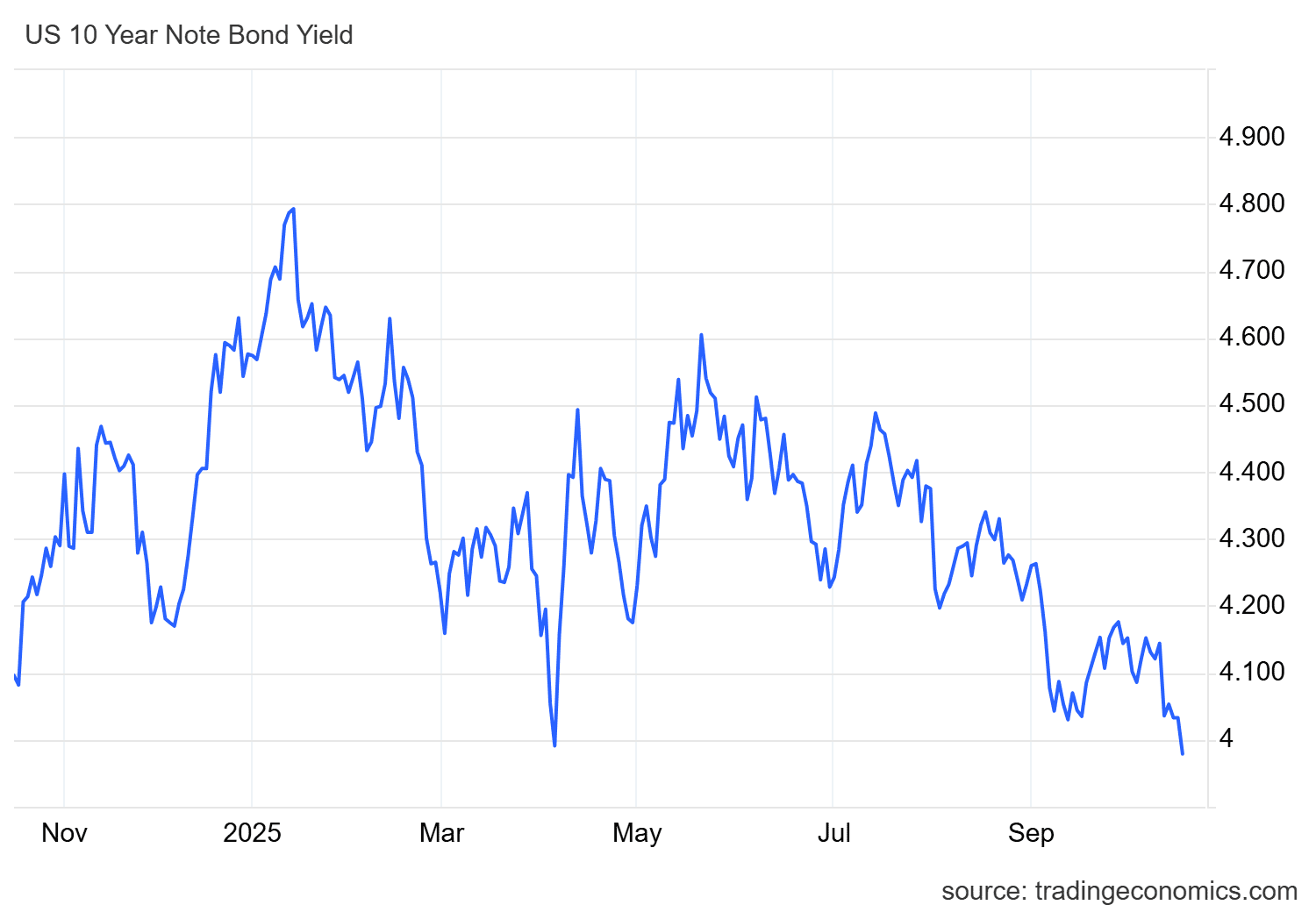
In recent sessions, the U.S. dollar has shown persistent weakness, weighed down by growing political uncertainty linked to the partial government shutdown, as well as the renewed trade war with China. The Federal Reserve’s stance — maintaining its plan to cut interest rates further before year-end — has also contributed to this weakness. Consequently, 10-year Treasury yields have fallen below 4%, reducing the dollar’s appeal as a short-term investment asset.
Source: TradingEconomics
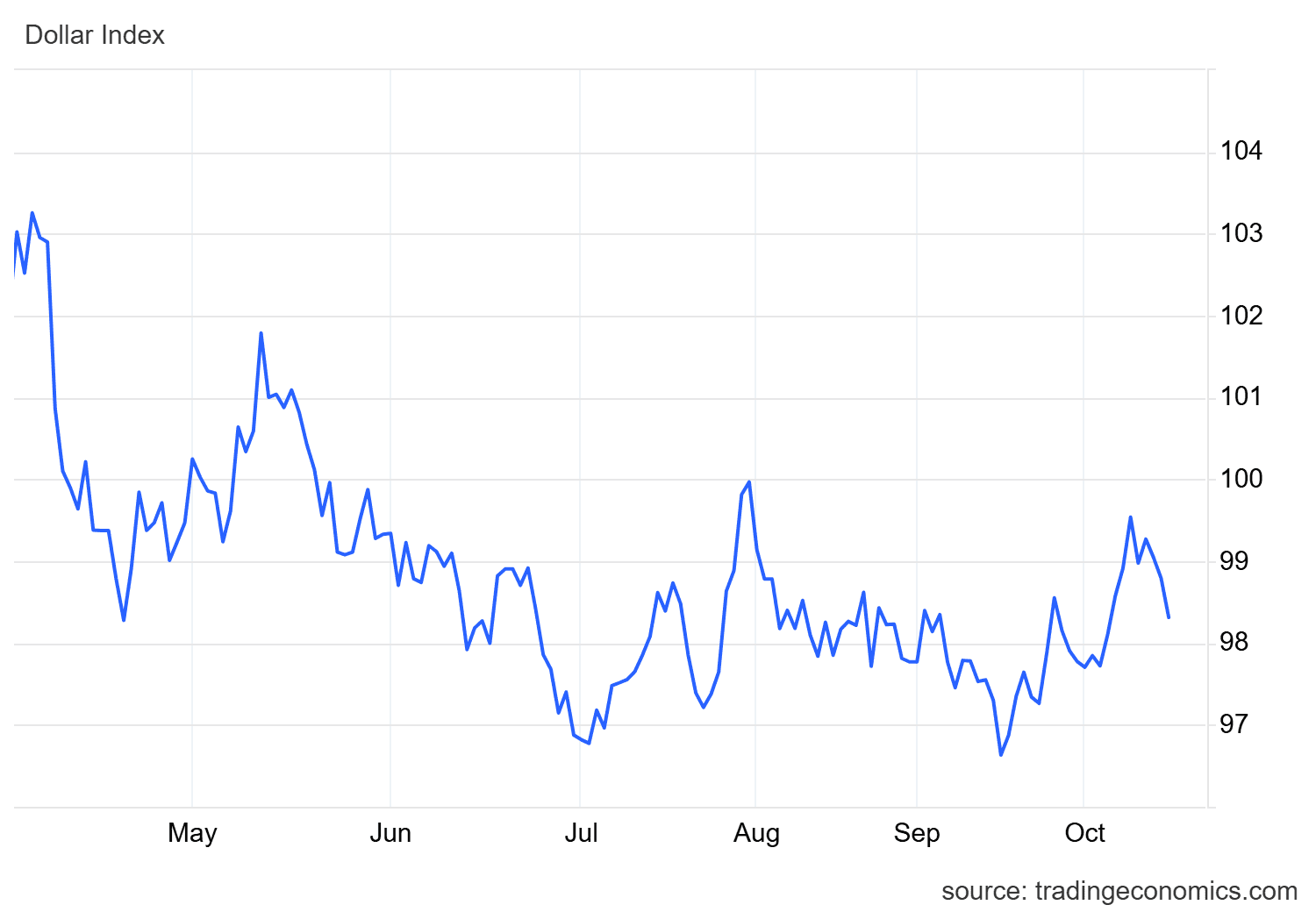
This weakness is reflected in the DXY Index, which measures the U.S. dollar’s strength against a basket of global currencies. The index has seen a steady decline over the past three sessions, falling back toward the 98-point level, with a downward slope that underscores the reduced demand for the dollar amid ongoing political and economic uncertainty in the U.S.
Source: TradingEconomics
As long as the DXY maintains this bearish trajectory and dollar demand continues to weaken, the Mexican peso could keep gaining ground in the short term. This could sustain downward pressure on USD/MXN, particularly if the market continues to favor emerging-market assets with higher yields, such as Mexican bonds.
USD/MXN Technical Outlook
Source: StoneX, Tradingview
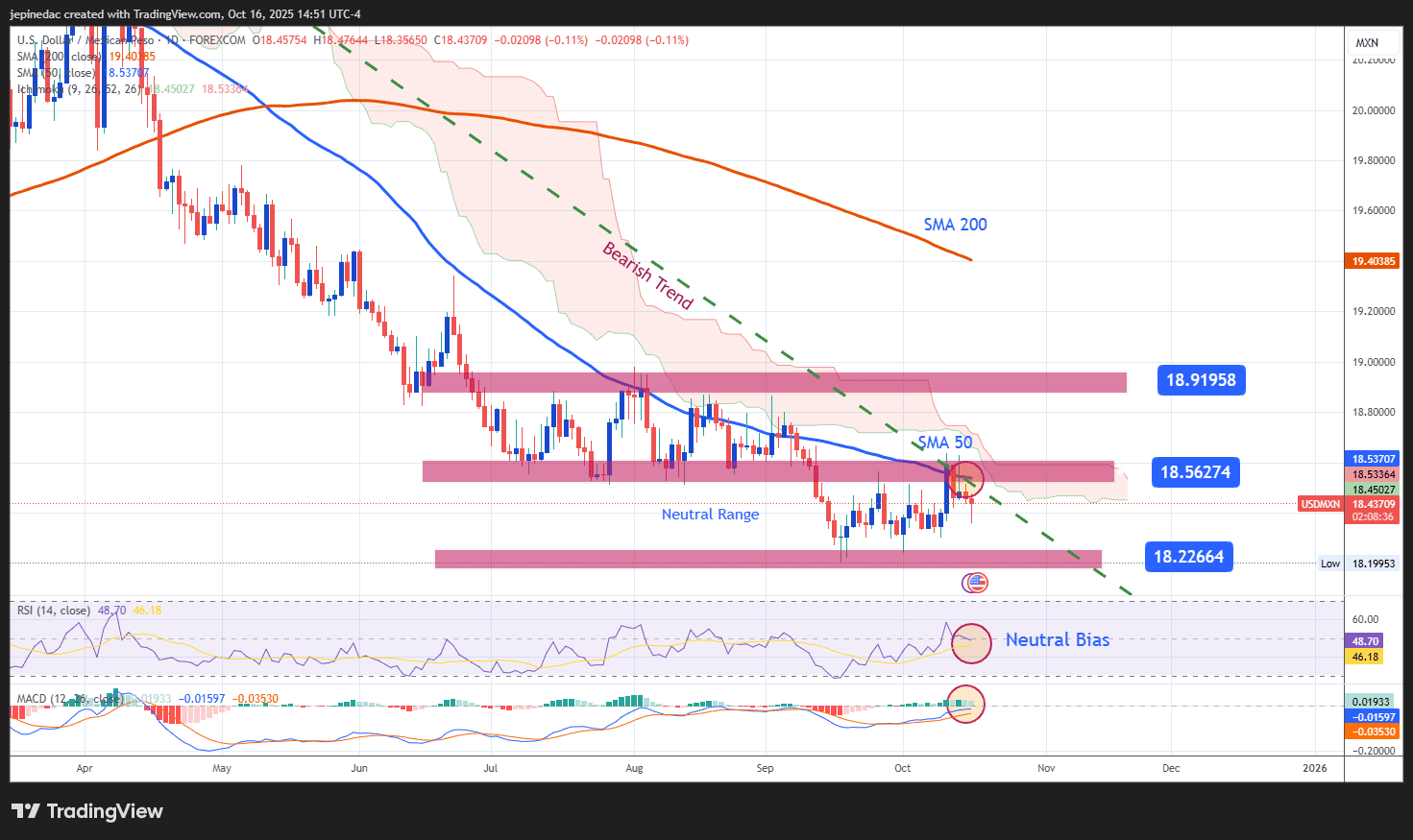
- Downtrend Persists: Throughout most of 2025, the USD/MXN has maintained a steady downward trendline. Despite recent bullish corrections, no significant breakout has occurred that would indicate a structural change in the trend. For now, prices remain below the 50-period moving average, reinforcing the prevailing bearish bias. However, as long as Japanese candlestick patterns continue to show indecision, a neutral phase in price action may persist.
- RSI: The RSI indicator continues to hover near the neutral 50 level, signaling balance between buying and selling pressure over the past 14 sessions. As long as this behavior continues, neutrality may remain the dominant sentiment in the short term.
- MACD: The MACD histogram shows a gradual decline, approaching the neutral line (0), suggesting a lack of clear directional momentum in short-term moving averages. This points to a sideways consolidation scenario likely to persist in the near term.
Key Levels to Watch:
- 18.91 – Major Resistance: Corresponds to a retracement zone observed in August 2025, acting as the most significant technical barrier for upward movements. A sustained move toward this level could challenge the current downtrend line and trigger a stronger bullish bias.
- 18.50 – Near-Term Barrier: Aligns with the 50-period simple moving average and the Ichimoku cloud, suggesting that while prices remain around this area, the market may enter a neutral or sideways phase in the short term.
- 18.22 – Key Support: Represents the most important retracement area from recent weeks. A break below this level, accompanied by sustained bearish momentum, could reinforce the prevailing downtrend and maintain a dominant selling bias in the short term.
Written by Julian Pineda, CFA – Market Analyst
Follow him on: @julianpineda25