The Week Ahead: US inflation, BOC and RBNZ meetings take the helm
Just one week into the month, it’s already apparent that volatility does not intend to get back in its box (which is usually the norm this time of year). Investors are being keep on edge with increasingly inverted yield curves, hawkish comments from central bankers and definitely strong economic data from the US justifying the Fed’s hawkish stance. Janet Yellen is currently treading eggshells in China, where one wrong stop could get messy - and have strong ramifications for global sentiment next week and beyond. As for economic data, US CPI takes the centre stage, with the Bank of Canada (BOC) and Reserve Bank of New Zealand (RBNZ) also set to announce their monetary policy decisions.
The week that was:
- Global bond yields continued to rise and their curves invert (where the short-term rate rise faster than the longer-term and push the spread into negative territory) as investors remain increasingly concerns about the global economy
- The FOMC minutes were more hawkish than traders were expecting, with the decision to pause in June not as ‘unanimous’ as originally suggested as “some members” supported a 25bp hike “almost all members” are on board for further hikes
- US economic data was also very strong overall ahead of NFP data, which saw ADP employment print nearly 500k jobs, layoffs fall and ISM services PMI expand faster than expected (with rising new orders, business activity and employment)
- However, US manufacturing sector continued to deteriorate with the ISM survey contracting at it fastest pace since the pandemic, with employment also falling alongside new orders
- PMI surveys across China, Europe and the US continue to weaken
- China’s services PMI was the latest of its series to disappoint, expanding at its slowest pace in five months and down -3.5 points m/m
- The RBA delivered their second pause of their tightening cycle in July, although warned that “inflation is still too high” and that “some further monetary policy tightening may be required”
- Sino-US relations took another step backwards as China warned that their decision to curb the export of metals used in semiconductors are “just the start”, ahead of US Treasury Secretary Janet Yellen’s visit to Beijing
The week ahead (calendar):

Central Bank members to speak: Time (GMT)
- 14:30 - Fed's Daly
- 15:00 - Fed's Mester
- 16:00 - Fed's Bostic
- 3:10 - RBA Governor Lowe
- 13:45 - Fed's Kashkari
- 15:00 - BOC's Macklem and Rogers
- 20:00 - Fed's Mester to Speak
This content will only appear on City Index websites!
The week ahead (key events and themes):
- US inflation
- Janet Yellen’s trip to China
- BOC and RBNZ cash rate decisions
- China inflation
- Inflation expectations
US inflation
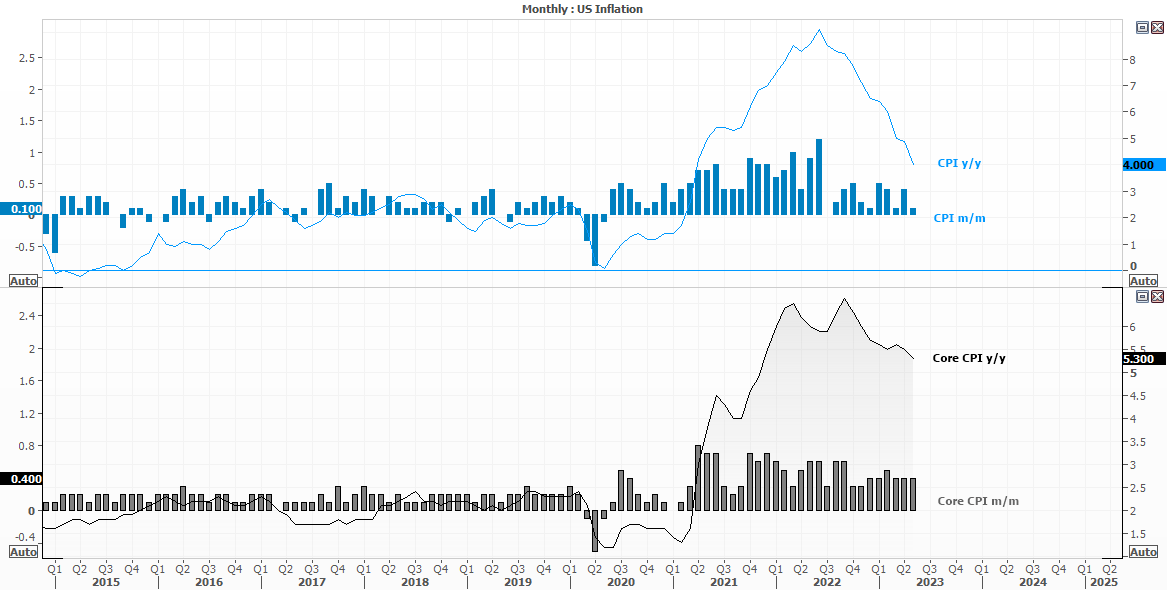
PCE inflation data came softer than expected last week, which saw traders jump back on to the ‘short dollar’ trade and further reduce the odds of any Fed hikes beyond July. Well, Jerome Powell has since said that two more consecutive hikes could be coming, the FOMC minutes were more hawkish than expected and US data overall has been definitely strong to justify at least another couple of hikes. And that puts next week’s inflation data back on the radar (not that it ever really left it).
Whilst headline inflation was soft in June’s report and services inflation showed signs of moderating, rents remained stubbornly high. It’s unlikely we’ll see inflation spike higher, but it if was to then we’d expect USD buying to come back in full force. By the same token, it would likely take much softer inflation figures to dampen the excitement (or fear) of the hawkish Fed that employment data is justifying. But we can at least expect volatility to dry up in the lead up to the headline calendar event, and quickly return when the data is released.
Market to watch: EURUSD, USD/JPY, WTI Crude Oil, Gold, S&P 500, Nasdaq 100, Dow Jones
Janet Yellen’s trip to China
Relations between US and China are back in the reverse gear with both remained in a tit-for-tat approach over trade restrictions, mostly around technology and in particular microchips. AI is the new space race, and both are doing their best to stimmy the other’s effort to succeed. So it will be interesting to see what, if anything, US Treasury Secretary Janet Yellen can achieve in her visit to China. She arrived on Thursday and spoke to China’s ambassador for a “frank and productive discussion”, but with topics such as national security Ukraine and Taiwan on the agenda, the ramifications of the visit could indeed make an impact next week and beyond.
Market to watch: USD/CNH, USD/JPY, S&P 500, Nasdaq 100, Dow Jones, VIX, AUD/JPY
BOC cash rate decision
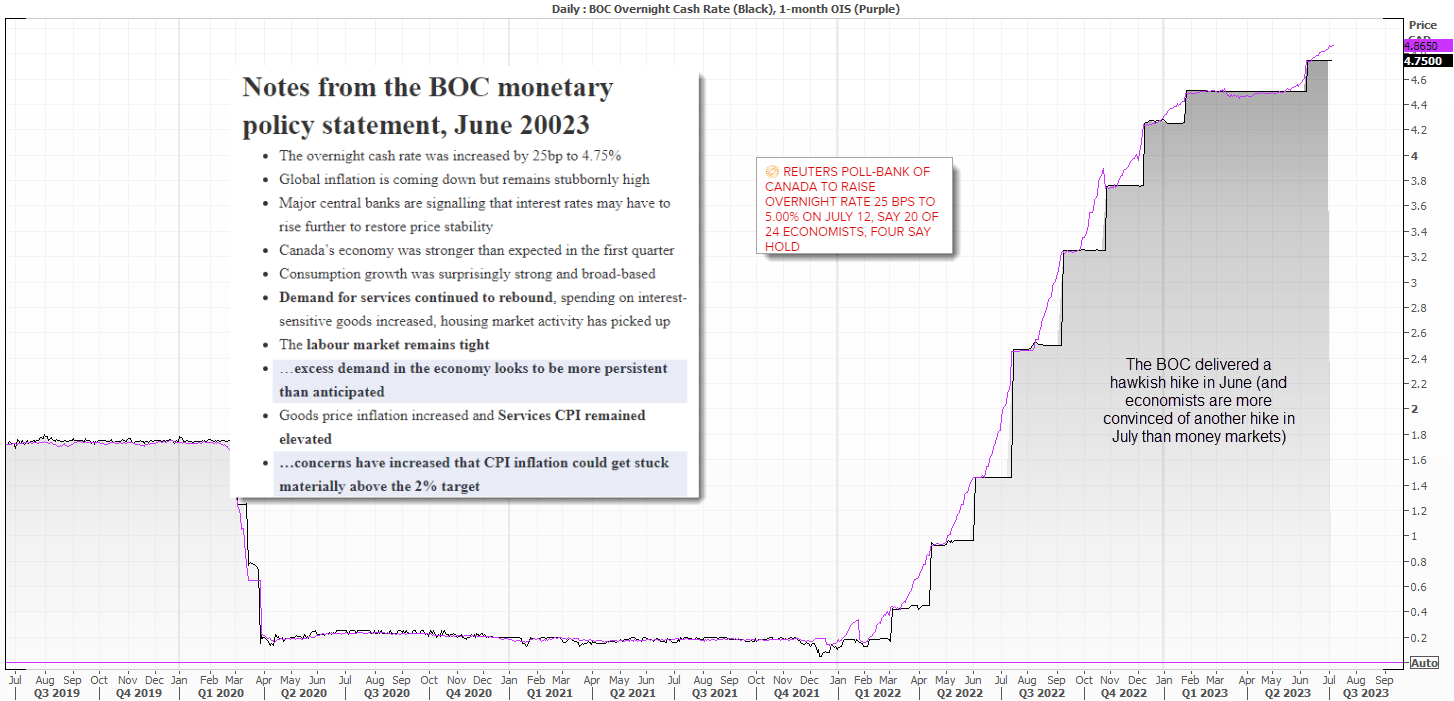
Like the RBA, the BOC also surprised markets with a 25bp hawkish hike in their June meeting. Those two decisions, alongside a 50bp hike from the BOE and warnings of another couple of hike from the Fed knocked sentiment as traders realised they had been complacent with their expectations for peak cycles.
A Reuters poll shows that 83% of economists back another 25bp hike on Wednesday and that it could be their last this cycle. Money markets seem less convinced with the 1-month OIS (overnight index swap) suggesting just a 48% chance of a hike, although the 3-month suggests an 80% chance. But with their statement explicitly saying that “excess demand in the economy looks to be more persistent than anticipated” and “concerns have increased that CPI inflation could get stuck materially above the 2% target”, we suspect a hike is more probable, even if recent inflation data did come in softer than expected. And a strong employment report later today could bolster bets that a hike is more probable than not.
Market to watch: USD/CAD, CAD/JPY, NZD/CAD,
RBNZ cash rate decisions
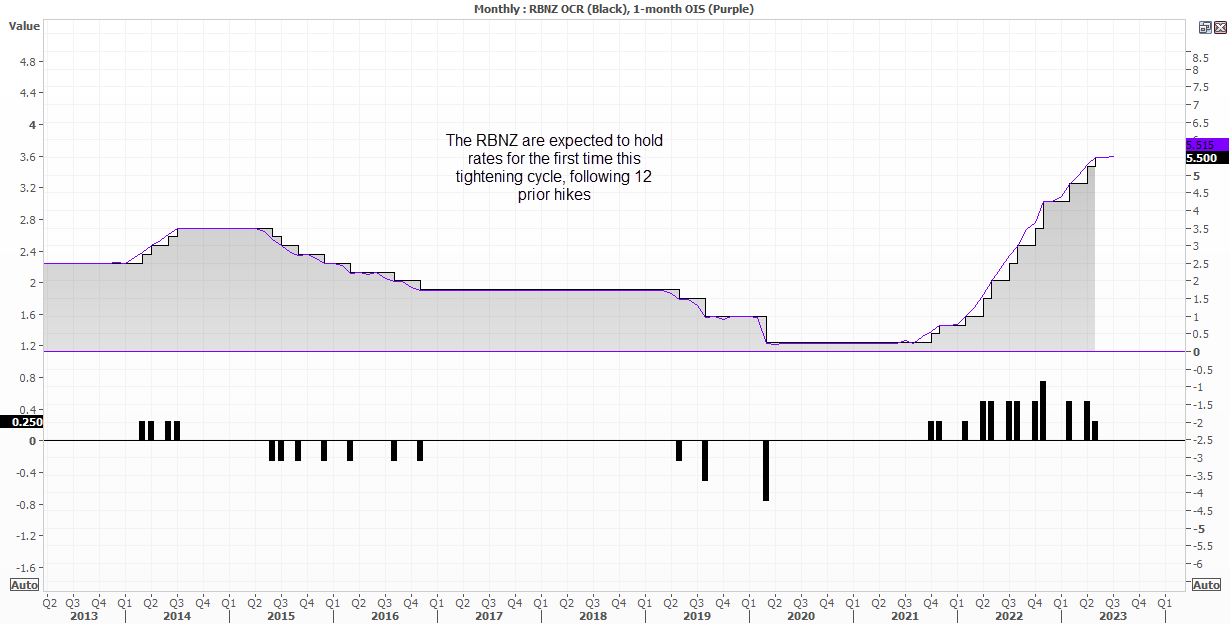
New Zealand’s central bank are my favourite central banks amongst the respective FX majors, as they do not mince their words and are not to come out swinging as and when required. They were the first major central bank to begin hiking (South Korea’s take the title for the first CB overall to begin this cycle), although expectations are for them to finally pause tightening on Wednesday. Their own forecasts pencilled in the current rate of 5.5%, inflation is expected to continue falling, demand is dwindling and NZ has since entered a technical recession. Whilst we see little room for a surprise at this meeting, we’ve learned to never drop out guard when the RBNZ is concerned – and that can prompt decent levels of volatility on NZD and AUD pairs.
Market to watch: AUD/USD, NZD/USD, AUD/NZD, NZD/JPY, AUD/JPY, ASX 200
-- Written by Matt Simpson
Follow Matt on Twitter @cLeverEdge