
FAQs
Get help with your trading account or browse answers on specific markets and products.
Popular FAQs
Account forms
About FOREX.com
FOREX.com VIP
Cash Rebates
CFDs
Charting Tools
Commodities
Demo Accounts
Forex Trading
FOREX.com Desktop Platform
FOREX.com Mobile Trading Apps
FOREX.com Web Trader Platform
Funding
Indices
Limit up/limit down
24-Hour CFD Equity Trading
Liquidation
Margin & Leverage
Market Analysis
Metals
MetaTrader
Opening an Account
Orders & Execution
Passwords and Account Settings
Performance Analytics
Pricing and Fees
RAW Pricing Account
Rollover
Security
Stocks
Trading Halts
TradingView
Withdrawals
Metals Trading FAQs
Browse this FAQ section for more information about metals trading.
With FOREX.com you can trade metals either as FX-quoted spot contracts (for gold or silver) or as expiring or non-expiring CFDs (all metals).
Spot Metals | Metals Futures CFD (Expiring) | Metals Cash CFD (Non-expiring) |
|---|---|---|
XAU/USD | Gold Futures CFD | Gold Cash CFD |
Expiring CFDs will have the current contract's month and year listed in the market name i.e. Gold (per 0.1) Jun 25 CFD
Non-expiring CFDs are designed to provide continuous exposure using futures market pricing rather than spot pricing. Prices may differ from spot market prices due to contract month pricing and market conditions.
Like options and futures, CFDs are another derivative that can be used to speculate on metals.
A CFD is a contract between a trader and a broker. CFD traders may take a position on the price moving up or downward. Traders who expect an upward movement in price will buy the CFD, while those who see the opposite downward movement will sell an opening position.
When you trade any CFD with FOREX.com, you're entering a contract to exchange the difference in price from when you open your position to when you close it. Here's an example:
- You open a long (buy) position on Gold at $3,000
- If gold rises to $3,100, you make a $100 profit (per ounce)
- If gold falls to $2,900, you'd have a $100 loss (per ounce)
The profit or loss is settled directly in your trading account after the position is closed.
They are non-expiring CFDs (also referred to as “cash CFDs”), they do not expire so you don't need to track expiry dates or roll over positions. They are often used in swing or position trading. They are subject to overnight financing fees. These products are priced using underlying futures markets, with daily position adjustments applied to reflect the relationship between the front and far contract months and market carry. Prices may differ from spot market prices due to futures pricing and interest rate effects. See How are Metals Cash CFDs priced? for more information.
They are based on specific futures contracts (i.e. gold futures), with the month and year of the tradable contract listed in the name of the instrument. They have a set expiration date, usually matching the expiry of the underlying futures contracts. On expiry, the positions are automatically closed by the broker or can be set in the order ticket to auto-roll into the next contract. They are not subject to overnight financing or daily adjustment charges. They directly reflect the pricing of the underlying futures contract.
Spot | Futures CFD (Expiring) | Cash CFD (Non-Expiring) | |
|---|---|---|---|
Pricing | Spot | Futures | Futures |
Expiration | No | Yes | No |
Rollover/Financing | Yes | No | Yes |
Daily basis adjustment | No | No | Yes |
The tick value of a CFD represents a single unit of movement, while the point value is the monetary value associated with a one-tick movement.
You can see the tick value of a market in the Dealing section of the Market Info screen. Simply log in to the Webtrading or mobile app platform > search for your desired market > select "Open Market Info" > then go to the "Dealing" section.
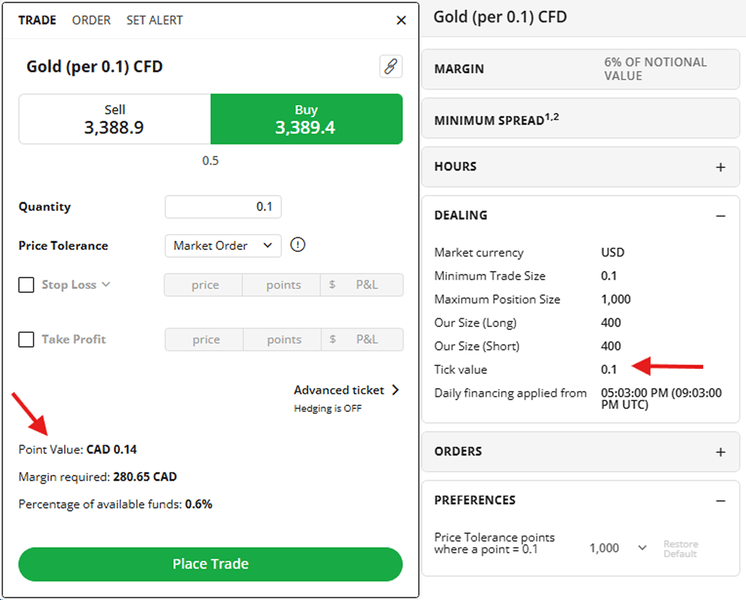
You can see the tick size of a market in the dealing ticket.
Please refer to the chart below for the contract values.
Market Name | Contract Value | Type |
|---|---|---|
Gold (per 0.1) Jun 25 CFD | 1 = 10 troy ounces | Metals CFD Monthly Futures |
Silver (per 0.5) Jul 25 CFD | 1= 200 troy ounces | |
Copper (per 0.05) Jul 25 CFD | 1 = 2000 pounds | |
Platinum (per 0.1) Jul 25 CFD | 1=10 troy ounces | |
Palladium (per 0.1) Jun 25 CFD | 1=10 troy ounces | |
Gold (per 0.1) CFD | 1 = 10 troy ounces | Metals Non-Expiring CFD |
Silver (per 0.5) CFD | 1= 200 troy ounces | |
Copper CFD | 1 = 10,000 pounds | |
Platinum CFD | 1= 1 troy ounce | |
Palladium CFD | 1= 1 troy ounce | |
XAU/USD | 1 = 1 troy ounce | Spot Metals Contract |
XAG/USD | 1 = 100 troy ounces | |
XAU/EUR | 1 = 1 troy ounce | |
XAU/JPY | 1 = 1 troy ounce | |
XAU/GBP | 1 = 1 troy ounce | |
XAU/CHF | 1 = 1 troy ounce | |
XAU/AUD | 1 = 1 troy ounce |
Currently we offer gold as XAU/USD, XAU/EUR, XAU/GBP, XAU/CHF, XAU/GBP, XAU/JPY and XAU/AUD. The symbol for spot silver is XAG/USD.
Gold and silver are available 23 hours a day from Sunday 6:00 ET through Friday 5:00 PM ET. Trading is closed daily from 5:00 PM to 6:00 PM ET; however, you may place new pending orders or edit/cancel existing pending orders during that time. Metals markets also follow CME holiday closures.
More information regarding market trading hours.
There is no expiration date when trading spot gold and silver. As long as you maintain the required margin, your position will remain open until you choose to close it. As with forex positions, open gold and silver positions automatically roll forward to the next day's value date following the close of NY trading at 5pm ET.
Margin for metals varies by market. To see current requirements, please view our Margin Requirements.
The maximum position a client may hold at any given time is 10,000 troy ounces for spot gold and 250,000 troy ounces for spot silver.
Yes, metal CFD futures have fixed monthly or quarterly expiration dates thus any position you have will close automatically when the market expires. When the market is close to expiration the next contract month will become available for you to trade.
You can view a market's expiration date in the Market 360 section inside the Web Trader platform.
Yes, but as with forex positions, rollover will be applied.
To price these non-expiring metals markets (NEM), we use two sufficiently liquid futures contracts on the underlying metal. This is usually the two with the nearest expiry date.
The contract with the closest expiry date is called the Front month contract and the second-nearest expiry date is called the Far month contract.
As the front-month contract approaches expiry, pricing gradually transitions toward the next (far-month) contract. This results in a daily price adjustment to reflect the difference between contract months. To ensure clients are not advantaged or disadvantaged by this adjustment, a corresponding credit or debit is applied to open positions. For example, if the NEM contract is adjusted by +2 points, clients with long positions will be debited 2 x stake and clients with short positions will be credited 2 x stake. See further explanation and video below.
In our video, the front month is labelled ‘A’ and the far month ‘B’.
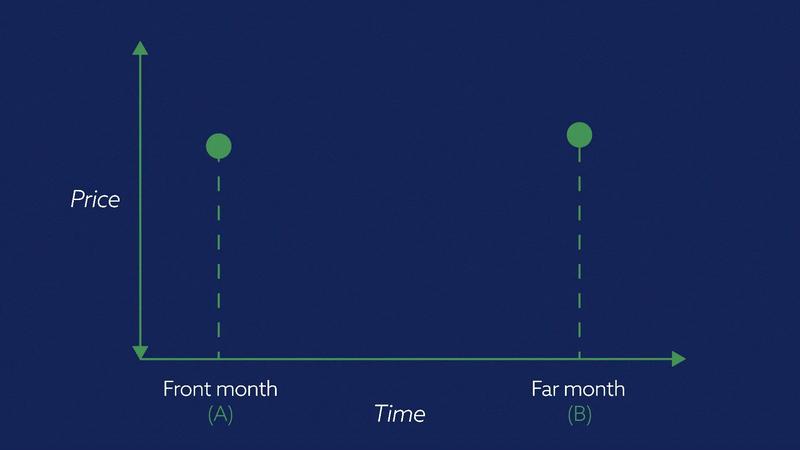
NEM contract market prices move from the price of market ‘A’ towards the price of market ‘B’ as the expiry date of ‘A’ becomes closer. The price of market ‘B’ may be higher or lower, depending on the metal, than that of market ‘A’.
Daily adjustments for NEM contract markets reflect a day’s movement from ‘A’ towards ‘B’.
In addition, a cost of carry adjustment is applied to reflect interest rates and market conditions.
This will be observed as a movement up daily (inc. weekends) during the close period of Underlying Ccy Overnight Rate * Last Price / 365. This reflects the cost of carry being paid by longs and received by shorts. This is, in essence, the cost of rolling to a new value date and explained in more detail below.
Cost of Carry Logic
A client can either buy an asset now and pay to borrow the cash for a day, or they can buy it tomorrow and pay one day’s less interest. Put another way, someone with $1000 can either buy $1000 of an asset today or receive one day's interest XX on that $1000 and buy $1000.XX of that asset tomorrow.
Both outcomes must be equal; this is the cash-futures parity. Otherwise, there is an arb, and everyone buys today and not tomorrow, or vice versa.
This is observed in Indices, where (ignoring dividends) the cash price moves up towards the future daily as the cost of carry to expiry reduces. We are applying this same logic to Cash Metals.