



2025 2H Central Bank Outlook
Major central banks may adjust their policy in the second half of 2025 as the Federal Reserve appears to be on track to reduce US interest rates.
Share this:

2025 2H Central Bank Outlook
Major central banks may adjust their policy in the second half of 2025 as the Federal Reserve appears to be on track to reduce US interest rates, while the European Central Bank (ECB) could be nearing the end of its rate-cutting cycle as ‘there was one Governing Council member who did not support the decision’ to lower the main refinancing rate to 2.15% in June.
North America
Federal Reserve
Keep in mind, the Federal Open Market Committee (FOMC) kept its benchmark interest rate at 4.25% to 4.50% in June as ‘increases in tariffs this year are likely to push up prices and weigh on economic activity,’ and the central bank may stick to the sidelines in the third quarter as the ongoing transition in fiscal policy clouds the outlook for the US economy.

Source: FOMC
However, the update to the Fed’s Summary of Economic Projections (SEP) suggests the central bank will further unwind its restrictive policy in 2025 as the ‘median participant projects that the appropriate level of the federal funds rate will be 3.9 percent at the end of this year, the same as projected in March.’
In turn, the Fed may abandon its wait-and-see approach later this year especially as the Trump administration avoids a trade war, and the US Dollar may face headwinds over the coming months on the back of expectations for lower interest rates.
Europe
European Central Bank
Meanwhile, the European Central Bank (ECB) lowered Euro Area interest rates throughout the second quarter as ‘most measures of underlying inflation suggest that inflation will settle at around our two per cent medium-term target on a sustained basis,’ and the Governing Council may pursue an accommodative policy as ‘a further escalation in global trade tensions and associated uncertainties could lower euro area growth.’
In response, the ECB may push Euro Area interest rates below neutral as ‘falling energy prices and a stronger euro could put further downward pressure on inflation,’ but little signs of a recession may lead the Governing Council to alter the course for monetary policy as the President Christine Lagarde and Co. acknowledge that ‘rising government investment in defence and infrastructure will increasingly support growth over the medium term.’
As a result, the ECB may transition to a wait-and-see approach following the rate cuts from earlier this year, and developments coming out of Europe may heighten the appeal of the Euro amid the expansion in fiscal spending.
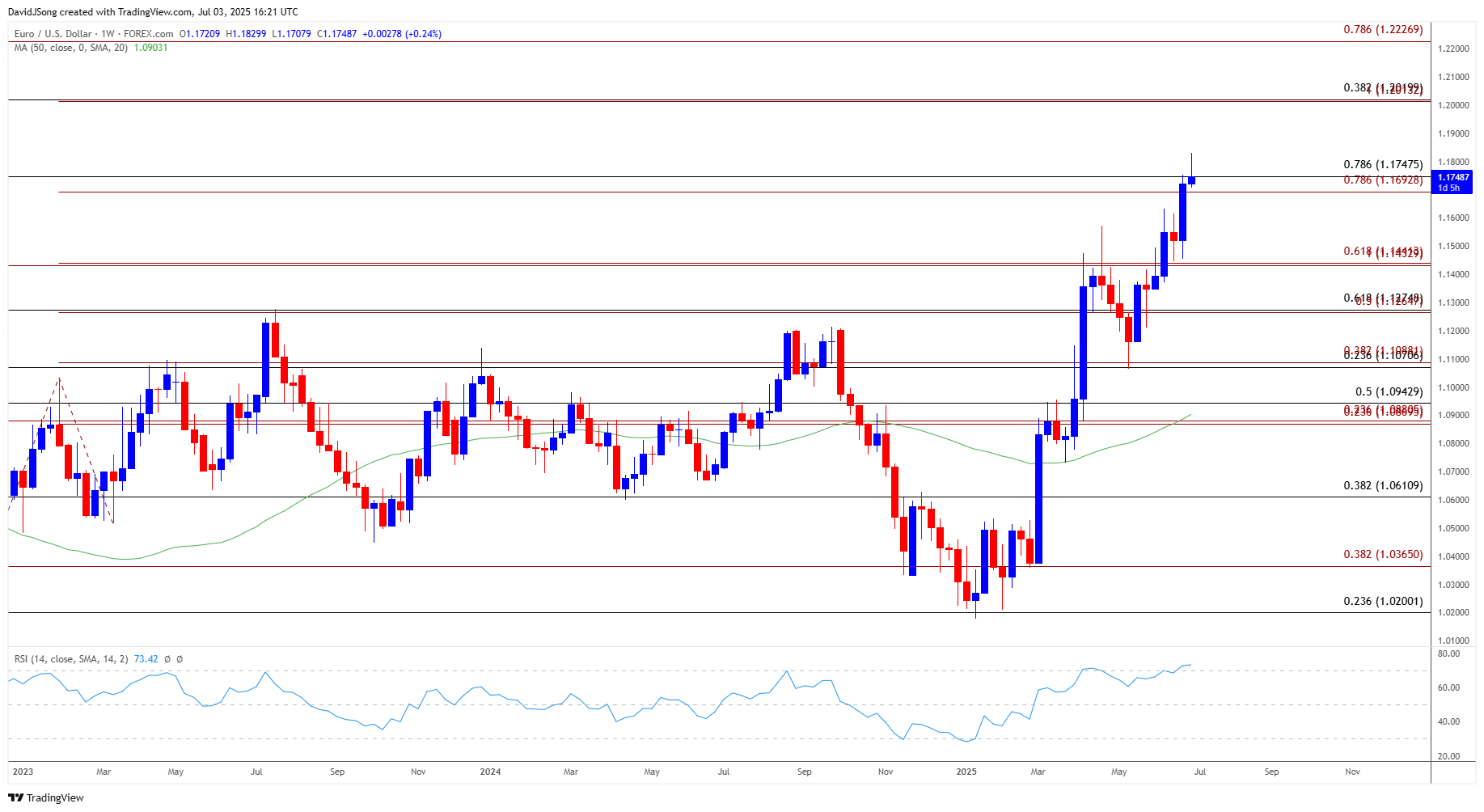
EUR/USD Weekly Chart
Source: TradingView
EUR/USD trades at its highest level since 2021 as it rallies to a fresh yearly high (1.1772) in the second quarter, with the rally in the exchange rate pushing the Relative Strength Index (RSI) on a weekly timeframe into overbought territory.
The bullish momentum may persist as long as the RSI holds above 70, and a move above the 1.1690 (78.6% Fibonacci extension) to 1.1750 (78.6% Fibonacci retracement) zone may lead to a test of the September 2021 high (1.1909).
Next area of interest comes in around 1.2010 (100% Fibonacci extension) to 1.2020 (38.2% Fibonacci retracement), but EUR/USD may face a near-term correction if it struggles to test the September 2021 high (1.1909).
Lack of momentum to hold above the 1.1690 (78.6% Fibonacci extension) to 1.1750 (78.6% Fibonacci retracement) zone may push EUR/USD back toward the 1.1430 (100% Fibonacci extension) to 1.1440 (61.8% Fibonacci extension) region, with the next area of interest coming in around 1.1270 (50% Fibonacci extension) to 1.1280 (61.8% Fibonacci retracement).
Asia/Pacific
Bank of Japan
At the same time, the Bank of Japan (BoJ) stuck to the sidelines at its last meeting in June, with the board voting unanimously to keep its benchmark interest rate at 0.50%.
Nevertheless, the BoJ announced that its purchases of Japanese government bonds (JGBs) ‘will be cut down, in principle, by about 400 billion yen each calendar quarter until January-March 2026, and by about 200 billion yen each calendar quarter from April-June 2026,’ and it seems as though the central bank is in no rush to further normalize monetary policy as ‘underlying CPI inflation is likely to be sluggish, mainly due to the deceleration in the economy.’
With that said, the BoJ looks poised to stay hold in the third quarter as Japan still negotiate a trade deal with the Trump administration, and swings in the carry trade may continue to influence the Japanese Yen as Governor Kazuo Ueda and Co. remain reluctant to implement higher interest rates.
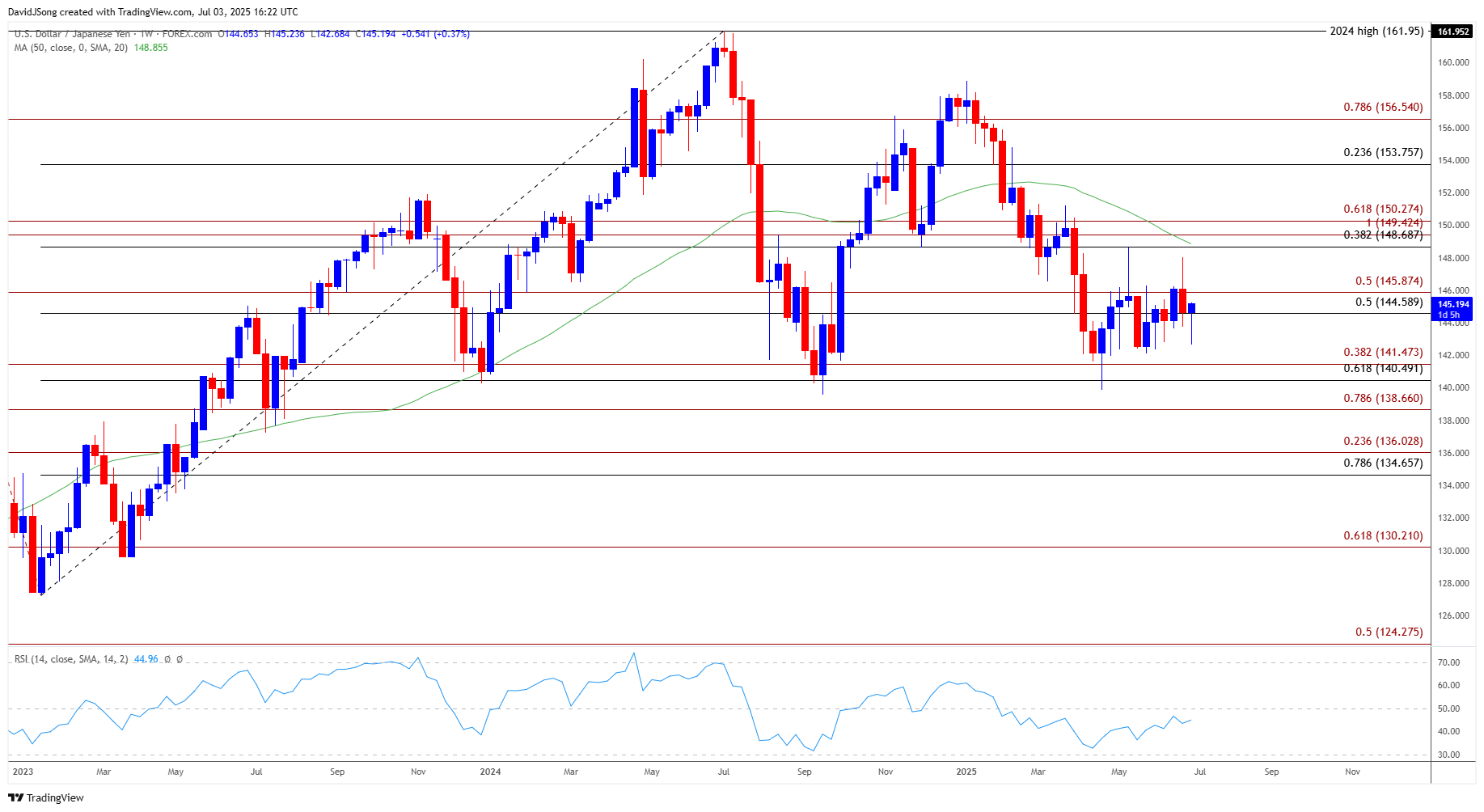
USD/JPY Weekly Chart
Source: TradingView
USD/JPY still trades within the 2024 range as it bounced back from a fresh yearly low (139.89) in April, and the exchange rate may continue to track sideways as amid the failed attempt to close below the 140.50 (61.8% Fibonacci retracement) to 141.50 (38.2% Fibonacci extension) region.
Need a move/close above the 148.70 (38.2% Fibonacci retracement) to 150.30 (61.8% Fibonacci extension) zone to bring the March high (151.31) on the radar, with the next area of interest coming in around 153.80 (23.6% Fibonacci retracement).
However, USD/JPY may no longer trade within last year’s range on a close below the 140.50 (61.8% Fibonacci retracement) to 141.50 (38.2% Fibonacci extension) region, with a move/close below 138.70 (78.6% Fibonacci extension) opening up the July 2023 low (137.24).
--- Written by David Song, Senior Strategist
Related tags:



Open an account in minutes
Experience award-winning platforms with fast and secure execution, and enjoy tight spreads from 0.5 pts on FX and 0.3 pts on indices.
Economic calendar
Web Trader platform
Our sophisticated web-based platform is packed with features.
Related articles

EUR/USD Update: Will Fed Expectations Keep Pressure on the Euro?
The week continues to present challenges for the euro's short-term strength. This is reflected in the recent performance of EUR/USD, which has declined by nearly 0.6% over the last three trading sessions


USD/JPY Analysis: Is the Yen Still Weak Despite the BOJ Rate Hike?
The Japanese yen continues to face challenging conditions in the short term. By the end of the week, USD/JPY had gained nearly 2.00% over the previous five trading sessions, highlighting ongoing weakness in the yen and showing that the U.S. dollar continues to gain ground.

BOJ split vote fuels yen weakness and Nikkei gains
A divided BOJ hike has left the yen under pressure and Nikkei bid, with Ueda now needing to convince markets that another two-and-a-half hikes by mid-2027 are justified.

This report is intended for general circulation only. It should not be construed as a recommendation, or an offer (or solicitation of an offer) to buy or sell any financial products. The information provided does not take into account your specific investment objectives, financial situation or particular needs. Before you act on any recommendation that may be contained in this report, independent advice ought to be sought from a financial adviser regarding the suitability of the investment product, taking into account your specific investment objectives, financial situation or particular needs.
StoneX Financial Pte. Ltd., may distribute reports produced by its respective foreign entities or affiliates within the StoneX group of companies or third parties pursuant to an arrangement under Regulation 32C of the Financial Advisers Regulations. Where the report is distributed to a person in Singapore who is not an accredited investor, expert investor or an institutional investor (as defined in the Securities Futures Act), StoneX Financial Pte. Ltd. accepts legal responsibility to such persons for the contents of the report only to the extent required by law. Singapore recipients should contact StoneX Financial Pte. Ltd. at 6826 9988 for matters arising from, or in connection with the report.
In the case of all other recipients of this report, to the extent permitted by applicable laws and regulations neither StoneX Financial Pte. Ltd. nor its associated companies will be responsible or liable for any loss or damage incurred arising out of, or in connection with, any use of the information contained in this report and all such liability is hereby expressly disclaimed. No representation or warranty is made, express or implied, that the content of this report is complete or accurate.
StoneX Financial Pte. Ltd. is not under any obligation to update this report.
Trading CFDs carries a high level of risk that may not be suitable for some investors. Consider your investment objectives, level of experience, financial resources, risk appetite and other relevant circumstances carefully. The possibility exists that you could lose some or all of your investments, including your initial deposits. If in doubt, please seek independent expert advice. Visit www.forex.com/en-sg/terms-and-policies for the complete Risk Disclosure Statement.