

WTI crude has accumulated four consecutive sessions of declines, with a short-term depreciation of more than 6%. Selling pressure remains firm, partly due to optimism surrounding a potential peace agreement between Russia and Ukraine, which could lead to the removal of key economic sanctions and allow a larger flow of Russian crude back into the market. This scenario has generated persistent weakness in oil prices in recent sessions, driven by the risk of a global supply surplus. Therefore, if optimism around peace negotiations continues, selling pressure on WTI is likely to remain dominant in the sessions ahead.

Is a Peace Agreement Approaching?
The market has reacted positively to recent progress in negotiations between Russia and Ukraine, following remarks from Trump in previous days stating that the agreement is “closer than ever,” referencing constructive dialogue based on security guarantees for Ukraine. Currently, about 90% of the key points have already been discussed among Ukraine, the European Union, and the United States. Only Russia’s official approval remains to move toward a structured agreement that could enable a short-term ceasefire.
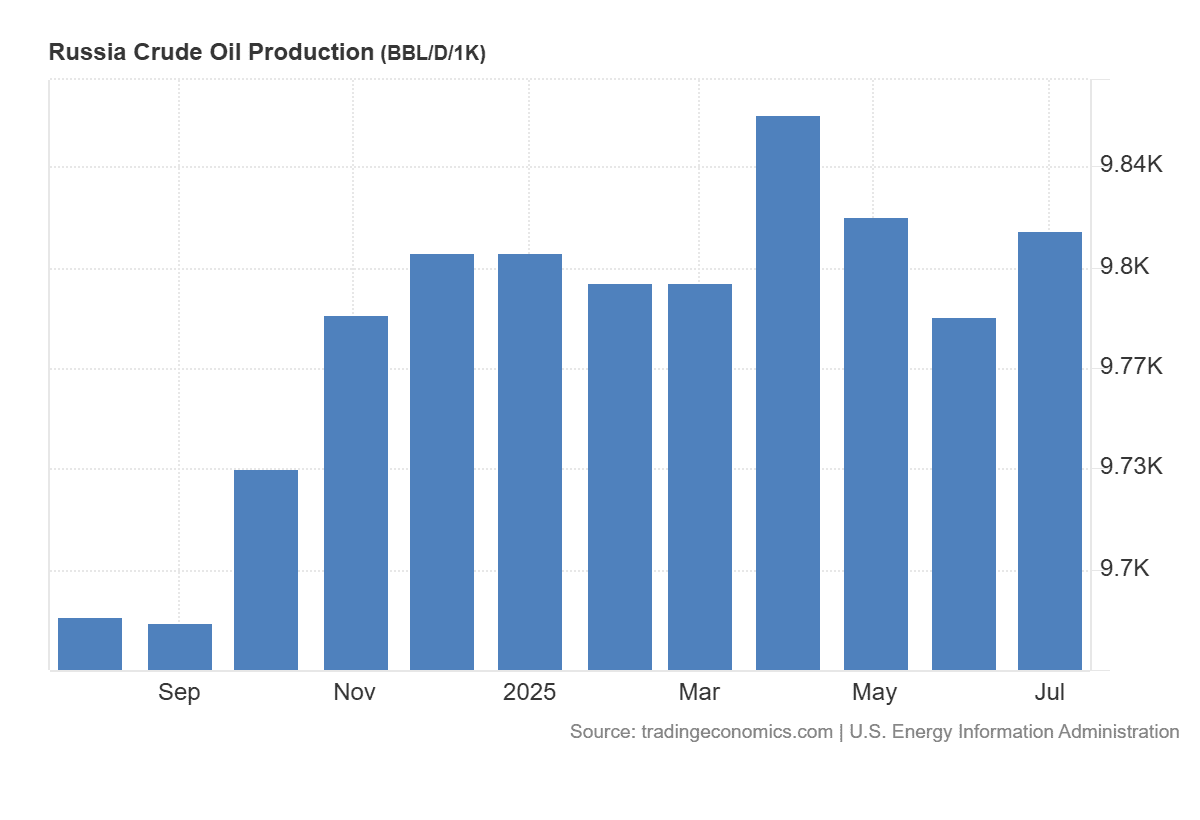
Recent announcements point to significant progress, which could open the door to lifting economic sanctions imposed by the United States and the European Union on the commercialization of Russian crude. It is important to recall that, according to recent data, Russia maintained output close to 9.8 million barrels per day as of July, placing it among the three largest oil producers in the world.
Source: TradingEconomics
With this in mind, it should be noted that crude oil’s structural weakness in recent months has stemmed from fears of a potential global oversupply, driven partly by OPEC+ announcements signaling their intention to gradually increase production. In this context, if sanctions on Russia are lifted as a result of a peace agreement, the return of its crude supply—partially restricted until now—could add a significant number of barrels to the market, reinforcing concerns about an oversupply scenario.
A larger supply, combined with a demand that has yet to show signs of solid recovery, could continue to push prices lower in the short term. This scenario is already affecting WTI, which is once again trading near the lowest levels of 2025. If a peace agreement materializes and implies an additional increase in global supply, WTI’s weakness may persist or even intensify. As long as this outlook for rising supply remains in place, selling pressure is likely to dominate in the coming sessions.
WTI Technical Outlook

Source: StoneX, Tradingview
- Downtrend Remains Dominant: Since mid-June, WTI has maintained a consistent bearish trendline that has pushed the price back toward the 2025 lows. If selling pressure continues, this trend may strengthen in the final weeks of the year. However, the proximity to the 2025 low could also allow space for short-term bullish corrections, particularly if the market perceives a temporary excess of selling pressure.
- RSI: The RSI line continues trending downward below the neutral 50 level, confirming the dominance of bearish momentum over the past 14 sessions. However, the indicator is nearing oversold territory (30), which may signal an imbalance of forces due to excessive selling. This could create room for short-term bullish corrections in the upcoming sessions.
- MACD: The MACD histogram continues to oscillate below the zero line, indicating that the average strength of short-term moving averages is aligned with a dominant bearish bias. If the MACD continues to decline, selling pressure could strengthen further in the near term.
Key Levels:
- 60 USD – Relevant resistance: This level corresponds to the confluence of the 50-period moving average and the bearish trendline. A sustained breakout above this zone would put the dominant trend at risk and could activate a stronger bullish bias toward year-end.
- 57 USD – Nearby barrier: A recent neutrality zone that has acted as short-term resistance in recent weeks. This level could serve as a key barrier in the event of bullish corrections in the short term.
- 55 USD – Key support: This level marks the 2025 lows and is currently the most important support zone for bearish movements. Price action sustained below this area would reinforce a consistent selling bias, extending the ongoing bearish trend into the coming weeks.
Written by Julian Pineda, CFA, CMT – Market Analyst
Follow him at: @julianpineda25