
The big drop in Chinese markets overnight caused commodity dollars to extend their falls, although the likes of the EUR/USD and GBP/USD were largely unaffected. Major European indices fell but found supported shortly after the European open. US index futures also recovered from their overnight lows. With not much on the economic calendar today, expect the dollar to remain largely in a holding pattern but with a slight hawkish tilt. This is because of ongoing Middle East tensions and following Friday’s blowout US jobs report which triggered a hawkish shift in rate expectations. In the near term, there doesn’t seem to be much to drive a significant US dollar sell-off, aside from a potential de-escalation in the Middle East. Markets have largely given up on the idea of a 50bp cut, and this week’s US inflation data probably won’t change that. In the eurozone, while German industrial data showed a surprise month-on-month rise of 2.9%, this is highly unlikely to stop the ECB from cutting rates by 25 basis points next week. As a result, the EUR/USD forecast remains modestly bearish.

EUR/USD forecast has turned moderately bearish
While the US dollar has surged since those hawkish remarks from Powell last week and the rather strong nonfarm payrolls report, we have seen more dovish signals emerge from other major central banks, including the ECB, BoE and BoJ. With Chinese markets starting the week on the backfoot, this is an additional factor that could negative impact the EUR/USD forecast.
In as far as the US dollar is concerned, well the markets are now fully aligned with Fed Chair Jerome Powell’s resistance to 50bp cuts and are now pricing in 25bp cuts in both November and December. Any shift in the EUR/USD forecast is unlikely before late October when new jobs and activity data are released, unless the ECB surprises next week.
The next key US data is release on Thursday when we will have the latest CPI estimate. The PPI measure of inflation will be published on Friday. Together, these inflation figures aren’t expected to alter the Fed’s stance or the dollar’s strength significantly, unless there’s a major surprise. September’s core CPI is projected to drop to 0.2% month-on-month, down from August’s 0.3% increase. Even if the reading comes in at 0.1%, it’s unlikely to shift attention from the labour market. With the Fed now focused on its employment mandate, any unexpected inflation data should only create minor dollar volatility, leaving the EUR/USD forecast relatively steady.
Geopolitics: Middle East concerns remain high
While tensions in the Middle East may not escalate further, a meaningful de-escalation appears unlikely, which means oil prices could remain elevated, even if they have fallen today along with Chinese markets today. This should keep the pressure on the euro.
US presidential election race on EUR/USD forecast
Additionally, with the US presidential election just around the corner, defensive positioning should favour the dollar more than the euro. The polls are very close, suggesting a tight race. Kamala Harris has taken a narrow lead of 49% vs. 46% over Trump in the race for the White House, according to the latest New York Times/Siena College poll, which was conducted between 29 September and 6 October. Separately, a Reuters/Ipsos poll finds Harris' lead over Trump narrowing to 46% vs 43%.
Meanwhile, odds on a presidential election blockchain-based betting platform Polymarket, shifted majorly in Trump’s favour on Monday. If this means Trump’s chances of winning has increased, this is likely to be a negative influence on the EUR/USD forecast (click to read more).
EUR/USD technical analysis
 Source: TradingView.com
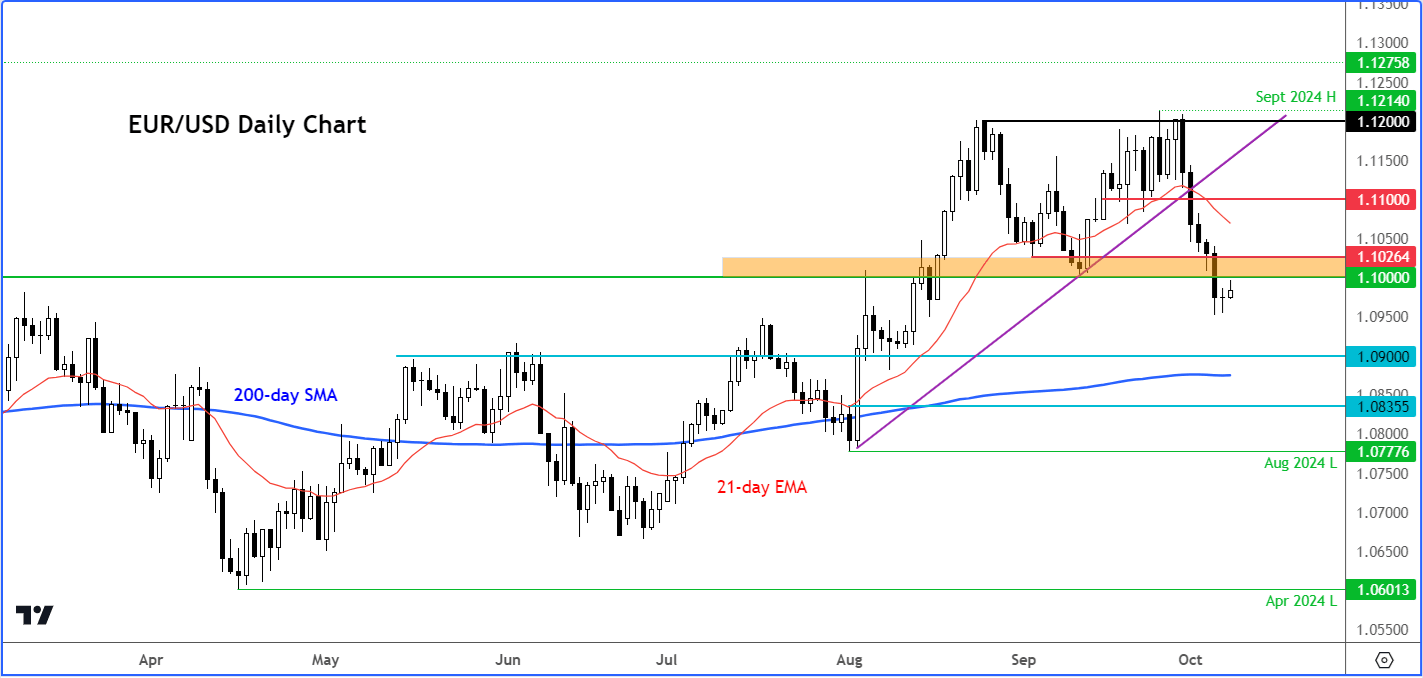
Last week saw the EUR/USD break a support area between 1.1000 to 1.1025. It has therefore created an interim lower low, suggesting that the technical EUR/USD forecast has turned bearish. Unless we go back above this area, the path of least resistance remains to the downside despite the small uptick in rates so far this week. The next key support level to watch is around 1.0900, followed by the 200-day average around 1.0875.
-- Written by Fawad Razaqzada, Market Analyst
Follow Fawad on Twitter @Trader_F_R