
Although the EUR/USD has been quite range-bound over the past several weeks and fell about 3% in July, the underlying trend remains bullish while it holds above the key 1.1500 support level. We reckon the pair is headed towards 1.20s in the coming months as the Fed starts to cut rates. The big caveat is if US inflation proves to be too hot in the coming month, preventing the Fed from delivering multiple rate cuts as the market is pricing. But as things stand, our EUR/USD outlook remains bullish.
EUR/USD outlook: Euro remains a strong currency
In recent years, we have seen a big rally in European stock markets, finally moving somewhat similar to the gains evidenced on Wall Street. It looks like the mood among global investors have shifted positively towards the Eurozone. Overseas buying of European assets have soared, underscoring appetite for European stocks, which therefore increases demand for the euro as a by-product. The ECB’s Balance of Payments figures show solid foreign appetite, with overseas buyers snapping up some €236 billion worth of eurozone debt and equities in just May and June alone. The figure is only set to rise with Germany expected to ramp up government spending aimed at boosted the eurozone’s largest economy.
Though one more ECB rate cut is expected this year, this probably won’t be enough to send the single currency tumbling. If anything, the ECB is probably ore closer to reaching the so-called neutral rate, and it is the Fed that needs to catch up with policy loosening. As the Fed potential cuts more than the ECB, this should narrow the yield differential between US and Eurozone debt, providing a positive backdrop for the EUR/USD outlook.
The only major risk I can think of right now to a bullish euro story is if the conflict in the Ukraine-Russia war deteriorates, leading to more sanctions on Russia and resulting in significantly higher energy prices again like we saw at the start of the conflict. However, as all sides seem to be pushing for a peace process, this is reducing the risks of such as an event.
Powell could give markets the signals they are waiting for
This week, it is all about the Jackson Hole Symposium. Expectations are leaning towards a neutral-to-dovish dollar story from Powell’s speech scheduled for Friday. I can’t imagine Powell brushing off those heavily revised payroll figures, especially with consumer confidence falling. It is also likely that the potentially tariff-driven spike in consumer inflation will prove to be more modest and short-lived than feared. The question, is this how the Fed sees inflation, and more important the chairman himself? If Powell blinks, then we could see 25bp cuts in September, and potentially a couple more in October and December. This scenario should be positive for the EUR/USD outlook. However, if Powell again turns out to be more hawkish than expected, then we could see a renewed bout of dollar buying.
Technical EUR/USD outlook: Key levels to watch
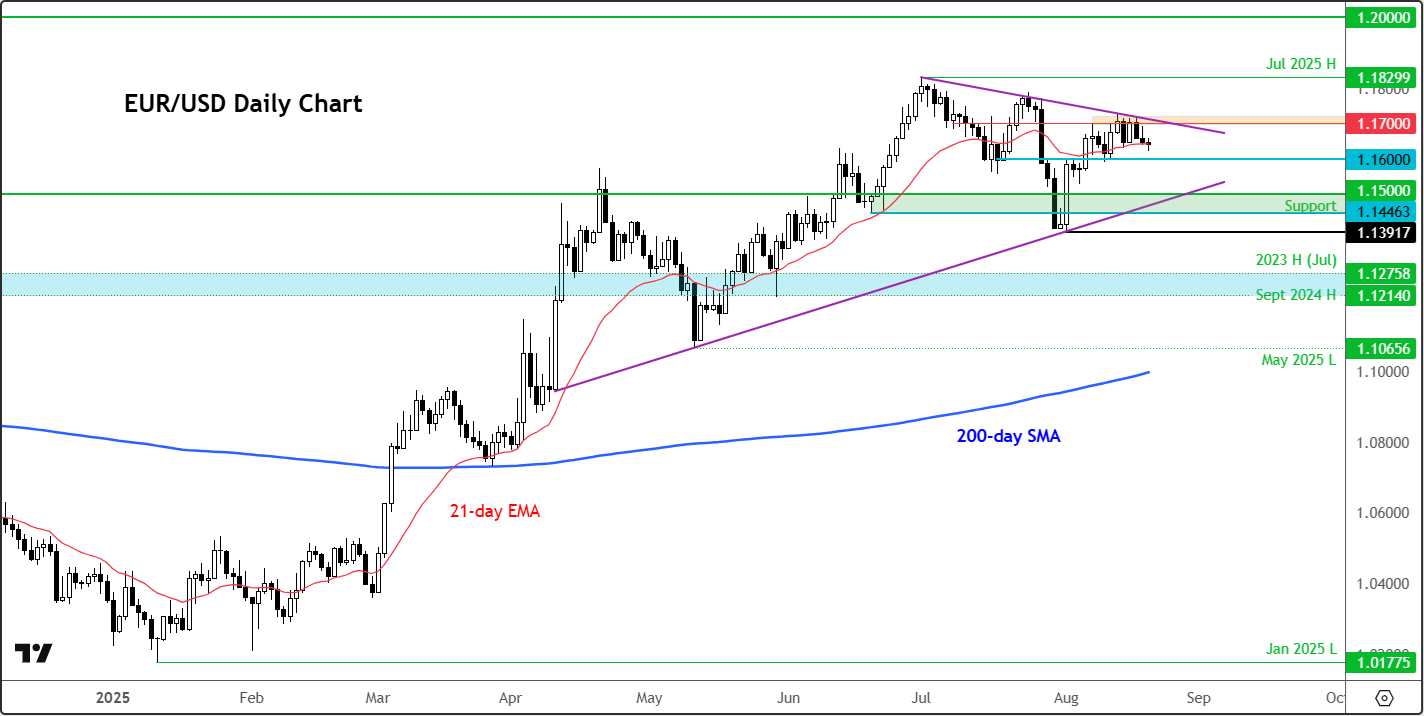
The ongoing consolidation in the EUR/USD chart should not be taken as a sign of weakness. That’s because most of the consolidation is taking place near the resistance trend of the triangle pattern, with the EUR/USD holding its own near the 21-day exponential average. Support comes in around 1.1600 and then 1.1500, which is now the most important area in as far the near-term technical EUR/USD outlook is concerned. On the upside, 1.1700 has been a tough nut to crack. Should it eventually break then this could pave the way for a potential continuation to the July high of 1.1830 and thus paving the way towards 1.20.
-- Written by Fawad Razaqzada, Market Analyst
Follow Fawad on Twitter @Trader_F_R