

Euro Grind Continues
President Trump has not been shy about what he wants: A weaker US Dollar to help American corporates, and this is something that also supports the tariffs that he’s continued to talk up and inject into the headlines whenever he’s wanted a shot of USD weakness. This weekend was very much on that tune as he waited until after markets were closed to announce the idea of more European tariffs because of the Greenland saga, and when markets opened on Sunday the USD sell-off took back over.
This isn’t a new thing, by the way, as it was just about a year ago that Trump initially began to steer the tariff cannon across the Atlantic. It was the first weekend in February, just a couple weeks after his inauguration, when he announced intent to levy reciprocal tariffs on Europe. At the time, the Dollar was still holding near highs following a blistering Q4 rally, a run which took place even as the Fed was cutting rates. Markets seemed unsure how to incorporate the news as there was both the probability of Trump walking it back and the prospect of bidding a Euro into a rather weak economic backdrop for the Euro-zone.
But, that initial gasp of USD-strength and EUR/USD weakness in the first weekly open of February last year saw an important inflection point get set, with EUR/USD showing a higher-low just above the 1.0200 handle, which ultimately helped to set the low for 2025.
The rest of February brought the build of an ascending triangle formation as buyers weren’t able to take out the 1.0500 level, but that happened in March as economic data began to show weakness in the US with a lot of fear driven by the prospect of economic slowing from tariffs. EUR/USD then broke out in a big way in a rally that lasted for the rest of H1, 2025. But as soon as the door opened into the second-half of the year, matters began to shift.
EUR/USD Weekly Chart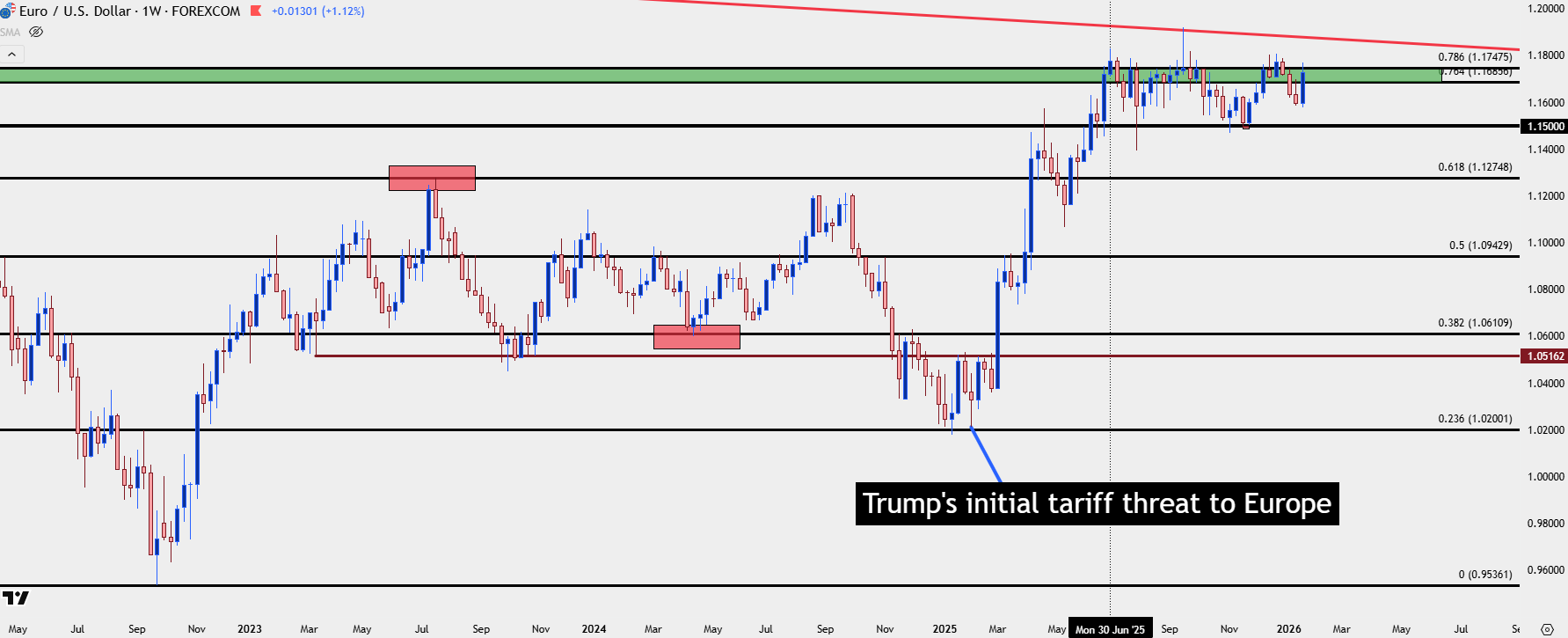
Chart prepared by James Stanley; data derived from Tradingview

EUR/USD: Divergence and Deduction
After setting that swing high on the first day of Q3 trade EUR/USD bulls started to spin their wheels, and the USD-weakness that could not continue wasn’t exactly unsupported by President Trump.
At that point, it was the Fed Chair nomination that Trump seemingly had in his back pocket to try to talk the Dollar lower, with the relationship being expectation of a more-dovish Fed Chair bringing with it the expectation for more rate cuts which could support the thesis of a weaker USD. The only problem is that the Dollar couldn’t really weaken all that much more as buyers continued to show up at support, but Q3 is when the narrative began to shift into a more supportive backdrop for rate cuts, helped along by the August 1st NFP release that saw a massive revision to prior months’ data.
It was just a couple days earlier that Jerome Powell said that he didn’t feel the market was in dire need of a rate cut as employment remained strong, as the unemployment rate held near ‘full employment’ levels, and inflation was still well-above the Fed’s target. But given the combined force of Trump’s push and the revision to jobs data, markets geared in for the Fed to finally start 2025 rate cuts at their next meeting in September.
It was Jerome Powell’s speech at Jackson Hole that showed a different tune and the breakout in gold in that aftermath was intense in a rally that still hasn’t really stopped. But in EUR/USD, the effect was largely muted as the rate cut announcement brought another show from EUR/USD bears and USD bulls that disallowed for trend continuation, and since then, the USD has been biased in a bullish manner as can be seen from the upward-sloping trendline on the below chart.
USD Daily Chart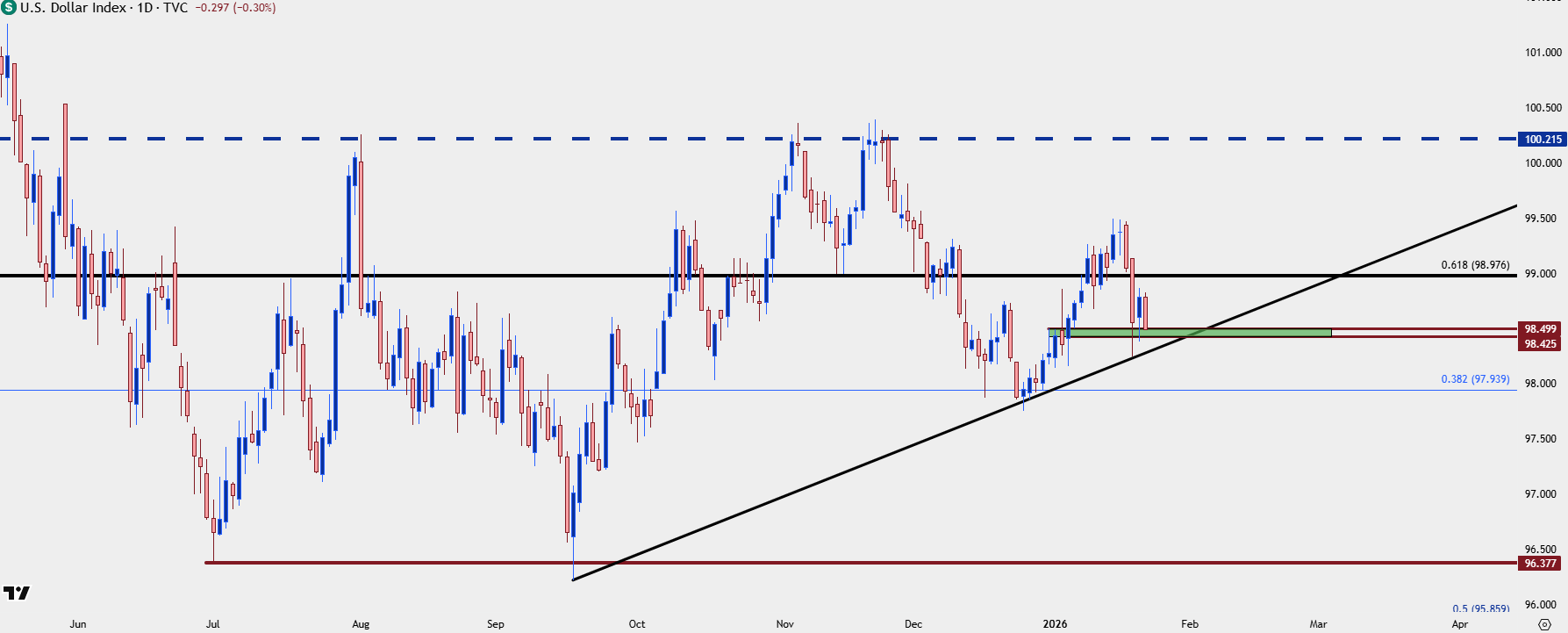
Chart prepared by James Stanley; data derived from Tradingview
EUR/USD Daily
EUR/USD price action has shown a similar dynamic, with both lower-highs and higher-lows posting over the past five months. Symmetrical triangles normally come along with no directional bias, but given the prior bullish trend that had shown here, this could be construed as a bull pennant formation, which would offer a topside bias towards possible resolution.
The challenge at that point and this is something that I think has already come into the equation in one way or another, is the fact that higher spot prices in the EUR/USD pair become more challenge with the prospect of the 1.2000 psychological level; and there’s not exactly a strong backdrop of European growth and inflation to support a significantly higher spot price.
So, for this to breakout it seems we’ll need to see either one of two scenarios: Either rapid improvement in European economic growth or deterioration in US economic conditions.
EUR/USD Daily Price Chart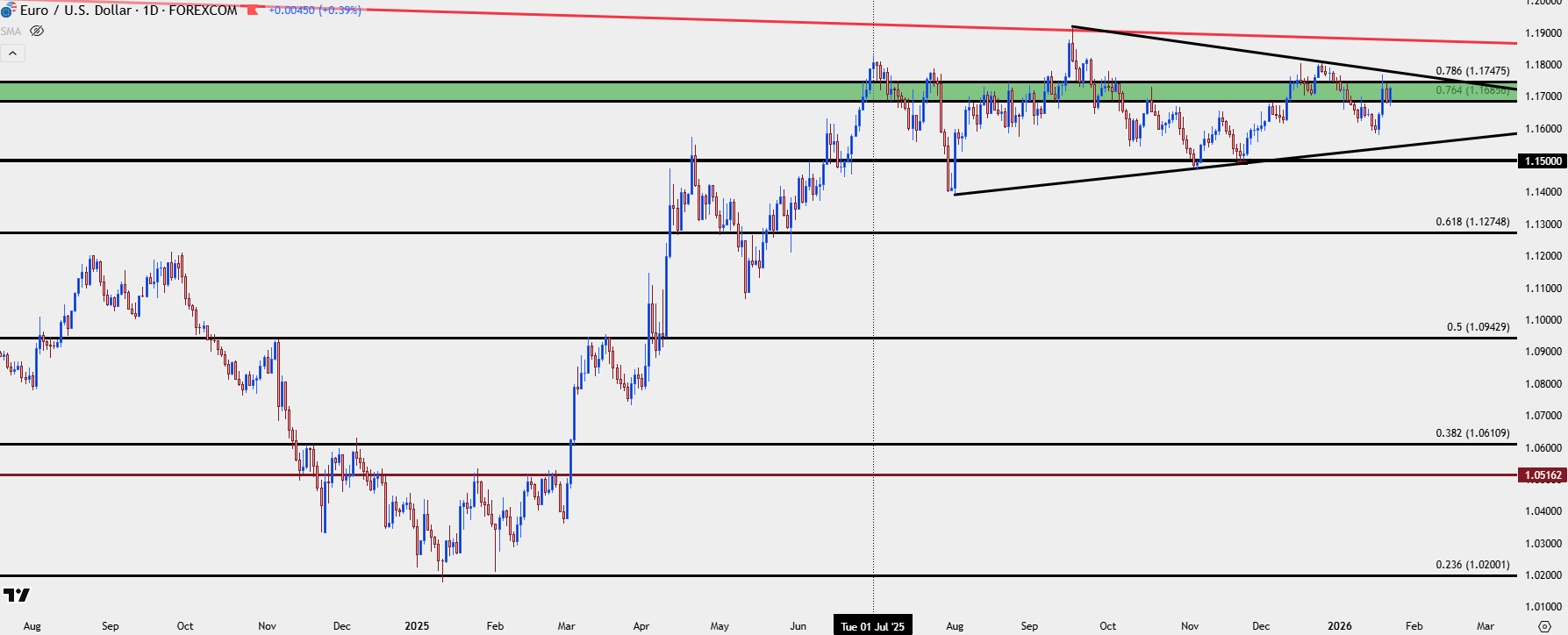
Chart prepared by James Stanley; data derived from Tradingview
Price Leads, Narrative Follows
Just as we saw last year when there were parity calls for the pair practically everywhere, by the time the headlines get locked in on an a theme it already may be too late. What’s perhaps more important is price movement and at this point, that can be approached in two very different ways.
Traders can either wait for resolution of the longer-term digestion pattern or work with short-term trends in anticipation of an eventual breakout, in one direction or the other.
I looked at this in-depth on the Tuesday webinar and I had also looked at it in last Friday’s video, highlighting EUR/USD stalling and holding at a significant spot of support as taken from a short-term Fibonacci level.
The 1.1593 level has so far proven important and this is a retracement that’s related to the 1.1492 swing that helped to hold the lows back in late-November. As shown in the Tuesday webinar the Monday and Tuesday rally has broken the short-term downtrend, opening the door for bullish biases that so far have continued to hold, with this morning showing a higher-low so far. This sets up for a test of the longer-term Fibonacci level at 1.1748 after which the three-month-high at 1.1804 comes into play. And then above that, it’s all about the 1.1900 figure which is, of course, followed by the 1.2000 psychological level.
As to how far the rally can run we’re probably going to need data to support that thesis although it should not be of surprise if President Trump takes another shot at the matter over the weekend.
EUR/USD Daily Price Chart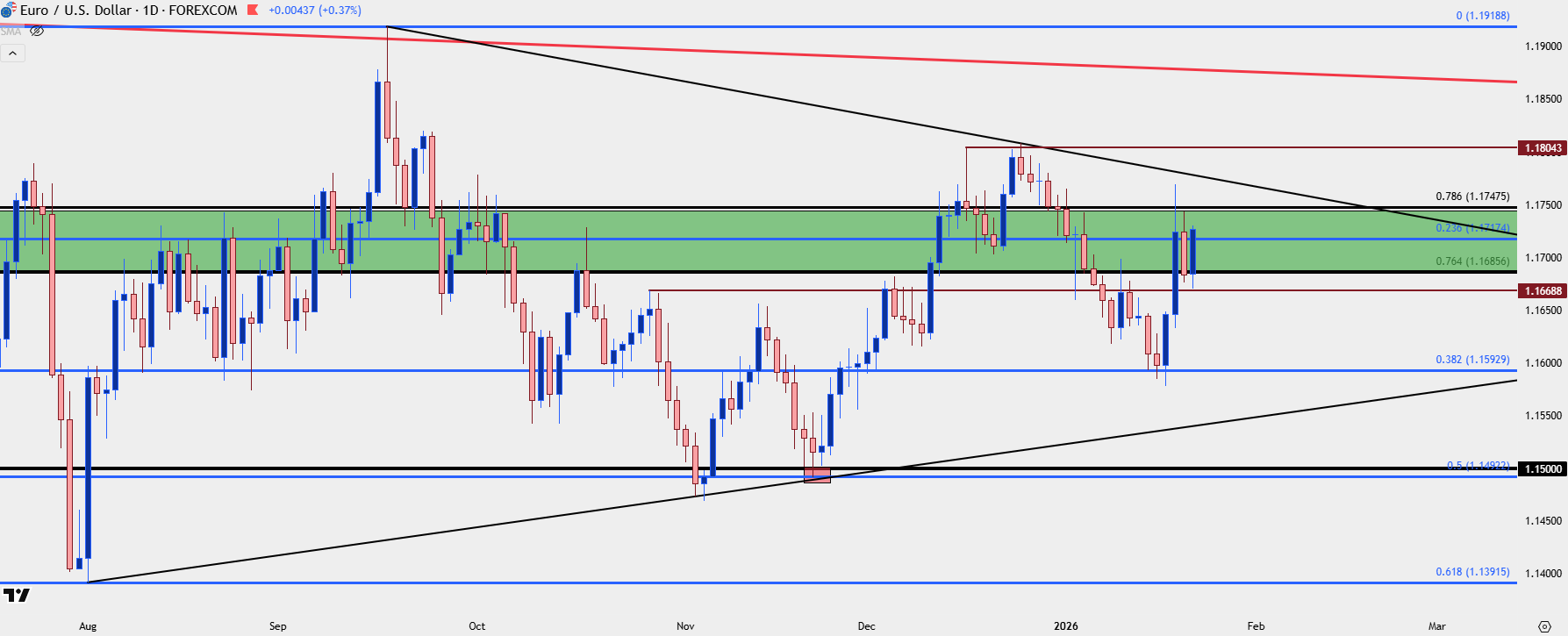
Chart prepared by James Stanley; data derived from Tradingview
--- written by James Stanley, Senior Market Analyst, Global Macro