
Key Events
- The weekend witnessed strikes on key oil facilities in Tehran, alongside reduced oil output from major GCC producers including the UAE, Saudi Arabia, and Iraq. To complicate matters further, desalination facilities across the Middle East region were also targeted.
- Crude prices jumped above $100 at Monday’s open, while the Nasdaq touched a five-month low near 23,900, amplifying cautious market sentiment and reinforcing rate-hold expectations.
The shift from US–Israel–Iran friction over a nuclear deal toward a full-blown regional war transformed crude’s bearish consolidation into a steep bullish breakout. Prices are now up over 50% as we enter the second week of the war, surging near $120 per barrel, levels last seen during the Russia-Ukraine invasion.
Previously, markets were pricing supply concerns that did not materially align with expectations. This time, disruptions appear more tangible. Iraq recently announced a reduction of 3 million barrels in output, with additional cuts from the UAE and Saudi Arabia to adjust to storage constraints following the Strait closure.

With material supply disruptions meeting and exceeding expectations, the surge has the potential to climb above 2022 peaks, with targets near $130 and $150 respectively. This would intensify pressure on energy-dependent markets and further complicate central bank rate decisions, amplifying bearish setups on US indices as sentiment remains firmly in the fear zone.
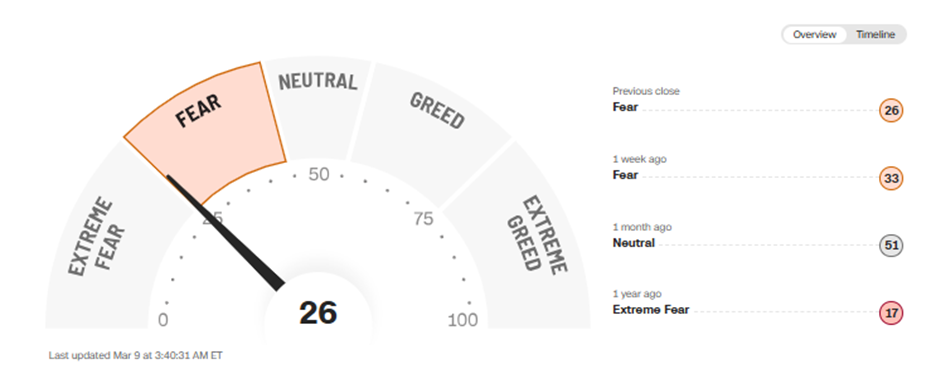
CNN Fear and Greed Indicator
Source: CNN
According to the CNN Fear and Greed Index, sentiment is in the fear zone, echoing April 2025 market conditions across US indices, not necessarily oil, as the war intensifies and prolongs, with key energy infrastructure damaged and resolutions still out of sight.
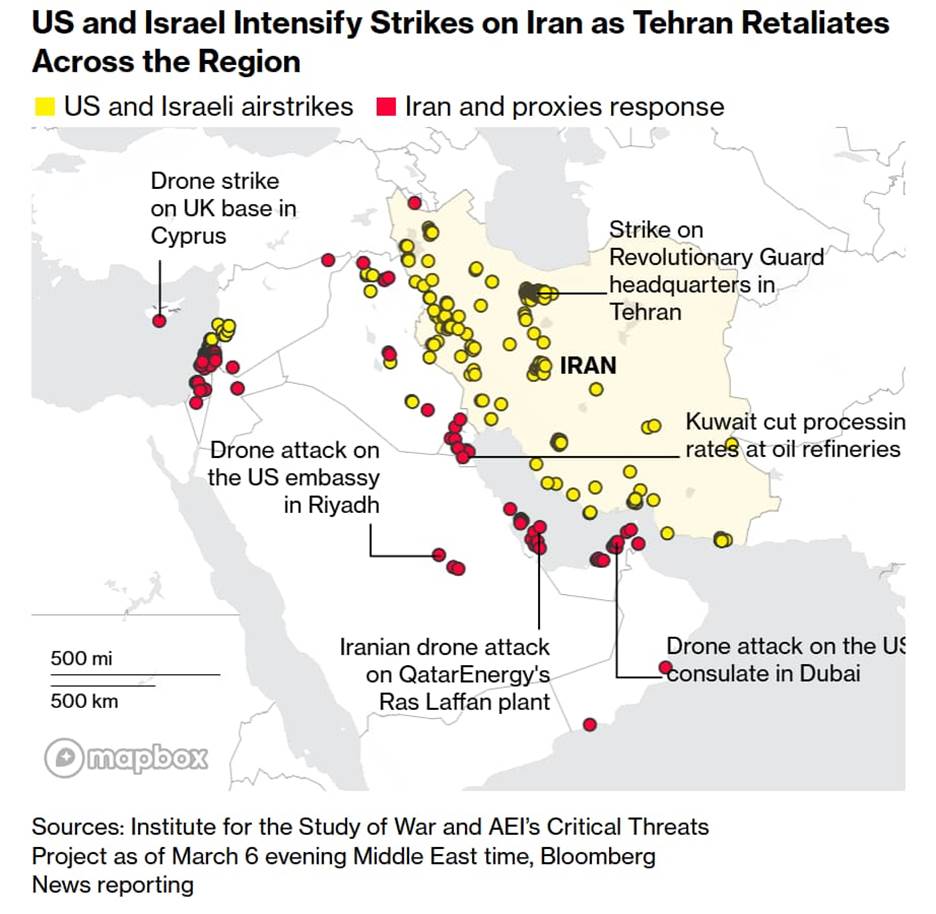
Below is a snapshot of key sites targeted since the beginning of the war, now entering its tenth day, including embassies, military bases, oil facilities, ports, and airports.
Source: Bloomberg
Naturally, this escalation reversed 2026 gains across Middle East indices, including the UAE MSCI and the TASI, while spillover risks extend into Asian markets, with the Nikkei down over 10% in the last two weeks and the KOSPI over 15%.
As for US markets, the Dow Jones is down over 4% and the Nasdaq 2% as we enter the second week of the war.
Crude Oil Outlook: 2 Week Time Frame – Log Scale

Source: Trading view
After closing near 2023 highs on Friday at $91 per barrel, the weekend’s intensified strikes on oil facilities and supply reduction announcements boosted prices toward the 2022 peaks near $119 per barrel, with overbought momentum reaching levels last seen in 2022.
This steep price action raises short-term consolidation risks below the $115 mark, with key support levels at $97, $91, and $85 respectively.
On the upside, a close above $115 exposes $130 and $150, the 0.786 and 100% Fibonacci extension ratios of the uptrend between the 2020 lows, 2022 highs, and 2026 lows. The $115 level aligns with the golden 0.618 retracement.
Crude’s price action will likely determine the magnitude of pressure across global currencies and indices, particularly in terms of inflation expectations, as the conflict either extends or begins to de-escalate.
Nasdaq Outlook: Weekly Outlook – Log Scale

Source: Trading view
Nasdaq’s consolidation below the October 2025 highs elevated distribution risks at the start of the year, especially with the absence of a Santa rally. This amplified a broader bearish setup driven initially by AI-related concerns (phase one of the drawdown), now compounded by the Middle East conflict.
Price action risks developing into a double-top structure similar to the December 2024 – February 2025 resistance zone. A weekly close below 23,900 exposes a deeper drawdown toward that prior double-top resistance area, with key levels at 23,700, 23,400, 22,300, and 22,200 respectively — potentially setting the stage for another long-term dip-buying opportunity.
On the upside, a close back above 24,600, 25,200, and 25,800 would revive bullish expectations toward the 27,000 threshold.
Written by Razan Hilal, CMT
Follow on X: @Rh_waves