

As November comes to an end, a growing weakness in the U.S. dollar has begun to emerge, allowing the Japanese yen to regain ground in the short term. Over the past five trading sessions, the pair has depreciated by nearly 0.8% in favor of the yen, approaching levels not seen since mid-November. Selling pressure has held firm due to a weaker dollar driven by expectations of lower interest rates from the Federal Reserve. If this scenario continues, the yen could keep strengthening consistently, generating a more pronounced selling bias in USD/JPY in the coming sessions.

Do Lower Rates Give the Yen Breathing Room?
During the last trading week, key U.S. economic data was released. The most notable figure was the core PPI, which measures producer price inflation. Markets expected a 0.2% reading, but actual data came in at only 0.1%, signaling that a potential acceleration in producer-level inflation has not materialized and may instead be moderating. Retail sales were also published at 0.2%, below the expected 0.4%, suggesting that U.S. economic activity may be experiencing headwinds as 2025 comes to an end.
These data releases have shifted the outlook from a week ago, when the Federal Reserve was facing persistent indecision regarding whether to cut or maintain interest rates. Now, with evidence of cooling inflation and a potentially weakening economy, markets are increasingly confident that the December 11 decision will lean toward a rate cut. This sentiment is reflected in the CME Group probability model, which now assigns an 86.9% probability that the federal funds rate will fall to 3.75%.
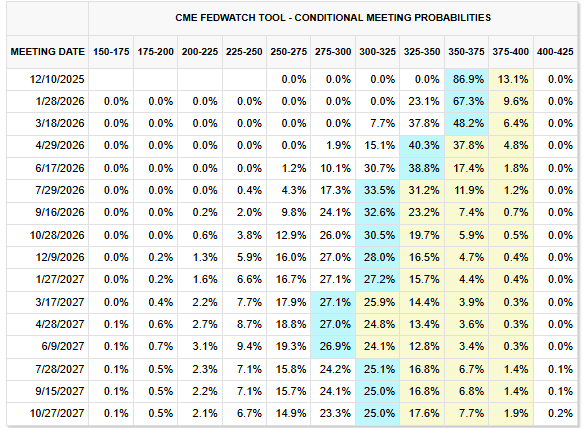
Source: CMEGroup
As a result, rising expectations of lower rates have begun to benefit the yen—not only because the U.S. may soon reduce its yield spread advantage over Japan, but also because a looser monetary stance by the Fed has started to weigh on the U.S. dollar’s performance. With markets anticipating further rate cuts, yields on 10-year Treasury bonds have dropped again below the 4.00% reference zone. Lower bond yields reduce demand for Treasuries, which in turn reduces dollar demand, giving room for the yen —considered a stable currency— to strengthen gradually.
This effect is clearly visible in the behavior of the DXY index, which has fallen from the 100-point area to 99 points, showing that confidence in the dollar has been deteriorating steadily as expectations of lower rates continue to build.
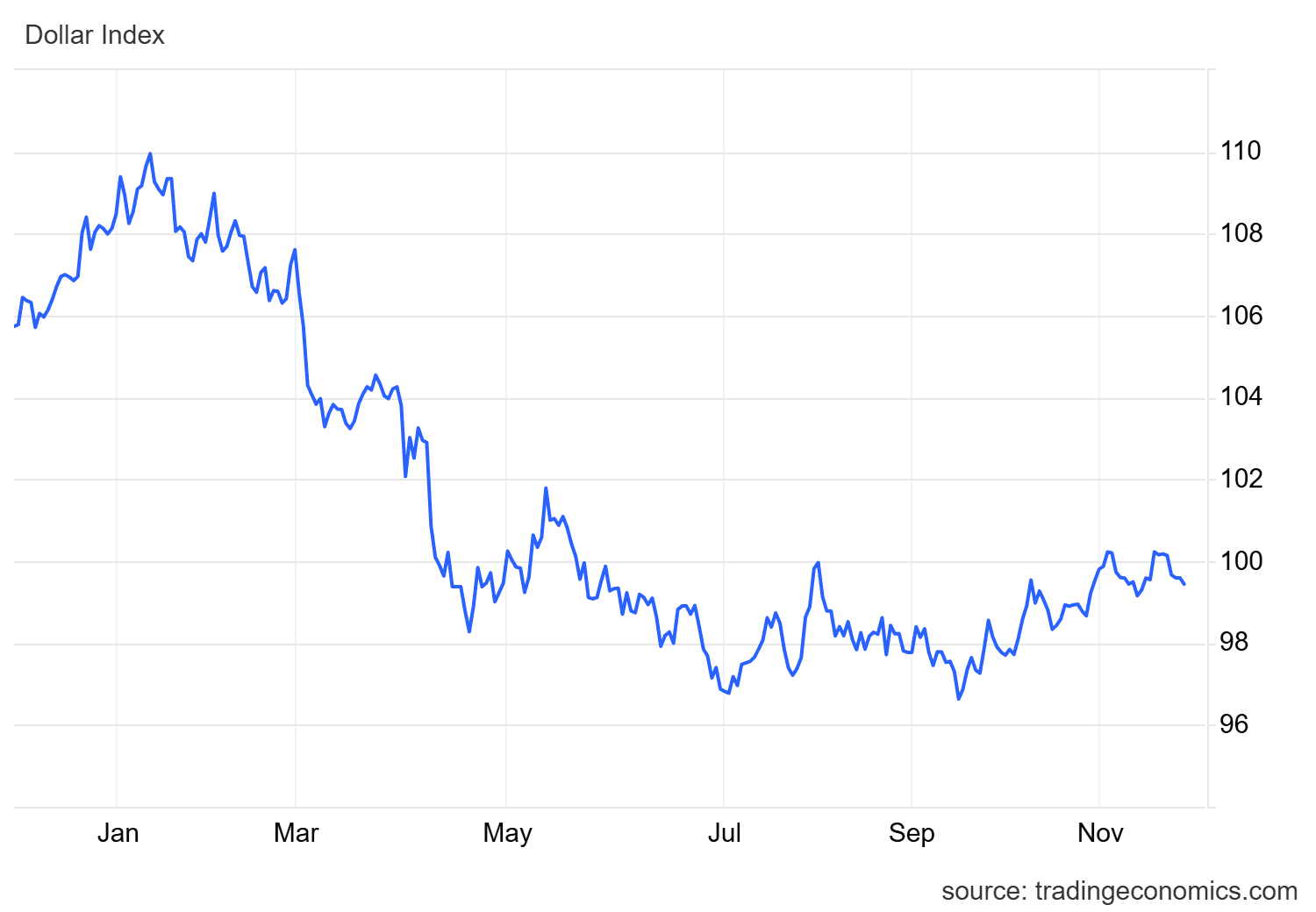
Source: TradingEconomics
Thus, the prospect of lower rates has served as a relief for the yen, which had lost substantial ground in recent weeks. As long as demand for the dollar remains pressured by expectations of a looser monetary policy, this environment could continue to act as a key catalyst for the yen’s recovery, potentially generating a persistent selling bias in USD/JPY over the coming weeks. However, it is important to consider that Japan still maintains an interest rate of only 0.5%, significantly lower than that of the United States. If the Bank of Japan signals in December that this extremely low rate will remain in place through 2026, the yen’s current strength may weaken again in the longer term.
USD/JPY Technical Outlook
Source: StoneX, Tradingview
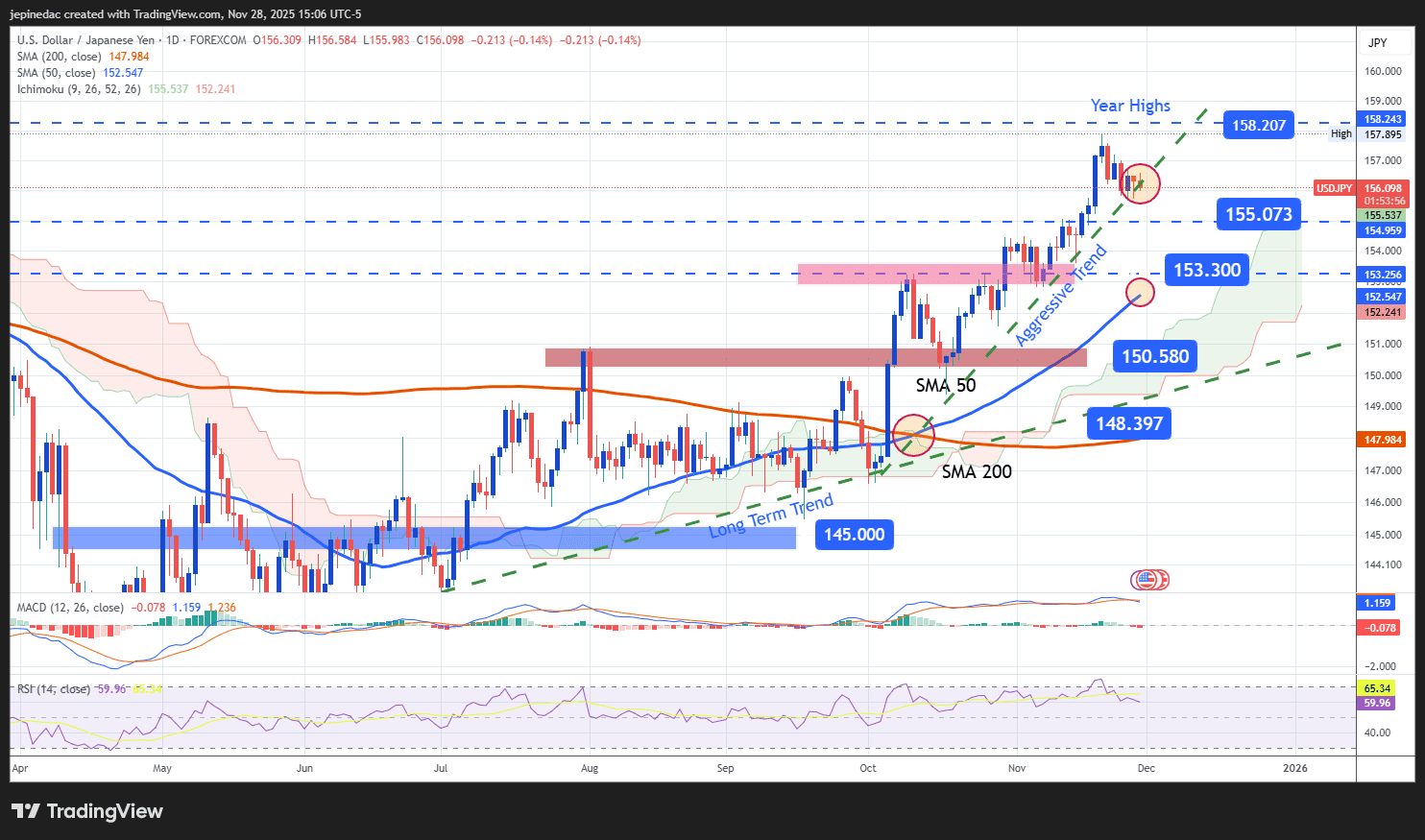
- Aggressive Trend at Risk: Since early October, USD/JPY had been following an aggressive bullish trend, driven by the dollar’s strength. For weeks, this structure dominated short-term movements. However, the recent wave of selling pressure has become more consistent, with price now testing the base of the ascending trendline. If selling continues, this could mark the end of the aggressive upward structure and open the door to a period of constant indecision in price movements.
- RSI: The RSI has been oscillating consistently above the neutral 50 level, but recently began to slope downward, suggesting it may be moving toward more neutral territory. This shift could signal a balance between buying and selling impulses, leading to a phase of price indecision.
- MACD: A similar scenario is even more apparent in the MACD, whose histogram remains near the zero line, indicating that short-term moving-average strength has entered a neutral zone. This could contribute to an extended period of indecision in USD/JPY movements.
Key Levels:
- 158.207 – Key Resistance: These are the annual highs and represent the most important bullish barrier for 2025. A sustained move above this level could reinforce the dominant bullish bias, reactivating upward acceleration in USD/JPY.
- 155.073 – Nearby Barrier: A recent pullback zone and the most relevant short-term support. If bearish movements continue pressing toward this level, it could signal the end of the aggressive trend and give way to a short-term lateral range.
- 153.300 – Main Support: This is the most consistent neutrality zone of recent weeks, aligned with the 50-period moving average. A break below it could shift market momentum and form a new bearish trend in the short term.
Written by Julian Pineda, CFA, CMT – Market Analyst
Follow him at: @julianpineda25