
As the first month of 2026 comes to an end, the short-term momentum across major cryptocurrencies continues to show persistent weakness, even after the recent escalation and subsequent de-escalation of diplomatic tensions. This has been accompanied by a growing sense of indecision in crypto market sentiment indicators, factors that have failed to support clear directional moves and may open the door to a prolonged neutral environment in the sessions ahead.

Fundamental events fail to provide enough support
The week was particularly active from a sentiment perspective. Early on, risk appetite deteriorated following announcements of potential 10% tariffs on at least eight European countries by the United States. However, this narrative began to shift when President Donald Trump, speaking from the Davos Forum, announced a temporary suspension of these tariff plans.
Despite this de-escalation, the positive impact on crypto market confidence proved limited and short-lived. While the tariff suspension eased short-term risk conditions, underlying structural issues, such as the strategic interests of the United States in Greenland, remain unresolved. This suggests that risk concerns could resurface, preventing a sustained recovery in risk appetite.
Recent crypto market moves have been revealing. Using Bitcoin as the market’s reference asset, the open interest indicator, which tracks total open long and short positions in the institutional market, fell back toward the $27.9 billion area by the end of the week. This decline points to a consistent reduction in institutional positioning, reflecting broad-based indecision following the volatility generated by diplomatic developments.
Rather than signaling a clear directional move, the drop in open interest highlights a lack of conviction and engagement in the Bitcoin market in the short term. In this sense, the crypto market is currently behaving neither as a safe haven nor as a pure risk asset, reinforcing the prevailing neutral bias.
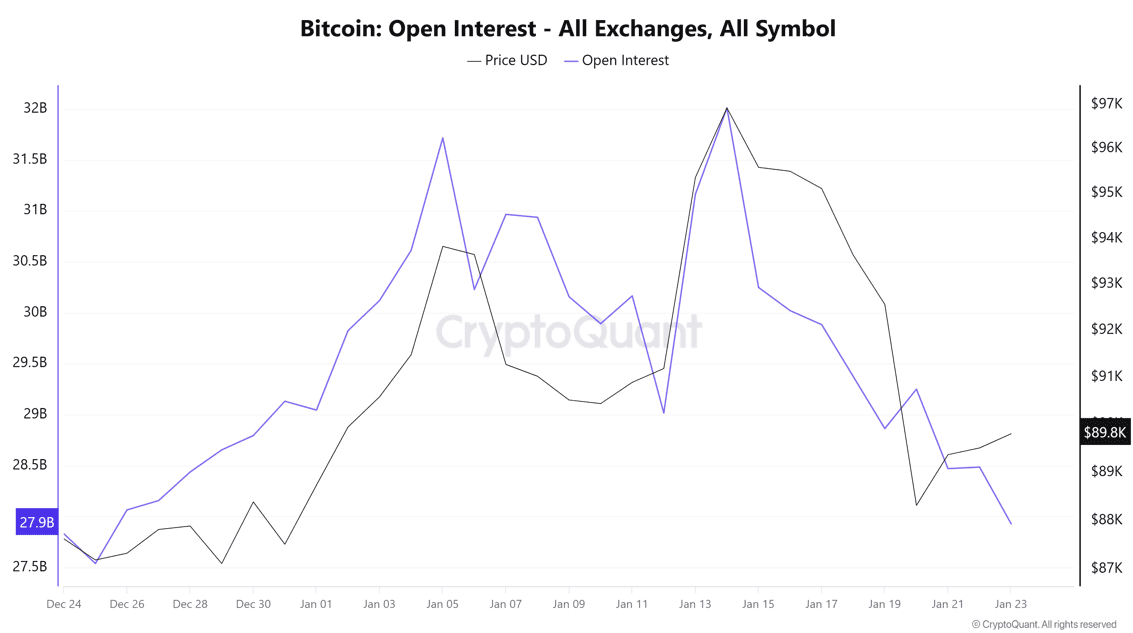
Source: Cryptoquant
As long as market indecision persists and interest in crypto—particularly in Bitcoin—continues to fade, short-term demand is likely to remain under pressure. In the absence of a meaningful fundamental catalyst capable of restoring confidence across the broader crypto market, this environment could evolve into more dominant selling pressure in the coming sessions, especially given Bitcoin’s difficulty in clearly benefiting from either risk-on or risk-off scenarios.
Bitcoin versus other markets
A notable development has been Bitcoin’s renewed positive correlation with the DXY index, exceeding 0.5 on average over the last 50 trading sessions. This indicates that, as the U.S. dollar has weakened, Bitcoin has tended to partially mirror that behavior, moving further away from its independent narrative. It is worth noting that correlation dynamics can change over time.
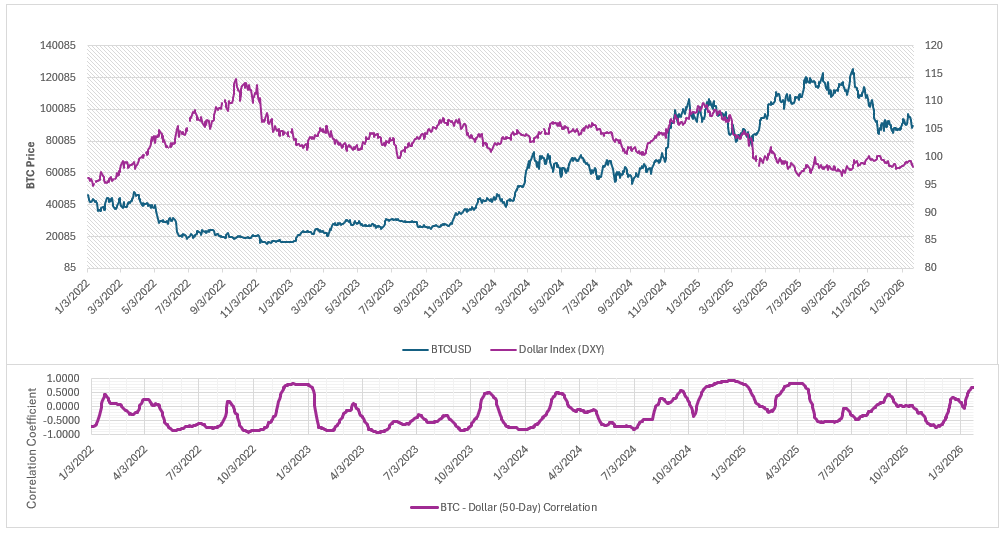
Source: Data – TVC, StoneX, Tradingview
Rather than supporting Bitcoin, this relationship suggests the cryptocurrency has adopted a weak bias similar to that of the dollar, one of the assets most affected this week. In practical terms, the market appears to be reducing exposure to both the dollar and cryptocurrencies, seeking alternatives in other asset classes. This dynamic could translate into ongoing weakness for the crypto market in the near term.
From a relative volatility perspective, most major cryptocurrencies are currently trading with volatility levels below their weekly and even annual averages, with the exception of Ethereum. This lack of price movement points either to prolonged neutrality or to a broader absence of market participation, reinforcing the current indecisive environment.
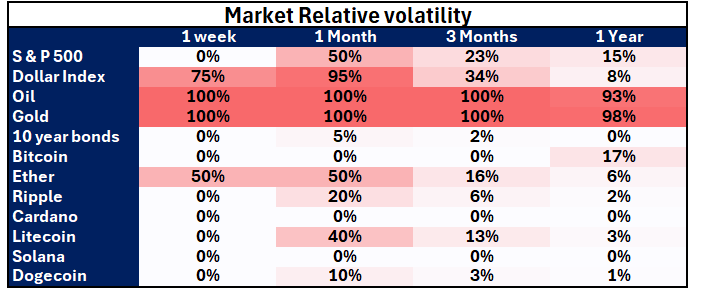
Source: Data – TVC, StoneX, Tradingview
Taken together, the combination of uncertainty, weak demand, and subdued volatility suggests that risk appetite in the crypto market is facing a challenging phase. As long as these conditions persist, the market may continue to experience dominant short-term weakness.
Confidence returns to negative territory
The Crypto Fear and Greed Index has shown a renewed and significant deterioration, falling back toward the 34-point area, which places it once again in “fear” territory. This move highlights that, despite the recent easing of diplomatic tensions, crypto market confidence has failed to recover and remains fragile.
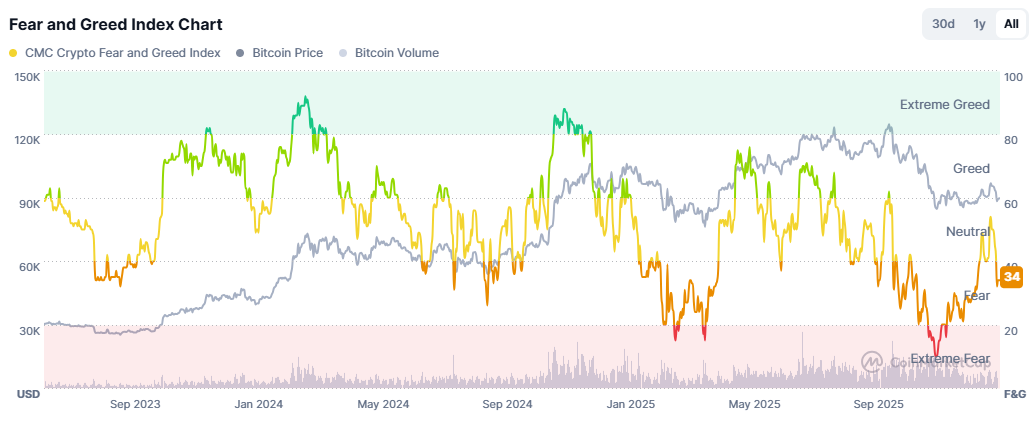
Source: Coinmarketcap
This decline in sentiment does not create a favorable environment for sustaining consistent short-term demand. Until confidence indicators show a clearer recovery, this backdrop is likely to continue weighing on the crypto market, potentially reinforcing downside pressure in the sessions ahead.
Written by Julian Pineda, CFA, CMT – Market Analyst
Follow him on: @julianpineda25