Learn how central banks control money supply using interest rates, open market operations, quantitative easing and tightening, and balance sheet policy. Read more.
Central banks are the key institutions that influence money supply, interest rates, and financial conditions in the economy. When people search how central banks control money, the idea is to understand how the central bank uses a policy tool to control inflation, support the economy, and guide the value of money in financial markets. Central banks have different structures depending on the country, but the core goal is similar: stabilize inflation, support sustainable economic growth, and maintain confidence in the financial system.
For example, the Federal Reserve sets monetary policy in the United States, while the European Central Bank does so for the Euro area. In the UK, the Bank of England sets the benchmark rate and manages policy choices. The names differ, but the central bank in each region uses comparable tools to influence the money supply in the economy, the market interest rate, and long term interest rates.
Mini glossary
- Policy rate (benchmark rate): The interest rate set by the central bank that influences borrowing costs across the economy (including mortgages and business loans).
- Federal funds rate: A key short-term rate in the United States that reflects the cost of overnight lending between banks and helps transmit Federal Reserve policy.
- Term premium: The extra yield investors demand for holding longer-term bonds instead of rolling over short-term bonds; it can shift long term interest rates even if policy rates don’t change.
- Yield curve: A line showing interest rates across different maturities (short-term to long-term). Its shape can signal expectations for growth, inflation, and future interest rates.
- Liquidity (market liquidity vs funding liquidity): Market liquidity is how easily assets trade without large price moves; funding liquidity is how easily institutions can borrow short-term. Central banks support both during stress.
- Bank reserves: Balances commercial banks hold at the central bank. Reserves help payments and settlement and influence how smoothly the banking system functions.
- Balance sheet normalization: A process of returning the central bank’s balance sheet toward more typical levels after periods of quantitative easing.
- Reinvestment (in QE/QT): When bonds mature on the central bank’s balance sheet, reinvestment means buying new bonds to keep holdings steady; stopping reinvestment is a common form of quantitative tightening.
- Transmission mechanism: How central bank decisions pass through to the real economy, via borrowing costs, lending conditions, asset prices, and expectations.
- Forward guidance: Central bank communication designed to shape expectations about the future path of interest rates, inflation priorities, or balance sheet policy.
Central banks and money supply in the economy
To understand how central banks control money, it helps to know where money comes from. In modern economies, much of the money supply is created through lending by commercial banks. When a bank issues a loan, the amount of money in deposit form can increase. That’s why central banks have a strong focus on lending conditions, the cost of borrowing, and bank reserves.
The idea is that money supply is not only cash; it is also the deposit money people use to pay for goods and services, mortgages, and everyday spending.
The amount of money and why it changes
The amount of money in circulation can change based on:
- Whether households spend more or save more
- Whether businesses borrow for expansion
- Whether banks lend or rather than hold liquidity
- Whether the economy is expanding or slowing
In turn, the money supply affects inflation, economic growth, and the value of a currency in the market.
Why money supply matters for the value of money
Money supply matters because changes in the amount of money in the economy can affect:
- The price of goods and services
- Inflation expectations
- Consumer and business demand
- The value of a currency in financial markets
If money growth slows sharply, borrowing and investment can cool, which can reduce inflation pressure but may also slow economic growth.
Interest rates and money supply: the basic relationship
Money supply is closely connected to interest rates because borrowing, saving, and lending decisions often change when the interest rate changes.
- Lower interest rates tend to make borrowing cheaper, encouraging people to spend more and businesses to invest, which can support the economy.
- Increasing interest rates can raise borrowing costs, discourage loans, and slow demand, helping to control inflation.
In theory, interest rates and money supply interact through mortgages, consumer credit, business loans, and bank funding conditions.
How central banks control money: the core toolkit
When you ask how central banks control money, you’re usually asking about the main policy tool set used by central banks have across the world:
- Setting interest rates
- Using open market operations in the open market
- Influencing bank reserves and lending conditions for commercial banks
- Using quantitative easing and quantitative tightening
- Adjusting the size and structure of its balance sheet (balance sheet policy)
These tools are adjusted over the year in response to inflation trends, growth data, and financial stability risks.
The central bank and commercial banks: why lending matters
The central bank influences the economy partly by shaping how easily commercial banks can lend. Banks decide whether to lend, tighten standards, or rather than hold reserves and liquidity. If the central bank makes borrowing cheaper and liquidity plentiful, banks may lend more, and households may spend more. If policy tightens, lending can slow.
This is why the money supply and credit conditions are so important in financial markets.
Reserve requirements and bank reserves (a direct lever)
Reserve requirements refer to how much a bank holds against deposits. While some systems rely more on liquidity frameworks than strict reserve ratios, the concept remains important: if a bank must hold more, it has less to lend.
When reserve constraints tighten, credit growth can slow. When they loosen, banks can lend more into the economy, which can support the economy.
Interest rates as a policy tool
Interest rates are the most visible policy tool. The central bank sets the benchmark rate, which influences the interest rate environment across mortgages, consumer borrowing, and business financing.
For example, a rate cut can support the economy by reducing borrowing costs. On the other hand, increasing interest rates can slow demand and help control inflation. In turn, changes in interest rates can influence the market value of bonds, stocks, and currencies.
Open market operations: the classic mechanism
Open market operations are a direct way for the central bank to influence liquidity by buying or selling government securities in the open market.
- If the central bank buys government bonds, it adds reserves to the banking system and injects money into the economy.
- If the central bank sells government bonds, it removes liquidity and can tighten financial conditions.
The idea is to guide the market interest rate, support policy transmission, and influence the amount of money in circulation indirectly.
Expansionary open market operations (injecting money into the economy)
In expansionary open market operations, the central bank buys government bonds from the market. This increases bank reserves and can support lending, rather than hold liquidity on the sidelines. In turn, easier funding conditions can support the economy and stimulate economic growth.
In theory, this can also lower term interest rates, depending on market expectations and risk conditions.
Contractionary open market operations (withdrawing liquidity)
In contractionary open market operations, the central bank sells government bonds (or reduces liquidity in other ways). This can reduce reserves and increase funding costs, which may tighten credit availability.
In response to inflation pressures, contractionary actions paired with increasing interest rates can help control inflation. Of course, policy decisions usually balance inflation with economic growth and financial stability.
Quantitative easing
Quantitative easing is used when conventional policy, like lowering the policy rate, cannot do enough, especially when rates are already low. Quantitative easing is a strategy where the central bank buys government bonds (and sometimes other financial assets) to inject money into the economy and lower long term interest rates.
Quantitative easing can influence:
- Term interest rates and long term interest rates
- Liquidity conditions in the market
- Risk appetite in financial markets
- The value of a currency
Quantitative easing is often deployed to support the economy when credit conditions are tight or confidence is weak.
Quantitative easing: why government bonds matter
Of quantitative easing, the core idea is simple: when the central bank buys government bonds, demand rises and yields tend to fall. Lower yields can push investors to seek a higher return in other financial assets, influencing the market.
In addition, by stabilizing government bond markets, Quantitative easing can improve overall financial conditions and support the economy by reducing uncertainty.
Quantitative tightening: shrinking its balance sheet
Quantitative tightening is the other hand of Quantitative easing. Instead of buying government bonds, the central bank reduces its balance sheet over time, often by letting bonds mature without replacement or selling assets into the open market.
Quantitative tightening can:
- Reduce liquidity into the economy
- Raise term interest rates
- Tighten financial conditions
- Affect the value of currencies through yield and risk channels
Balance sheet policies are more recent as core tools, Quantitative tightening is now a major part of “how central banks control money” discussions.
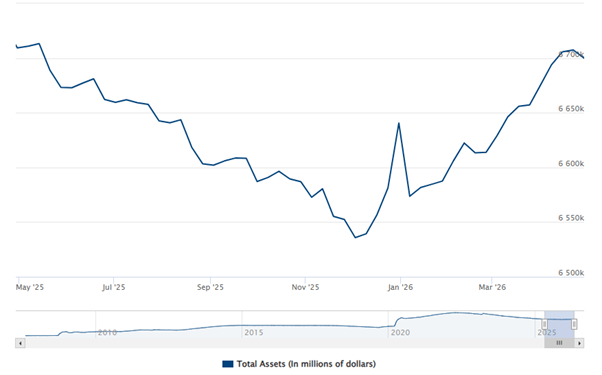
Source: Federal Reserve Bank. Note: Figures can change over time due to revisions and ongoing updates from the source.
This chart shows how the Federal Reserve’s total assets increased during periods of quantitative easing and later declined as quantitative tightening reduced its balance sheet. Shifts in balance sheet size can influence liquidity in financial markets and affect term interest rates and long term interest rates.
The Federal Reserve and the federal funds rate
The Federal Reserve (the Fed) influences short-term funding conditions through the federal funds rate. This matters for global financial markets because the US dollar is widely used. References like “Federal Reserve Bank of” appear because the system includes regional reserve banks.
When the Fed changes interest rates, it can influence capital flows and the value of currencies, not only in the United States but globally.
The Bank of England
The Bank of England is a useful example because the Bank of England uses interest rates, market operations, and balance sheet tools across different cycles.
For example, when growth slows, the Bank of England may cut rates and buy government bonds to support the economy. When inflation remains elevated, the Bank of England may raise rates and shift toward quantitative tightening to reduce its balance sheet.
The European Central Bank and cross-market influence
The European Central Bank influences a large economic bloc. Its policy tool decisions can affect bank funding, government bond yields, and conditions in financial markets. Like other central banks, the European Central Bank uses interest rates and balance sheet programs to stabilize inflation and maintain financial stability.
In addition, its actions can influence how the market prices term interest rates and longer borrowing costs.
Bank of Japan: first used quantitative easing
The Bank of Japan is often referenced because it first used quantitative easing earlier than many peers. The Bank of Japan adopted Quantitative easing approaches to address weak growth and deflation pressures after major asset price declines.
Because the bank of Japan first used these tools, it became a key example in global analysis of quantitative easing and its balance sheet impacts on the economy and financial markets.
In response to major economic shocks
In response to major economic shocks or periods of severe financial stress, central banks may act quickly to support the economy and stabilize financial markets. For example, they may lower interest rates, expand open market operations to keep funding markets functioning, and use quantitative easing to inject money into the economy.
As conditions normalize, the central bank may shift toward increasing interest rates and quantitative tightening to reduce its balance sheet, influence term interest rates, and control inflation.
Money supply in action: the Bank of England scenario
To make this practical, consider a hypothetical case. The bank of England faces slower economic growth and rising unemployment. The bank holds several levers to stimulate economic growth and boost demand in the economy.
Step 1: Ease lending constraints for commercial banks
The Bank of England improves liquidity conditions so commercial banks can lend rather than hold excess reserves.
Step 2: Lower interest rates
Lower interest rates reduce borrowing costs for households and businesses. This can lead people to spend more and support the economy.
Step 3: Use open market operations
The Bank of England buys government bonds in the open market, adding bank reserves and injecting money into the economy.
Step 4: Expand quantitative easing in addition
In addition, the bank of England expands quantitative easing by purchasing more government bonds, aiming to lower long term interest rates and support the economy further.
How central banks control money comes down to steering financial conditions, money supply, interest rates, credit creation, and confidence, so the economy can grow without destabilizing inflation. Central banks have multiple ways to act in response to changing data, shifting market expectations, and financial stability risks.
Open market operations, increasing interest rates, reserve and liquidity frameworks, and balance sheet actions all work together in turn. More recently, quantitative tightening has become just as important as quantitative easing, because its balance sheet can influence term interest rates, long term interest rates, and liquidity into the economy.
The idea is not to perfectly control outcomes, but to keep the value of money stable enough that households and businesses can plan, invest, and spend more sustainably, even when shocks force rapid policy changes.