



DAX forecast: Stocks under pressure | Greenland tariff retaliation looms
The European leaders are exploring possible retaliation measures after Donald Trump threatened to impose tariffs on countries opposing his ambitions to acquire Greenland, a move that has rattled both investors and long-standing allies. European leaders appear to be hardening their stance.
Share this:

The European leaders are exploring possible retaliation measures after Donald Trump threatened to impose tariffs on countries opposing his ambitions to acquire Greenland, a move that has rattled both investors and long-standing allies. European leaders appear to be hardening their stance. Germany has warned that Trump has crossed a red line, while the European Union is reportedly discussing retaliatory tariffs on up to €93bn of US goods. Risk sentiment has deteriorated sharply, meanwhile. Gold and silver surged to fresh record highs, while US futures, European equities and cryptos sold off. Renewed fears over an escalating trade war has dented the DAX forecast.
What could be EU’s response to Trump’s demands on Greenland and tariffs?
European leaders are weighing up how to respond to Trump's threats of tariffs if the bloc opposes his plans to buy Greenland. There are a few options at their disposal, but this is fast becoming a transatlantic crisis of a kind not seen for generations – and behind it all is just one man: Donald Trump.
The first option is diplomacy. So far, it has failed. There is a growing recognition in Brussels that Donald Trump is serious about Greenland, and that talking alone has not shifted his position. That said, there is an opportunity this week. The World Economic Forum gets under way in Davos, with Trump attending alongside the NATO secretary general and many of Europe’s senior leaders. It offers a chance for face-to-face discussions, but European leaders will want to arrive with leverage in hand. That leaves very little time to agree a united set of measures they can present to the US president, in the hope he might yet climb down. IF so, this could fuel fresh gains for stocks globally, benefitting the DAX and other European indices the most.
The second option would be to delay the ratification of the EU–US trade deal agreed last summer. That would undoubtedly hurt European economies too, but it would also carry consequences for the Americans. This scenario should be net negative for risk assets, and it could weigh on the DAX forecast.
The third option would be to trigger the anti-coercion instrument. This is a highly complex piece of legislation, originally designed to be used against states viewed as hostile to European interests. It was never intended to be deployed against an ally like the United States. And yet, the unthinkable is now being seriously discussed, particularly by the French president, Emmanuel Macron. If activated, it would allow Europe to impose tariffs on the US, restrict American companies’ access to the single market, and limit their ability to invest in Europe. The economic impact on the US would be significant, and it would almost certainly provoke a swift and angry response from Washington, potentially triggering a trade war. This is the most worrying scenario for stocks and risk assets in general.
Technical DAX forecast: Technical analysis and key levels to watch
From a technical perspective, the DAX chart still looks quite bullish, despite the sell-off, given that we are just coming off from repeated record highs. Ignoring today’s drop, we have seen multiple higher highs and higher lows, and the market has recently broken out of a multi-month consolidation to the upside. As long as key support levels hold and no major trend lines break down, this should keep bullish traders comfortable. Some may even view the current pullback as another opportunity to buy the dip. That said, for sentiment to turn decisively positive again, we will likely need to see some positive developments regarding the situation in Greenland and the ongoing threat of tariffs on the EU.
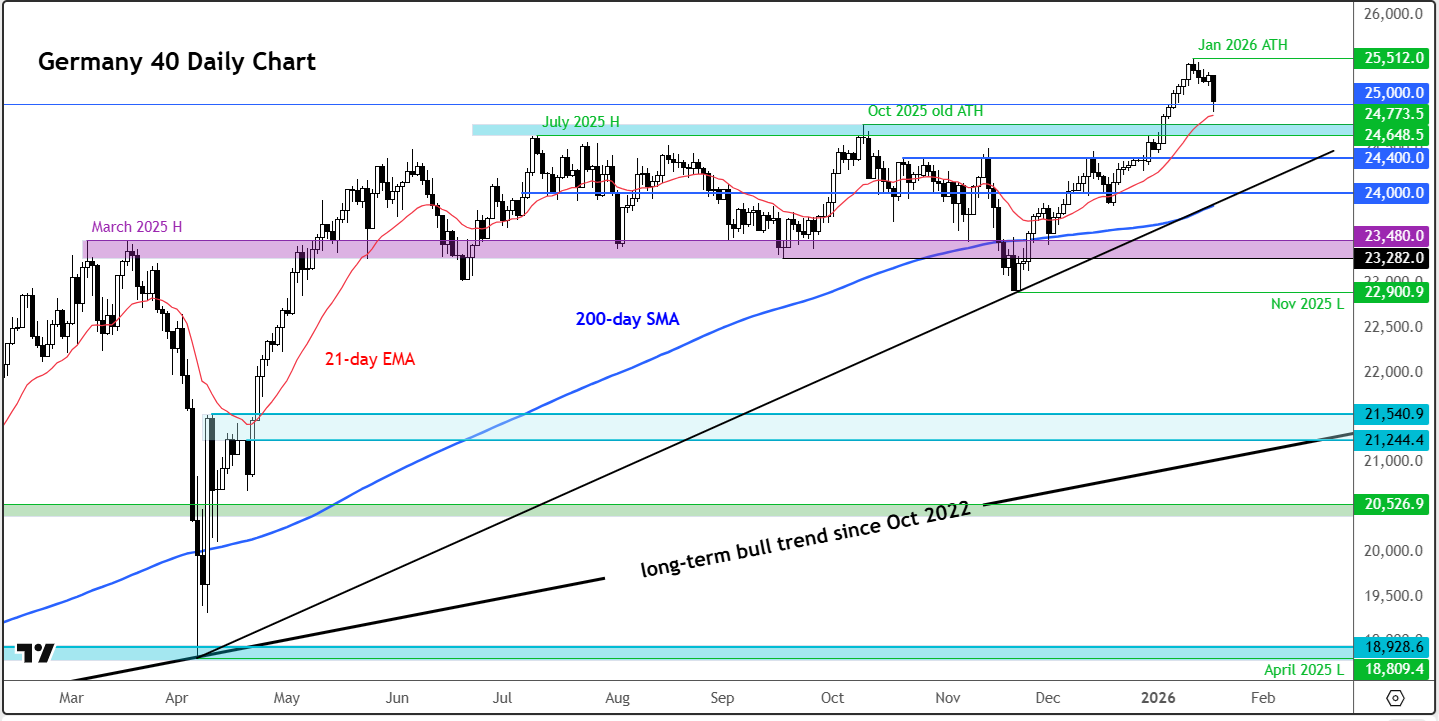
In terms of levels to watch, the area between 24,650 and 24,770, which marks the highs from July 2025 and October 2025, is the first key support zone. Previously a major resistance area, this region could now act as support on a potential retest from above. Below that, 24,400 is the next level of potential support, which also previously acted as resistance.
Further down, there is a bullish trend line coming in around the 24,000 area, where the 200-day moving average is also located slightly below. Things could become more interesting if these support levels start to break down, as that could open the door to a discussion around a potential market top. For now, however, the benefit of the doubt remains with the bulls, and attention stays firmly on whether the market can remain supported at these levels.
On the upside, potential resistance to watch includes the area around 25,200, which was the low from Friday’s range. That level could act as resistance if we see a midweek bounce. Beyond that, there is very little in the way of resistance until the all-time high reached earlier this month at 25,512.

-- Written by Fawad Razaqzada, Market Analyst
Follow Fawad on Twitter @Trader_F_R
Related tags:


The complete CFD trading experience
Award-winning platforms, competitive spreads, low commissions and dedicated support.
We live and breathe the markets and are dedicated to helping traders realise their ambitions as we continue to set the industry bar.
Economic calendar
Web Trader platform
Our sophisticated web-based platform is packed with features.
Related articles

Nikkei breakout accelerates as yen weakness returns
Nikkei has started October with a powerful breakout, helped by renewed yen weakness and strong upside momentum


S&P 500 Forecast: SPX Continues to Drift Away from Record Highs
Recent trading sessions have done little to restore confidence in the equity market. Over the last four sessions, the S&P 500 has declined by nearly 1.00%, a move that highlights growing short-term weakness and keeps the index moving further away from its record-high territory.


The RBA Hiked Rates and the Australian Dollar Still Fell
AUD/USD fell after the RBA rate hike because the central bank's hawkish stance was already priced in while the U.S. dollar stayed firm.
StoneX Europe Ltd may make third party material available on this website which may contain information included but not limited to the conditions of financial markets. The material is for information purposes only and does not contain, and should not be construed as containing, investment advice and/or investment recommendation and/or an investment research and/or an offer of or solicitation for any transactions in financial instruments; any decision to enter into a specific transaction shall be made by the client following an assessment by him/her of their situation.
StoneX Europe Ltd makes no representation or warranty and assumes no liability as to the accuracy or completeness of the information provided, nor any loss arising from any investment based on a recommendation, forecast or other information supplied. You should always seek independent advice as to your suitability to speculate in any related markets and your ability to assume the associated risks, if you are at all unsure. We are not under any obligation to update any such material. Any opinion made may be personal to the author and may not reflect the opinion of StoneX Europe Ltd.