



EUR/USD forecast: Traders eye 1.10 on softer US inflation data
The weaker US inflation data supports our bullish EURUSD forecast: We think that the single currency is likely heading above $1.10 soon.
Share this:

The FX markets had been quite quiet as traders sat on their hands ahead of this week’s most important macro data – the US Consumer Price Index. Well, the data didn’t disappoint in terms of market reaction – unless you were a dollar bull. In response to a weaker headline print, traders sold the dollar and bought gold, silver and bonds. Stock index futures and crude oil also jumped. Our EUR/USD forecast remains unchanged that the single currency is likely heading above 1.10 soon. The weaker CPI print has raised doubts over whether the Fed will now hike rates at all next month, after a 25bp hike was priced in with a 75% probability for the May 3 FOMC meeting. Now, that probability has fallen to around 66%, suggesting investors feeling that the Fed is near the end of the hiking cycle will feel even more comfortable now.
- US CPI falls to 5% from 6%, boosting peak interest rates narrative
- FOMC minutes, PPI, retail sales and consumer confidence to come
- Improving Eurozone data suggests more ECB rate increases likely
US CPI weakens to 5%
Until Friday’s stronger non-farm payrolls report, the trend for US data has been negative surprises and the market has correspondingly been repricing lower the Fed’s projected interest rate path. This repricing caused a significant downward move in the dollar until the NFP data provided the greenback some relief.
The market will continually question whether more rate hikes are forthcoming, which is why a lot of attention was on the CPI release today. The market’s immediate response seems to be that we are now a lot closer to the peak in terms of interest rate hikes, now that inflation has cooled to 5.0% year-over-year in March, thus continuing its trend of weakening price pressures.
The 5% reading on the headline front was weaker than 5.2% expected, and down sharply from 6.0% recorded the month before. Core inflation came in as expected, however, edging higher to 5.6% from 5.5% previously.
I suppose the fact that core CPI rose is something that will prevent the dollar from falling significantly further. What’s more, it was energy's decline that was the biggest annual deflationary driver for the headline CPI print, but with crude oil climbing back above $80 a barrel in light of the OPEC’s surprise decision last week, this could provide a fresh inflation jolt in the months ahead.
For now, traders will be happy to see headline inflation falling, which should keep the dollar under pressure for a while. Meanwhile, there will be more inflation data on Thursday in the form of PPI. However, the latter is not going to be as important as CPI, I don’t think
Focus will turn to FOMC minutes
Now that we have seen inflation falling to 5%, investors focus will turn to the FOMC’s last meeting minutes, due for release later in the day. A bit of profit-taking on the dollar shorts might be expected. The minutes will reveal some of the Fed's thinking behind the 25bp hike in March, amidst the banking crisis. If the minutes reveal concrete signs that the central bank is very close to a peak in interest rates, or policymakers confirming to market expectation of cutting interest rates later in the year if needed, then this would likely be seen as dollar negative.
There’s more data to come on the last day of the week, which should keep FX traders busy…
US Retail Sales and UoM Consumer Confidence (Friday)
The Fed’s rate projections have been cut sharply in recent weeks owing to weakness in US data and signs of peak inflation. Worries over the health of US consumers will intensify if we see a weaker print in either retail sales or consumer confidence, especially as they are going to feel the impact of higher gasoline prices in light of the OPEC’s decision to sharply cut crude production. Both headline and core retail sales are seen falling 0.4% month-over-month. The University of Michigan’s consumer confidence index is a more forward-looking indicator of consumer’s health and may thus trigger a sharper move in the dollar should we see a bigger-than-expected deviation from the expected 62.0 reading.
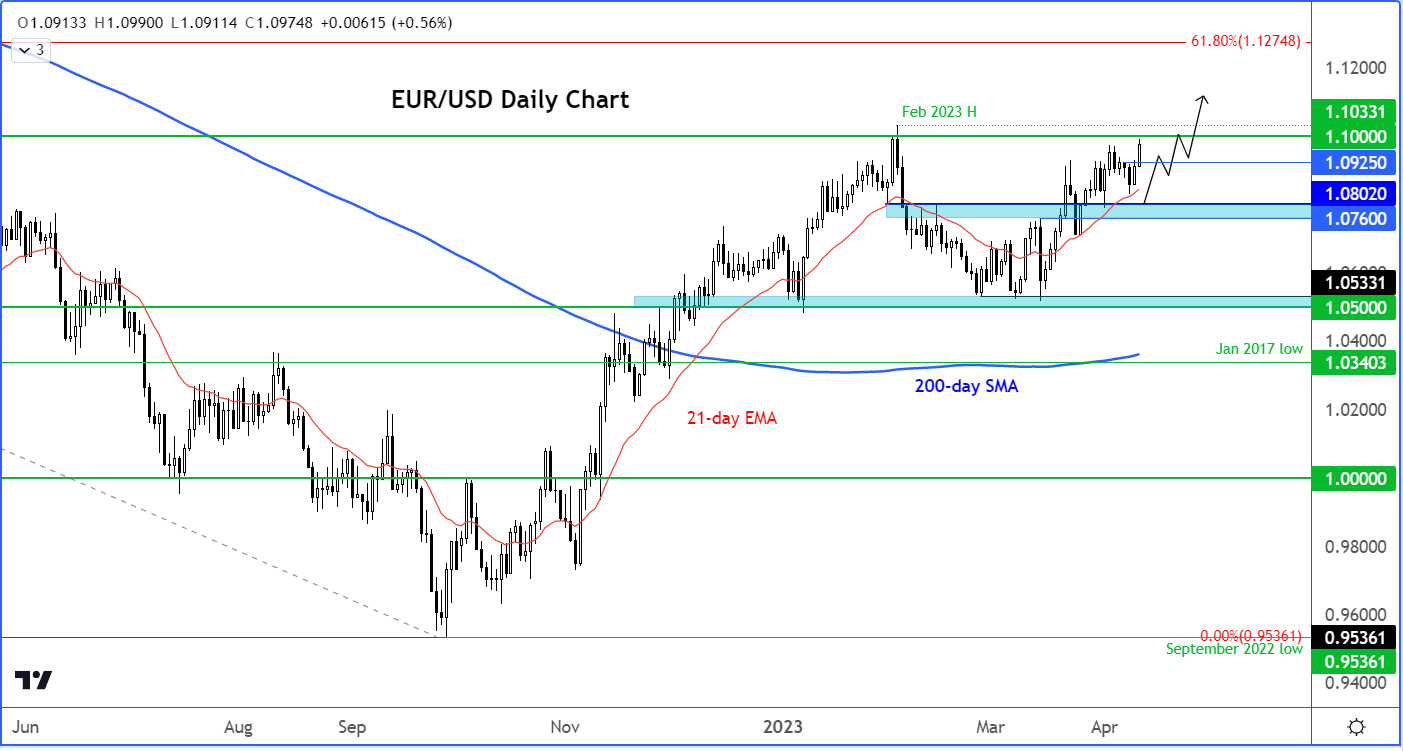
EUR/USD forecast: Higher lows point to +1.10
The EUR/USD has been printing higher lows ever since it held key support around 1.05 in early March. The single currency’ ascend has been nice and steady. With price holding above the 21-day exponential moving average and key support at around 1.0800, the path of least resistance remains to the upside. So our EUR/USD forecast remains valid as we think price is track to climb above the February high of 1.1033 soon.
Source: TradingView.com
Our EUR/USD forecast supported by stronger EZ data
Supporting the EUR/USD has been the publication of stronger-than-expected Eurozone data of late. Las week we saw German industrial production jumped 2.0% month-over-month in February, easily beating the 0.1% increase forecast and adds to the 3.7% gain in January. Tin addition, we saw German factory orders surged 4.8% MoM, while the eurozone composite PMI rose to a 10-month high.
As result of the improvement in data, Germany is now expected to avoid a recession. Indeed, a couple of German economic institutes now think the Eurozone’s largest economy will grow this year. The IFO institute, for example, thinks the economy would likely grow by 0.3% in 2023. Although this doesn’t sound much, a few months ago a deep recession seemed almost unavoidable.
The German economic recovery has been supported by the reopening of China and strong activity in the automotive sector. Indeed, we saw German exports surge higher in February while imports also rose. More significantly, the German trade surplus has been noticeably higher at the start of this year compared to Q4.
The improving German economy and receding concerns over an energy crisis is why the German DAX index has been able to outperform its Wall Street peers so far this year, and why the EUR/USD has been able to get close to the 1.10 handle.
But it is not just Germany. A few other Eurozone countries have also been doing relatively well, not least Spain, where the services sector has been going from strength to strength.
Given the above macro considerations, I expect the ECB to raise interest rates at least a couple of more times before potentially pausing. Two 25 basis points rate rises in May and June would push monetary policy deeper into restrictive territory. This would therefore further narrow the disparity between the ECB and Fed’s monetary policies, and thus support our bullish EUR/USD forecast.
-- Written by Fawad Razaqzada, Market Analyst
Follow Fawad on Twitter @Trader_F_R
How to trade with City Index
You can trade with City Index by following these four easy steps:
- Open an account, or log in if you’re already a customer
• Open an account in the UK
• Open an account in Australia
• Open an account in Singapore
- Search for the company you want to trade in our award-winning platform
- Choose your position and size, and your stop and limit levels
- Place the trade
Latest market news




The complete CFD trading experience
Award-winning platforms, competitive spreads, low commissions and dedicated support.
We live and breathe the markets and are dedicated to helping traders realise their ambitions as we continue to set the industry bar.
Economic calendar
Web Trader platform
Our sophisticated web-based platform is packed with features.
Related articles
EUR/USD weekly outlook: Oil, inflation and NFP in focus
After coming under significant pressure in recent weeks, the EUR/USD came off its lows to finish the week on a positive note on Friday, albeit with only a mild rebound. That was not enough to prevent the exchange rate falling for the third consecutive week, as the US dollar and bond yields rallied across the board.

Gold Q4 2026 outlook: Resilience in the face of rallying dollar and yields
As we headed towards the latter stages of Q3 and into Q4, the Fed had just hiked rates in a hawkish FOMC meeting, while the likes of the ECB and BoJ had also tightened their respective policies. Oil prices remained elevated amid the prolonged US-Iran conflict. Meanwhile, bond yields were breaking out, and the dollar was higher across the board. Yet, remarkably, gold was still holding in the positive territory for the third quarter, even if it had weakened somewhat in September.

EUR/USD Q4 2026 Outlook: Euro at a Crossroads as Fed, ECB Tighten 9 25 2026
EUR/USD enters Q4 at a pivotal inflection point as competing Fed-ECB policy paths and persistent inflation risks collide with major technical support.
StoneX Europe Ltd may make third party material available on this website which may contain information included but not limited to the conditions of financial markets. The material is for information purposes only and does not contain, and should not be construed as containing, investment advice and/or investment recommendation and/or an investment research and/or an offer of or solicitation for any transactions in financial instruments; any decision to enter into a specific transaction shall be made by the client following an assessment by him/her of their situation.
StoneX Europe Ltd makes no representation or warranty and assumes no liability as to the accuracy or completeness of the information provided, nor any loss arising from any investment based on a recommendation, forecast or other information supplied. You should always seek independent advice as to your suitability to speculate in any related markets and your ability to assume the associated risks, if you are at all unsure. We are not under any obligation to update any such material. Any opinion made may be personal to the author and may not reflect the opinion of StoneX Europe Ltd.