



Gilts gone wild!
The yield on the 30-year Gilt has moved from a high on the day of 5.092% down to a low of 3.869%.
Share this:

The Bank of England intervened in the Bond market on Wednesday. According to a Reuters “source”, the intervention was a response to issues with liability-driven investments and links to pension funds. The BOE has said that it would buy Gilts with maturities over 20 years, beginning today and lasting until October 14th. As a result, the yield on the 30-year Gilt has moved from a high on the day of 5.092% down to a low of 3.869%. Recall that it was just Thursday that the Bank of England announced a rate hike of 50bps to bring the overnight rate to 2.25% and that it would begin selling its holdings of Gilts at a rate of 80 billion Pounds per year. This sale has been pushed back and will now begin on October 31st. The opening level on the 30-year Gilt on Thursday was 3.535%. However, note the volatility in 30-year Gilt yield since then, which has been more directly related to the fear of new PM Truss’s fiscal policies than fear of the BOE’s monetary policy. 30-year Gilt yields moved up 134bps since Friday’s open and has retraced almost all of that back today!

Source: Tradingview, Stone X
GBP/USD made an intra-day high at 1.1738 on September 13th, just over 2 weeks ago. The pair has been moving aggressively lower since. On Friday morning, GBP/USD opened at 1.1252 and by Monday, the pair had traded to an all-time low of 1.0357. GBP/USD bounced to just above resistance at the 38.2% Fibonacci retracement level from the highs of September 13th to the lows of Monday, near 1.0931. GBP/USD oscillated between 1.0650 and 1.0800 until today. When the BOE made its announcement, GBP/USD rallied 200 pips to 1.0848, before falling to 1.0539 as traders digested the new information. At the end of the day on Wednesday, GBP/USD was trading near its daily highs at 1.0915.

Source: Tradingview, Stone X
As my colleague Fawad Razaqzada points out, the intervention may not be good for the Pound in the long-term. However, as we have seen today, the BOE may have “saved the Pound” in the short-term. If the pair continues to move higher, the first horizontal resistance is near 1.1020. Above there, the pair can move to the 50% Fibonacci retracement level from the above-mentioned timeframe near 1.1047, then a downward sloping trendline from the September 13th highs near 1.1135. First support is at the spike high after the BOE announcement at 1.0838. Below there, GBP/USD can fall to today’s low of 1.0539, then the all-time low at 1.0357.
Did the Bank of England succeed in saving the Gilt market and thus, saving the Pound? It may have worked in the short-term as the yield on the 30-year Gilt fell over 100bps today and GBP/USD closed up over 150 pips on the day. However, in the long-term, the intervention may not be sustainable, and GBP/USD could end up moving to parity or below!
The Bank of England intervened in the Bond market on Wednesday. According to a Reuters “source”, the intervention was a response to issues with liability-driven investments and links to pension funds. The BOE has said that it would buy Gilts with maturities over 20 years, beginning today and lasting until October 14th. As a result, the yield on the 30-year Gilt has moved from a high on the day of 5.092% down to a low of 3.869%. Recall that it was just Thursday that the Bank of England announced a rate hike of 50bps to bring the overnight rate to 2.25% and that it would begin selling its holdings of Gilts at a rate of 80 billion Pounds per year. This sale has been pushed back and will now begin on October 31st. The opening level on the 30-year Gilt on Thursday was 3.535%. However, note the volatility in 30-year Gilt yield since then, which has been more directly related to the fear of new PM Truss’s fiscal policies than fear of the BOE’s monetary policy. 30-year Gilt yields moved up 134bps since Friday’s open and has retraced almost all of that back today!

Source: Tradingview, Stone X
GBP/USD made an intra-day high at 1.1738 on September 13th, just over 2 weeks ago. The pair has been moving aggressively lower since. On Friday morning, GBP/USD opened at 1.1252 and by Monday, the pair had traded to an all-time low of 1.0357. GBP/USD bounced to just above resistance at the 38.2% Fibonacci retracement level from the highs of September 13th to the lows of Monday, near 1.0931. GBP/USD oscillated between 1.0650 and 1.0800 until today. When the BOE made its announcement, GBP/USD rallied 200 pips to 1.0848, before falling to 1.0539 as traders digested the new information. At the end of the day on Wednesday, GBP/USD was trading near its daily highs at 1.0915.
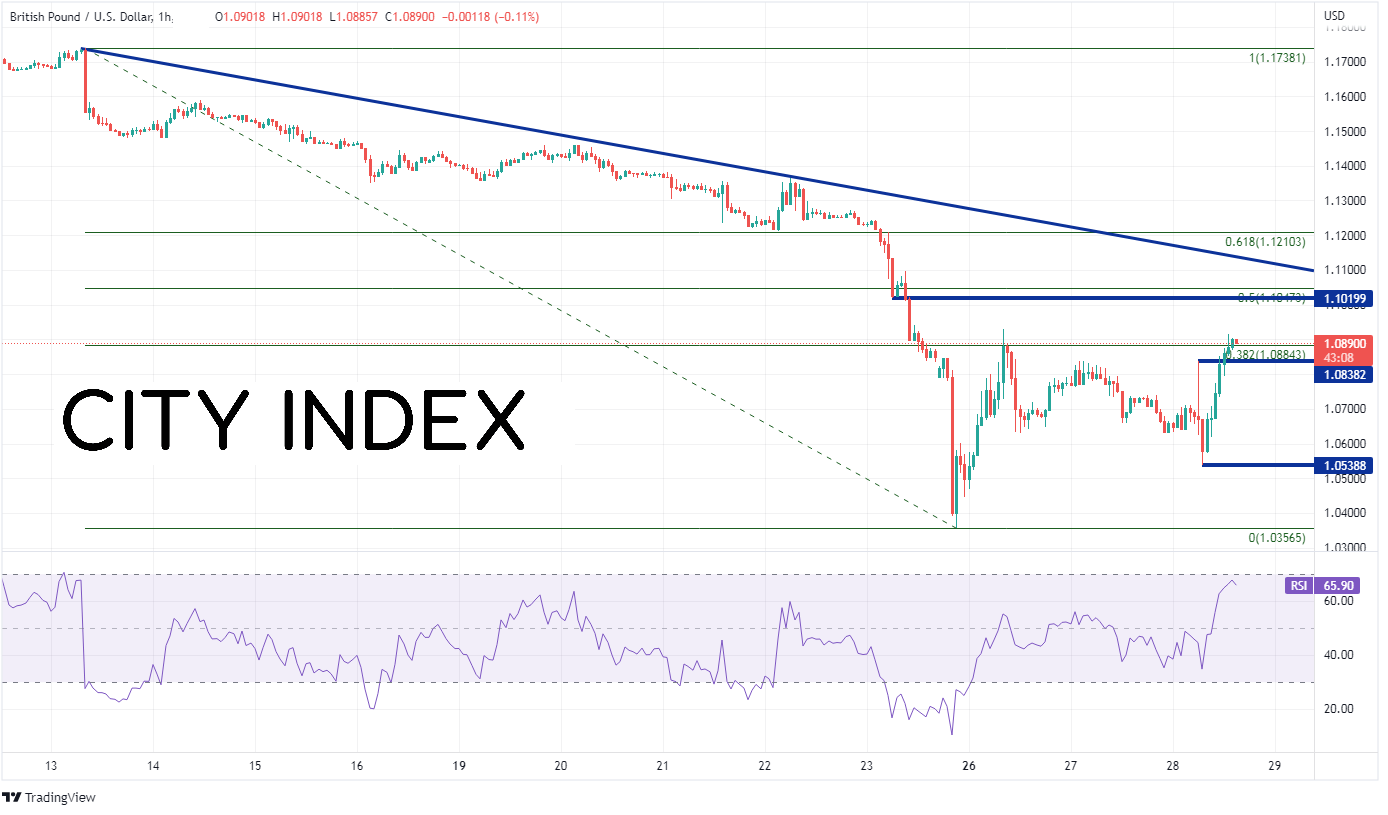
Source: Tradingview, Stone X
Trade GBP/USD now: Login or Open a new account!
• Open an account in the UK
• Open an account in Australia
• Open an account in Singapore
As my colleague Fawad Razaqzada points out, the intervention may not be good for the Pound in the long-term. However, as we have seen today, the BOE may have “saved the Pound” in the short-term. If the pair continues to move higher, the first horizontal resistance is near 1.1020. Above there, the pair can move to the 50% Fibonacci retracement level from the above-mentioned timeframe near 1.1047, then a downward sloping trendline from the September 13th highs near 1.1135. First support is at the spike high after the BOE announcement at 1.0838. Below there, GBP/USD can fall to today’s low of 1.0539, then the all-time low at 1.0357.
Did the Bank of England succeed in saving the Gilt market and thus, saving the Pound? It may have worked in the short-term as the yield on the 30-year Gilt fell over 100bps today and GBP/USD closed up over 150 pips on the day. However, in the long-term, the intervention may not be sustainable, and GBP/USD could end up moving to parity or below!
Learn more about forex trading opportunities.
Related tags:
Latest market news




The complete CFD trading experience
Award-winning platforms, competitive spreads, low commissions and dedicated support.
We live and breathe the markets and are dedicated to helping traders realise their ambitions as we continue to set the industry bar.
Economic calendar
Web Trader platform
Our sophisticated web-based platform is packed with features.
Related articles
USD/JPY Weekly Outlook: Volatility Has Left the Building
The yen has ignored broad dollar weakness, falling Treasury yields and renewed market turbulence. Yet its relationship with US interest rates remains intact. So why is USD/JPY going absolutely nowhere fast?
Swiss Franc Forecast: USD/CHF Seven-Week Rally Reverses From Yearly Highs 10 16 2026
A sharp rejection from fresh highs has shifted momentum in favor of USD/CHF bears, raising the stakes for a critical support test.


Nasdaq 100 forecast: Tech stocks not out of woods yet
US index futures pushed higher in the first half of Friday’s session, taking cues from a strong performance from European equities. Both European and US equity futures extending yesterday’s impressive recovery after the sharp sell-off earlier in the week. But the lingering concerns around the AI investment cycle remain, while bond markets were easing lower again, lifting yields.

StoneX Europe Ltd may make third party material available on this website which may contain information included but not limited to the conditions of financial markets. The material is for information purposes only and does not contain, and should not be construed as containing, investment advice and/or investment recommendation and/or an investment research and/or an offer of or solicitation for any transactions in financial instruments; any decision to enter into a specific transaction shall be made by the client following an assessment by him/her of their situation.
StoneX Europe Ltd makes no representation or warranty and assumes no liability as to the accuracy or completeness of the information provided, nor any loss arising from any investment based on a recommendation, forecast or other information supplied. You should always seek independent advice as to your suitability to speculate in any related markets and your ability to assume the associated risks, if you are at all unsure. We are not under any obligation to update any such material. Any opinion made may be personal to the author and may not reflect the opinion of StoneX Europe Ltd.