


OPEC+ preview: Will OPEC+ cut production again?
According to recent “sources”, OPEC+ is likely to leave production unchanged when it meets virtually on December 4th.
Share this:

OPEC+ meets on Sunday, December 4th to decide whether it should increase or decrease oil production. It could also leave the current level of output unchanged. The meeting was supposed to be held in Vienna; however, it will now be held as a virtual meeting. Last week, it was rumored that Saudi Arabia said the group was going to increase output by 500,000bpd. The price of WTI Crude Oil fell four dollars on the rumor. However, it was later denied, and Crude Oil quickly pared its losses.
As the meeting gets closer though, “sources” say that OPEC+ will leave output unchanged. This comes after OPEC+ surprised markets in October by cutting production by 2,000,000bpd. Uncertainties in China are contributing to the likelihood that OPEC+ will leave production unchanged as the country tries to re-establish its manufacturing sector. Lockdowns and restrictions in China have led to fears of a lack of demand, which would push the price lower. However, over the last few days, China has announced several new measures to help ease Covid restrictions, including in the manufacturing city of Zhengzhou. Stores and cinemas are set to reopen, as well as taxi service and subways. On the other hand, on Wednesday, China released its NBS Manufacturing PMI for November. This print was 48 vs an expectation of 49 and a previous reading of 49.2. This is the lowest print since April. Slower manufacturing and uncertainties around Covid in China add to reasons the Committee may let the dust settle before adjusting output.
In addition, there is the matter of the EU price cap, which is expected to be decided on December 5th (the day after the OPEC+ meeting). The EU cap is still up for discussion, as some countries wish to punish Russia more than others for the invasion of Ukraine. Estimates are that the cap will be between $60 and $70. However, OPEC+ may wish to wait to see what the impact will be on Russian oil from the upcoming price cap before adjusting supply.
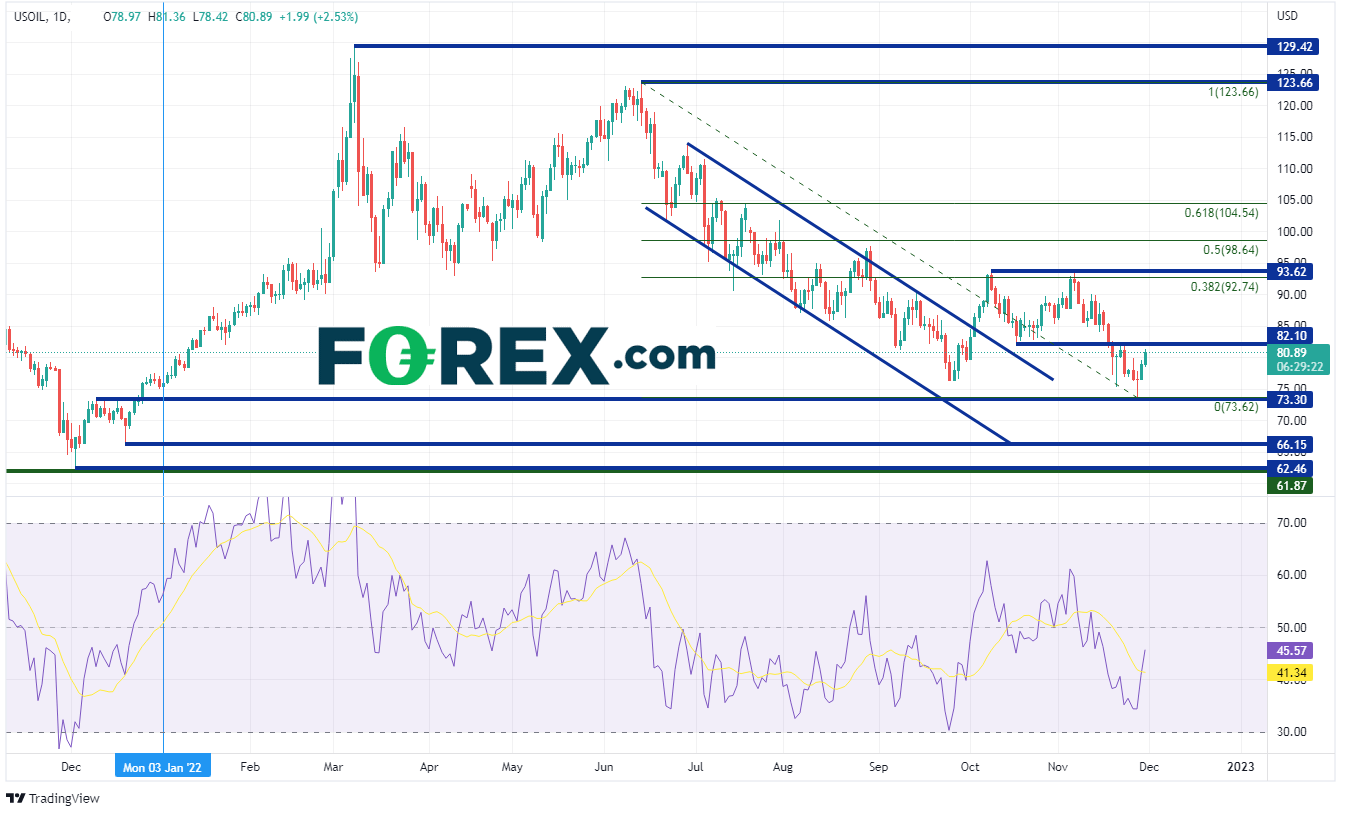
If OPEC+ leaves output unchanged, prices will increase if demand increases. If prices continue to trade higher, resistance is at the lows from October 17th at 82.10. Above there, price may struggle between previous highs and the 38.2% Fibonacci retracement level from the highs of June 14th to the lows of November 28th between 92.74 and 93.62. The next level of resistance is the 50% retracement from the same timeframe at 98.64. If demand is set to decrease as markets price-in the possibility of a global recession, prices should fall. First support is at the highs from late December 2021 at 73.30, then previous lows at 66.15 and 62.46.
Source: Tradingview, Stone X
According to recent “sources”, OPEC+ is likely to leave production unchanged when it meets virtually on December 4th. With uncertainties surrounding China’s Covid measures and its manufacturing industry, OPEC+ is likely in “wait and see” mode as the situation plays out. Add to that the uncertainty of how an EU price cap will affect the market, and the group is likely to remain on hold.
OPEC+ meets on Sunday, December 4th to decide whether it should increase or decrease oil production. It could also leave the current level of output unchanged. The meeting was supposed to be held in Vienna; however, it will now be held as a virtual meeting. Last week, it was rumored that Saudi Arabia said the group was going to increase output by 500,000bpd. The price of WTI Crude Oil fell four dollars on the rumor. However, it was later denied, and Crude Oil quickly pared its losses.
As the meeting gets closer though, “sources” say that OPEC+ will leave output unchanged. This comes after OPEC+ surprised markets in October by cutting production by 2,000,000bpd. Uncertainties in China are contributing to the likelihood that OPEC+ will leave production unchanged as the country tries to re-establish its manufacturing sector. Lockdowns and restrictions in China have led to fears of a lack of demand, which would push the price lower. However, over the last few days, China has announced several new measures to help ease Covid restrictions, including in the manufacturing city of Zhengzhou. Stores and cinemas are set to reopen, as well as taxi service and subways. On the other hand, on Wednesday, China released its NBS Manufacturing PMI for November. This print was 48 vs an expectation of 49 and a previous reading of 49.2. This is the lowest print since April. Slower manufacturing and uncertainties around Covid in China add to reasons the Committee may let the dust settle before adjusting output.
In addition, there is the matter of the EU price cap, which is expected to be decided on December 5th (the day after the OPEC+ meeting). The EU cap is still up for discussion, as some countries wish to punish Russia more than others for the invasion of Ukraine. Estimates are that the cap will be between $60 and $70. However, OPEC+ may wish to wait to see what the impact will be on Russian oil from the upcoming price cap before adjusting supply.
Trade USOIL now: Login or Open a new account!
• Open an account in the UK
• Open an account in Australia
• Open an account in Singapore
If OPEC+ leaves output unchanged, prices will increase if demand increases. If prices continue to trade higher, resistance is at the lows from October 17th at 82.10. Above there, price may struggle between previous highs and the 38.2% Fibonacci retracement level from the highs of June 14th to the lows of November 28th between 92.74 and 93.62. The next level of resistance is the 50% retracement from the same timeframe at 98.64. If demand is set to decrease as markets price-in the possibility of a global recession, prices should fall. First support is at the highs from late December 2021 at 73.30, then previous lows at 66.15 and 62.46.

Source: Tradingview, Stone X
According to recent “sources”, OPEC+ is likely to leave production unchanged when it meets virtually on December 4th. With uncertainties surrounding China’s Covid measures and its manufacturing industry, OPEC+ is likely in “wait and see” mode as the situation plays out. Add to that the uncertainty of how an EU price cap will affect the market, and the group is likely to remain on hold.
Learn more about oil trading opportunities.
Related tags:
Latest market news




The complete CFD trading experience
Award-winning platforms, competitive spreads, low commissions and dedicated support.
We live and breathe the markets and are dedicated to helping traders realise their ambitions as we continue to set the industry bar.
Economic calendar
Web Trader platform
Our sophisticated web-based platform is packed with features.
Related articles
Gold Q4 2026 outlook: Resilience in the face of rallying dollar and yields
As we headed towards the latter stages of Q3 and into Q4, the Fed had just hiked rates in a hawkish FOMC meeting, while the likes of the ECB and BoJ had also tightened their respective policies. Oil prices remained elevated amid the prolonged US-Iran conflict. Meanwhile, bond yields were breaking out, and the dollar was higher across the board. Yet, remarkably, gold was still holding in the positive territory for the third quarter, even if it had weakened somewhat in September.

EUR/USD Q4 2026 Outlook: Euro at a Crossroads as Fed, ECB Tighten 9 25 2026
EUR/USD enters Q4 at a pivotal inflection point as competing Fed-ECB policy paths and persistent inflation risks collide with major technical support.

S&P 500 Forecast: SPX rises as oil prices fall, but treasuries remain at multi-decade highs
U.S. stocks are rising on Friday after a volatile week that saw a surge in Treasury yields ripple through financial markets.
StoneX Europe Ltd may make third party material available on this website which may contain information included but not limited to the conditions of financial markets. The material is for information purposes only and does not contain, and should not be construed as containing, investment advice and/or investment recommendation and/or an investment research and/or an offer of or solicitation for any transactions in financial instruments; any decision to enter into a specific transaction shall be made by the client following an assessment by him/her of their situation.
StoneX Europe Ltd makes no representation or warranty and assumes no liability as to the accuracy or completeness of the information provided, nor any loss arising from any investment based on a recommendation, forecast or other information supplied. You should always seek independent advice as to your suitability to speculate in any related markets and your ability to assume the associated risks, if you are at all unsure. We are not under any obligation to update any such material. Any opinion made may be personal to the author and may not reflect the opinion of StoneX Europe Ltd.