



RBA instant reaction and what comes next for the AUDUSD
After implementing a series of five easing measures at its board meeting in November last year, the RBA has today taken another step towards normalising its emergency monetary policy settings.
Share this:

While the RBA kept its target of 10 basis points for the cash rate and confirmed it will continue to purchase government bonds at a rate of $4 billion per week, it put an end to its "yield curve control" (YCC) policy aimed at keeping the April 2024 government bond yield at 0.1%.
“The decision to discontinue the yield target reflects the improvement in the economy and the earlier-than-expected progress towards the inflation target.”
The RBA noted inflation has picked up, but in underlying terms, inflation remains low and is expected to increase only modestly from the current rate of 2.1%. (This doesn’t provide a lot of breathing room as the reopening from recent lockdowns gain traction.
“The central forecast is for underlying inflation of around 2¼ per cent over 2021 and 2022 and 2½ per cent over 2023.”
The RBA remains focused on wage-price inflation as noted in the last paragraph:
"The Board will not increase the cash rate until actual inflation is sustainably within the 2 to 3 per cent target range. This will require the labour market to be tight enough to generate wages growth that is materially higher than it is currently. This is likely to take some time. The Board is prepared to be patient, with the central forecast being for underlying inflation to be no higher than 2½ per cent at the end of 2023 and for only a gradual increase in wages growth."
The inclusion of the words “some time” replaces the RBA’s previous forward guidance “not before 2024” as to the timing of rate hikes.
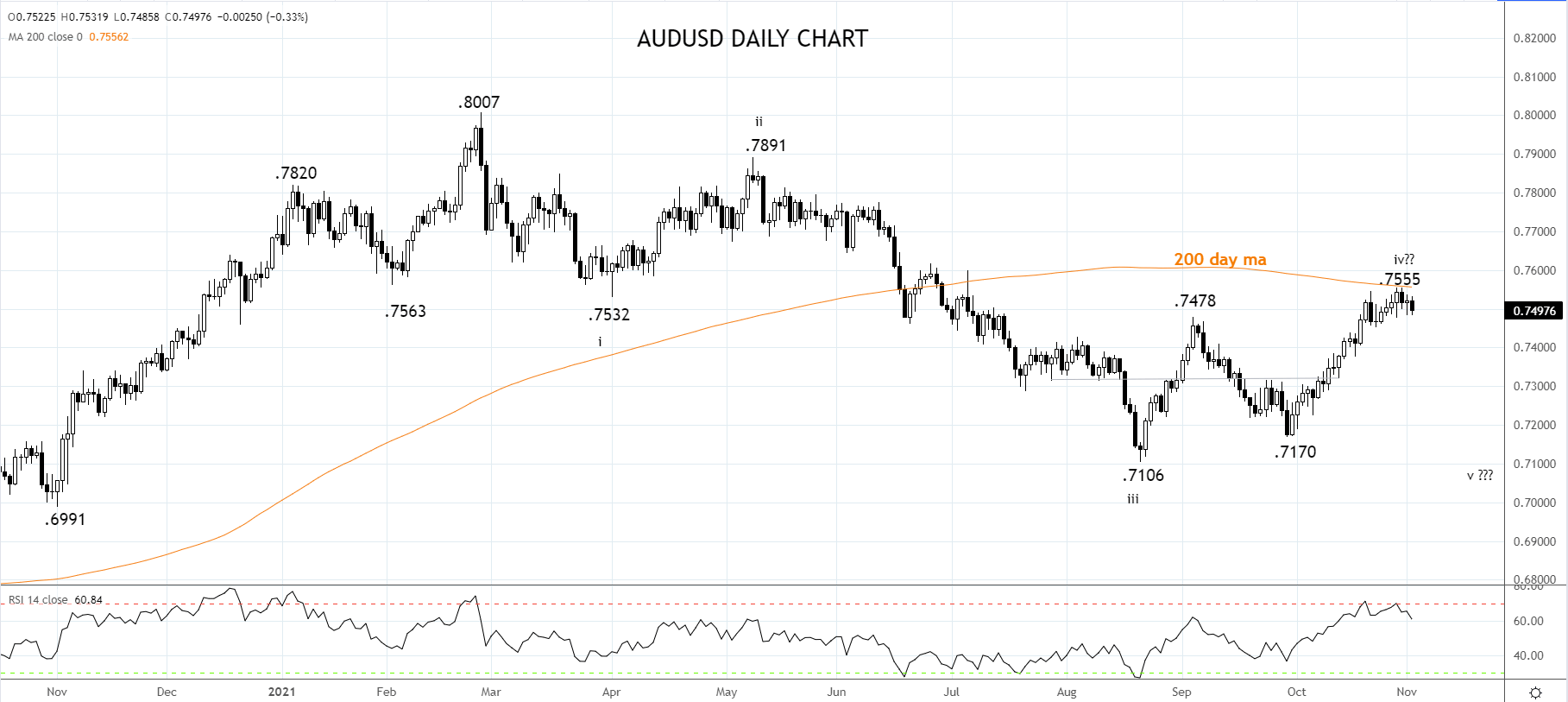
Reflecting the dovish tones and some uncertainty around the somewhat vague guidance, the AUDUSD has fallen modestly from .7520 to around .7500c.
Technically we retain a mild bearish bias in the AUDUSD leaning against resistance .7550/60c (wave equality and the 200-day ma), although needing a break below support .7470/50 to confirm the bearish bias and that a deeper decline is underway.
Source Tradingview. The figures stated are correct as of November 2nd, 2021. Past performance is not a reliable indicator of future performance. This report does not contain and is not to be taken as containing any financial product advice or financial product recommendation
How to trade with City Index
You can trade easily trade with City Index by using these four easy steps:
- Open an account, or log in if you’re already a customer
• Open an account in the UK
• Open an account in Australia
• Open an account in Singapore
- Search for the company you want to trade in our award-winning platform
- Choose your position and size, and your stop and limit levels
- Place the trade
While the RBA kept its target of 10 basis points for the cash rate and confirmed it will continue to purchase government bonds at a rate of $4 billion per week, it put an end to its "yield curve control" (YCC) policy aimed at keeping the April 2024 government bond yield at 0.1%.
“The decision to discontinue the yield target reflects the improvement in the economy and the earlier-than-expected progress towards the inflation target.”
The RBA noted inflation has picked up, but in underlying terms, inflation remains low and is expected to increase only modestly from the current rate of 2.1%. (This doesn’t provide a lot of breathing room as the reopening from recent lockdowns gain traction.
“The central forecast is for underlying inflation of around 2¼ per cent over 2021 and 2022 and 2½ per cent over 2023.”
The RBA remains focused on wage-price inflation as noted in the last paragraph:
"The Board will not increase the cash rate until actual inflation is sustainably within the 2 to 3 per cent target range. This will require the labour market to be tight enough to generate wages growth that is materially higher than it is currently. This is likely to take some time. The Board is prepared to be patient, with the central forecast being for underlying inflation to be no higher than 2½ per cent at the end of 2023 and for only a gradual increase in wages growth."
The inclusion of the words “some time” replaces the RBA’s previous forward guidance “not before 2024” as to the timing of rate hikes.
Reflecting the dovish tones and some uncertainty around the somewhat vague guidance, the AUDUSD has fallen modestly from .7520 to around .7500c.
Technically we retain a mild bearish bias in the AUDUSD leaning against resistance .7550/60c (wave equality and the 200-day ma), although needing a break below support .7470/50 to confirm the bearish bias and that a deeper decline is underway.
Source Tradingview. The figures stated are correct as of November 2nd, 2021. Past performance is not a reliable indicator of future performance. This report does not contain and is not to be taken as containing any financial product advice or financial product recommendation
- Open a Forex.com account, or log in if you’re already a customer.
- Search for the pair you want to trade in our award-winning platform.
- Choose your position and size, and your stop and limit levels.
- Place the trade.
Latest market news




The complete CFD trading experience
Award-winning platforms, competitive spreads, low commissions and dedicated support.
We live and breathe the markets and are dedicated to helping traders realise their ambitions as we continue to set the industry bar.
Economic calendar
Web Trader platform
Our sophisticated web-based platform is packed with features.
Related articles
USD/JPY outlook: Hawkish Fed recalibration pressures the yen
Stronger US growth momentum and rising Treasury yields are keeping USD/JPY pointed higher, even as Japanese policymakers try to limit the pressure building across domestic markets.
USD/MXN Forecast: Peso Loses Momentum Ahead of Banxico Decision
Over recent trading sessions, the Mexican peso has started to show signs of losing strength against the U.S. dollar. This can be seen in the performance of USD/MXN, which has gained more than 1.7% over the last three sessions, highlighting the dollar's renewed strength against the peso.

Euro Short-term Outlook: EUR/USD Selloff Nears Critical Yearly Support 9 23 2026
Euro has fallen seven of the past nine sessions, with stretched momentum raising the stakes as EUR/USD closes in on a major inflection zone.

StoneX Europe Ltd may make third party material available on this website which may contain information included but not limited to the conditions of financial markets. The material is for information purposes only and does not contain, and should not be construed as containing, investment advice and/or investment recommendation and/or an investment research and/or an offer of or solicitation for any transactions in financial instruments; any decision to enter into a specific transaction shall be made by the client following an assessment by him/her of their situation.
StoneX Europe Ltd makes no representation or warranty and assumes no liability as to the accuracy or completeness of the information provided, nor any loss arising from any investment based on a recommendation, forecast or other information supplied. You should always seek independent advice as to your suitability to speculate in any related markets and your ability to assume the associated risks, if you are at all unsure. We are not under any obligation to update any such material. Any opinion made may be personal to the author and may not reflect the opinion of StoneX Europe Ltd.