



Stocks extend slide
Central banks from two of the world’s largest trading blocs signalled that their restrictive monetary policies are going to remain in place for longer than expected.
Share this:

European stock markets have extended their losses, with US futures also pointing to another sharp drop at the open. “Risk-off” remains dominant theme, with safe-haven US dollar also rising. The publication of stronger-than-expected European PMIs was unable to lift the mode, although they all remained below the expansion level of 50.0. Eurozone CPI was revised a touch higher to 10.1%, underscoring the ECB’s desire to keep its restrictive policy in place for longer.
So, what is really driving the markets?
In a nutshell, it is all about fears over a sharper economic slowdown in 2023 than previously expected. While macro data have been weak of late, there was still hope that the downturn might be short-lived and that a recession might be avoided in some regions altogether, amid signs of inflation peaking in some regions like the US.
However, the market has questioned that view after central banks from two of the world’s largest trading blocs signalled that their restrictive monetary policies are going to remain in place for longer than expected.
There were hopes that with inflation showing signs of peaking, the Fed and ECB would end their rate increases soon.
While the Fed was a little more hawkish in that the FOMC projected a terminal interest rate of around 5%, slightly more than the market had anticipated, the real surprise was the ECB, which caught many people by surprise.
Though the EUR/USD initially rallied, its gains soon evaporated as risk sentiment quickly turned sour and stocks fell. Traders became concerned about the ECB’s desire to raise interest rates at a 50 basis-point pace “for a period of time,” according to President Christine Lagarde.
Other high-beta currencies also sold off, and this helped to support the safe-haven US dollar.
But the impact of the hawkish ECB was felt even greater in the stock market, where the major indices suffered one of their biggest declines in weeks.
At the time of writing, there was still no end in sight in the stock market sell-off as we headed to the final day of the week, and final weeks of the year.
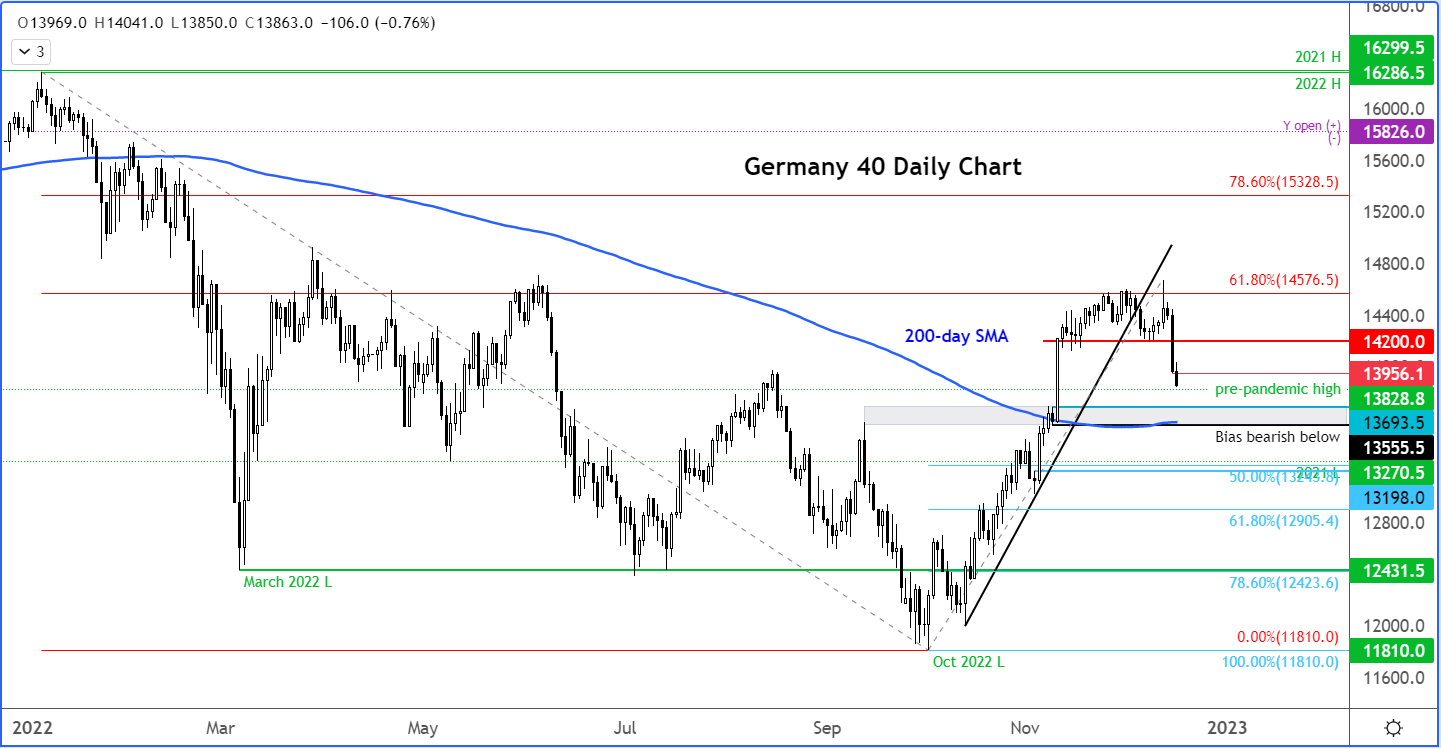
There are a few key support levels approaching on the major indices such as the below highlighted region on the German DAX index, but let’s see if the markets will bounce there and whether any bounce that we might see will hold.
How to trade with FOREX.com
Follow these easy steps to start trading with FOREX.com today:
- Open a Forex.com account, or log-in if you’re already a customer.
- Search for the pair you want to trade in our award-winning platform.
- Choose your position and size, and your stop and limit levels.
- Place the trade.
How to trade with City Index
You can trade with City Index by following these four easy steps:
- Open an account, or log in if you’re already a customer
• Open an account in the UK
• Open an account in Australia
• Open an account in Singapore
- Search for the company you want to trade in our award-winning platform
- Choose your position and size, and your stop and limit levels
- Place the trade
Related tags:
Latest market news




The complete CFD trading experience
Award-winning platforms, competitive spreads, low commissions and dedicated support.
We live and breathe the markets and are dedicated to helping traders realise their ambitions as we continue to set the industry bar.
Economic calendar
Web Trader platform
Our sophisticated web-based platform is packed with features.
Related articles
EUR/USD weekly outlook: Oil, inflation and NFP in focus
After coming under significant pressure in recent weeks, the EUR/USD came off its lows to finish the week on a positive note on Friday, albeit with only a mild rebound. That was not enough to prevent the exchange rate falling for the third consecutive week, as the US dollar and bond yields rallied across the board.
Gold Q4 2026 outlook: Resilience in the face of rallying dollar and yields
As we headed towards the latter stages of Q3 and into Q4, the Fed had just hiked rates in a hawkish FOMC meeting, while the likes of the ECB and BoJ had also tightened their respective policies. Oil prices remained elevated amid the prolonged US-Iran conflict. Meanwhile, bond yields were breaking out, and the dollar was higher across the board. Yet, remarkably, gold was still holding in the positive territory for the third quarter, even if it had weakened somewhat in September.

Oil Quietly Hands the Fed a Reason to Stay Hawkish
Oil prices and the U.S. dollar are both on the front foot as elevated energy costs feed Fed warnings that inflation may prove sticky.
StoneX Europe Ltd may make third party material available on this website which may contain information included but not limited to the conditions of financial markets. The material is for information purposes only and does not contain, and should not be construed as containing, investment advice and/or investment recommendation and/or an investment research and/or an offer of or solicitation for any transactions in financial instruments; any decision to enter into a specific transaction shall be made by the client following an assessment by him/her of their situation.
StoneX Europe Ltd makes no representation or warranty and assumes no liability as to the accuracy or completeness of the information provided, nor any loss arising from any investment based on a recommendation, forecast or other information supplied. You should always seek independent advice as to your suitability to speculate in any related markets and your ability to assume the associated risks, if you are at all unsure. We are not under any obligation to update any such material. Any opinion made may be personal to the author and may not reflect the opinion of StoneX Europe Ltd.