




US banks Q2 earnings preview JPM WFC C and BAC
See the key themes and trends we'll be watching next week as major US banks report Q2 earnings.
Share this:

The bank's forward guidance remained dovish. Specifically, the RBA reiterated that the conditions to raise interest rates including inflation sustainably between the 2 to 3% target rate and wages growth of 3% are unlikely to be met until 2024 at the earliest.
Reflecting the stronger than expected economic recovery the RBA took its first steps to reduce stimulus after the expiration of the bank's Term Funding Facility (TFF) on June 30 by not electing to extend its three-year “yield target bond” from the April 2024 bond to the November 2024 bond.
It also announced a more flexible approach to its latest QE program after the current program of $100bn is complete in September, reducing the pace of purchases to $4 billion a week from the current pace of purchases of $5 billion per week. It will reassess this decision in Mid-November.
Attention now turns to RBA Governor Lowes prepared remarks at 4.00 pm Sydney time that are expected to contain similar information to what was provided at the 2.30 pm meeting and details around which month, quantity, and bond yields the RBA will target under its new QE program.
What does it mean for the AUDUSD?
After a brief fall to .7544 after the announcement, the AUDUSD has rebounded to be testing the resistance coming from the 200 day moving average near .7570.
Should the AUDUSD break and post a couple of consecutive daily closes above .7570ish it would be an initial indication that a short-term low is in place at last week’s .7446 low and that the AUDUSD can rally towards .7700c.
Source Tradingview. The figures stated areas of the 6th of July 2021. Past performance is not a reliable indicator of future performance. This report does not contain and is not to be taken as containing any financial product advice or financial product recommendation
Q2 earnings season picks up speed next week when the major US banks start to report. Against the backdrop of improving global growth, fiscal stimulus, vaccines allowing reopening, and low-interest rates, US banks are expected to deliver investors record earnings in 2021.
Below, we highlight the key themes we’ll be watching from the major US bank earnings reports:
Guidance
Q2 has marked the eye of the US re-opening. GDP data to be released in a few weeks’ time is expected to confirm the US economy grew at ~9% in Q2. Households are in good shape and are thought to have accumulated about $2.4T in forced savings that represent ~11% of GDP.
According to data from Factset, “the Q2 bottom-up EPS estimate (which is an aggregation of the median Q2 EPS estimates for all the companies in the index) increased by 7.3% (to $45.03 from $41.97) during this period”.
This represents the largest increase in the bottom-up EPS estimate during a quarter since FactSet began tracking the data in Q2 2002. The previous record was 6.5%, from Q1 2021. At the sector level, nine of the 11 sectors recorded an increase in their bottom-up EPS estimates during the quarter, including Financials (+9.3%).
Now a note of caution. It is important to remember that Q2 is expected to be the peak of the recovery. Lower interest rates, reduced volatility as well as uncertainty around the Federal Reserve’s tapering of asset purchases and the re-emergence of inflation may be reflected in comments by company executives when outlining prospects for the second half of 2021.
Loan loss reserves
After making large provisions in anticipation of losses on loan books following the onset of the pandemic, it turns out that US banks did very well as loan losses failed to materialise. This allowed banks to reverse many of those provisions and re-realize profits on previous loans in Q1.
Last month the Federal Reserve released the results of its annual stress test that confirmed US banks could easily withstand a severe recession and that all 23 institutions examined remained “well above” minimum required capital levels during a hypothetical economic downturn.
Buybacks and dividends
After banning buybacks and capping dividend pay-outs last year, the Fed has since cleared all 23 financial institutions examined in their recent stress test to increased pay-outs.
Under the Fed's new “stress test capital buffer” framework, banks have regained flexibility in how they want to pay dividends and buybacks. This is expected to lead to higher dividends and larger buybacks going forward.
JPMorgan Chase (JPM) - Reports 13 July
Expectation: $3.13 in EPS on $29.87B in revenues
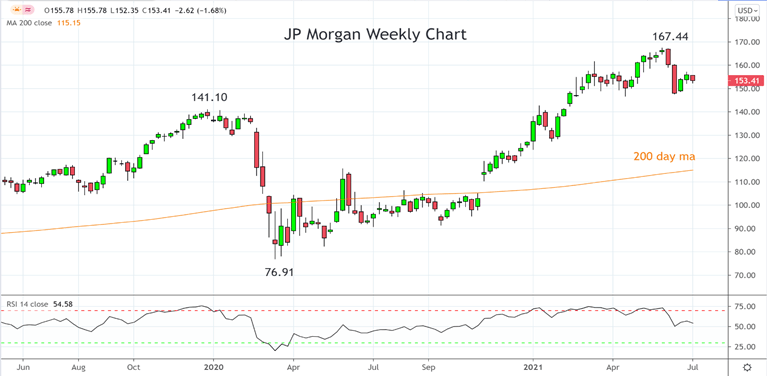
JPMorgan is the largest US bank by market capitalisation with over $3.2 trillion in assets. The bank is expected to continue with its $30 billion share repurchase plan in December 2020, valid for an indefinite timeframe.
Revenue is expected to fall from $33.13B in Q1 to $29.87B in Q2, partly due to decreased volatility noted recently by JPM CEO Jamie Dimon who projected a 38% year-over-year plunge in trading revenues.
On the other hand, JPMorgan’s IB revenues are anticipated to be up in Q2, backed by an active M&A market and strong client activity in equities and debt capital markets.
The stock price of JPM has gained ~20% from the beginning of 2021, increasing from $127 to near $153.40 at the time of writing, reflecting outperformance over the S&P500 which has rallied about 15.5% over the same period.
Wells Fargo (WFC) - Reports 14 July
Expectation: $0.93 in EPS on $17.78B in revenues
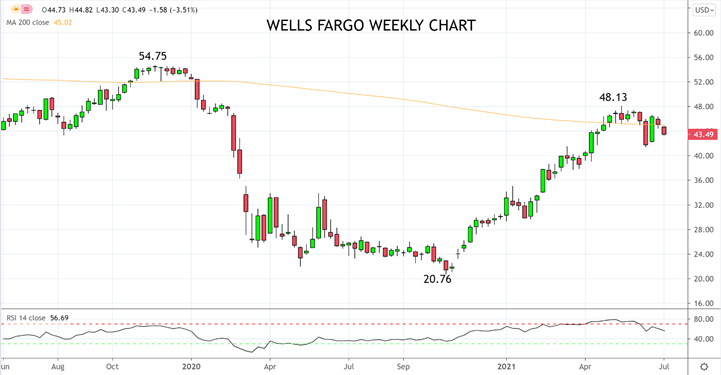
Wells Fargo is the third-largest US bank by market capitalization with over $1.77T in assets. It is the largest mortgage banker in the United States.
Revenues are expected to fall slightly from $18.06B in Q1 to $17.78B in Q2 as the decline in interest rates during Q2 weighs on net interest income on its loan book.
The share price of Wells Fargo has rallied ~ 43% from the beginning of 2021, increasing from $30 to approximately $43.49 at the time of writing, reflecting significant outperformance over the S&P500 which has rallied about 15.5% over the same period.
Citigroup (C) - Reports 14 July
Expectation: $2.04 in EPS on $17.58B in revenues
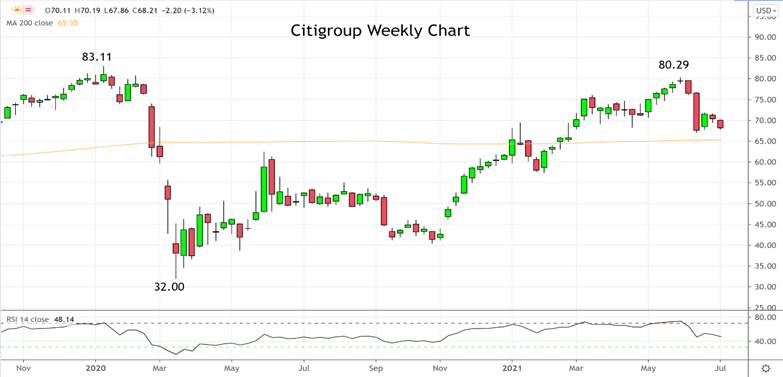
Citigroup is the fourth-largest US bank by market capitalization with over $1.68T in assets.
Revenues are expected to fall slightly from $19.3B in Q1 to $17.58B in Q2, as trading revenues fall by a percentage in the “low 30s”. Strength in equity trading unable to counter weakness in fixed income trading.
Also weighing on revenue, a decision to close the retail banking operations in 13 countries across Asia and parts of Europe to focus more on wealth management, not to mention lower US interest rates in Q2 that reduces net interest income on the loan book.
After falling from a high of $80.29 in early June, the share price of Citigroup is trading near $67.93 at the time of writing. This is still 10% above where it started the year but reflects underperformance vs the S&P500 which has rallied about 15.5% over the same period.
Bank of America (BAC) - Reports 14 July
Expectation: $0.77 in EPS on $22.08B in revenues
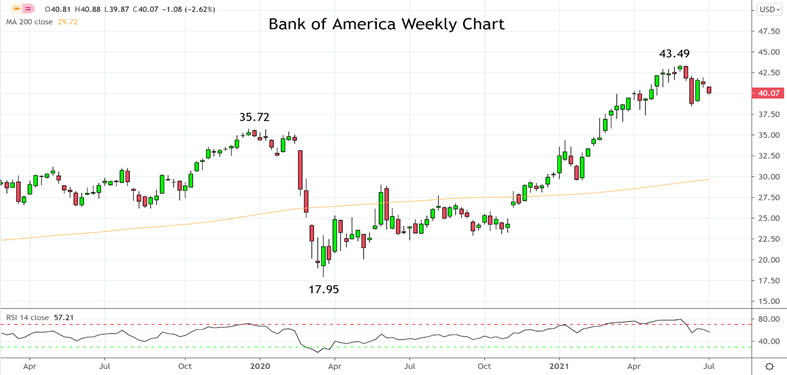
Bank of America is the second-largest US bank by market capitalization with over $2.32T in assets.
Revenues are expected to fall slightly from $22.93B in Q1 to $22.08B in Q2 reflecting softer net interest income that contributes more than 50% of total revenue. Lower interest rates and volatility during Q2are also likely to impact the bank's earnings from the investment banking and sales & trading divisions.
After falling from a high of $43.49 in early June, the share price of Bank of America is trading near $39.75. This is over 30% above where it started the year and reflects significant outperformance vs the S&P500 which has rallied about 15.5% over the same period.
Source Tradingview. The figures stated areas of the 8th of July 2021. Past performance is not a reliable indicator of future performance. This report does not contain and is not to be taken as containing any financial product advice or financial product recommendation
Latest market news




The complete CFD trading experience
Award-winning platforms, competitive spreads, low commissions and dedicated support.
We live and breathe the markets and are dedicated to helping traders realise their ambitions as we continue to set the industry bar.
Economic calendar
Web Trader platform
Our sophisticated web-based platform is packed with features.
Related articles
EUR/USD Q4 2026 Outlook: Euro at a Crossroads as Fed, ECB Tighten 9 25 2026
EUR/USD enters Q4 at a pivotal inflection point as competing Fed-ECB policy paths and persistent inflation risks collide with major technical support.

USD/JPY Q4 2026 Outlook: Hawkish Fed Pricing Clashes With Intervention Risk
The year-end tug-of-war is clear: hawkish Fed pricing supports USD/JPY, while intervention risk limits the upside.


Japanese Yen Forecast: USD/JPY 4% Rally Challenges Post-Intervention Downtrend 9 24 2026
USD/JPY momentum has shifted sharply higher, putting a major resistance confluence in focus as U.S. and Japanese event risk builds.
StoneX Europe Ltd may make third party material available on this website which may contain information included but not limited to the conditions of financial markets. The material is for information purposes only and does not contain, and should not be construed as containing, investment advice and/or investment recommendation and/or an investment research and/or an offer of or solicitation for any transactions in financial instruments; any decision to enter into a specific transaction shall be made by the client following an assessment by him/her of their situation.
StoneX Europe Ltd makes no representation or warranty and assumes no liability as to the accuracy or completeness of the information provided, nor any loss arising from any investment based on a recommendation, forecast or other information supplied. You should always seek independent advice as to your suitability to speculate in any related markets and your ability to assume the associated risks, if you are at all unsure. We are not under any obligation to update any such material. Any opinion made may be personal to the author and may not reflect the opinion of StoneX Europe Ltd.