


US NFP in-line. What does it mean for the Fed?
Based on today’s NFP report, the US jobs market is still strong and should lead to more rate hikes by the Fed.
Share this:

September US Non-Farm Payrolls showed that the economy added 263,000 jobs to the economy, roughly in line with expectations. Although the print was less than August’s 315,000, it still shows that the jobs market is humming along nicely. The Unemployment Rate dropped back to 3.5% vs an expectation of 3.7%. This print returned to the same level as in July, which was the lowest in over 2 years. In addition, the Participation Rate fell to 62.3% vs 62.4% prior. Average Hourly Earnings was in-line with expectations at 0.3%.
The Fed should be happy with the jobs data. Although lower than August’s print, September’s NFP print still shows that the jobs market is strong. The Fed has been saying in unison lately that lowering inflation is its number one concern. The way to lower inflation is by hiking interest rates. The Fed has long said that it is willing to lower inflation at the expense of jobs. So far, the Fed’s rate hikes from 0% to 3.25% have not had a hit to the Unemployment Rate. Note also that the Average Hourly Earnings was +0.3%. This shows that earnings are continuing to move higher as inflation moves higher. Therefore, September’s jobs data should continue to give the FOMC confidence to raise rates by 75bps when it meets again on November 2nd. If the CPI data next week is stronger than expected (economist’s consensus is for 8.1% YoY), then markets may see calls for rate hikes as high at 100bps!
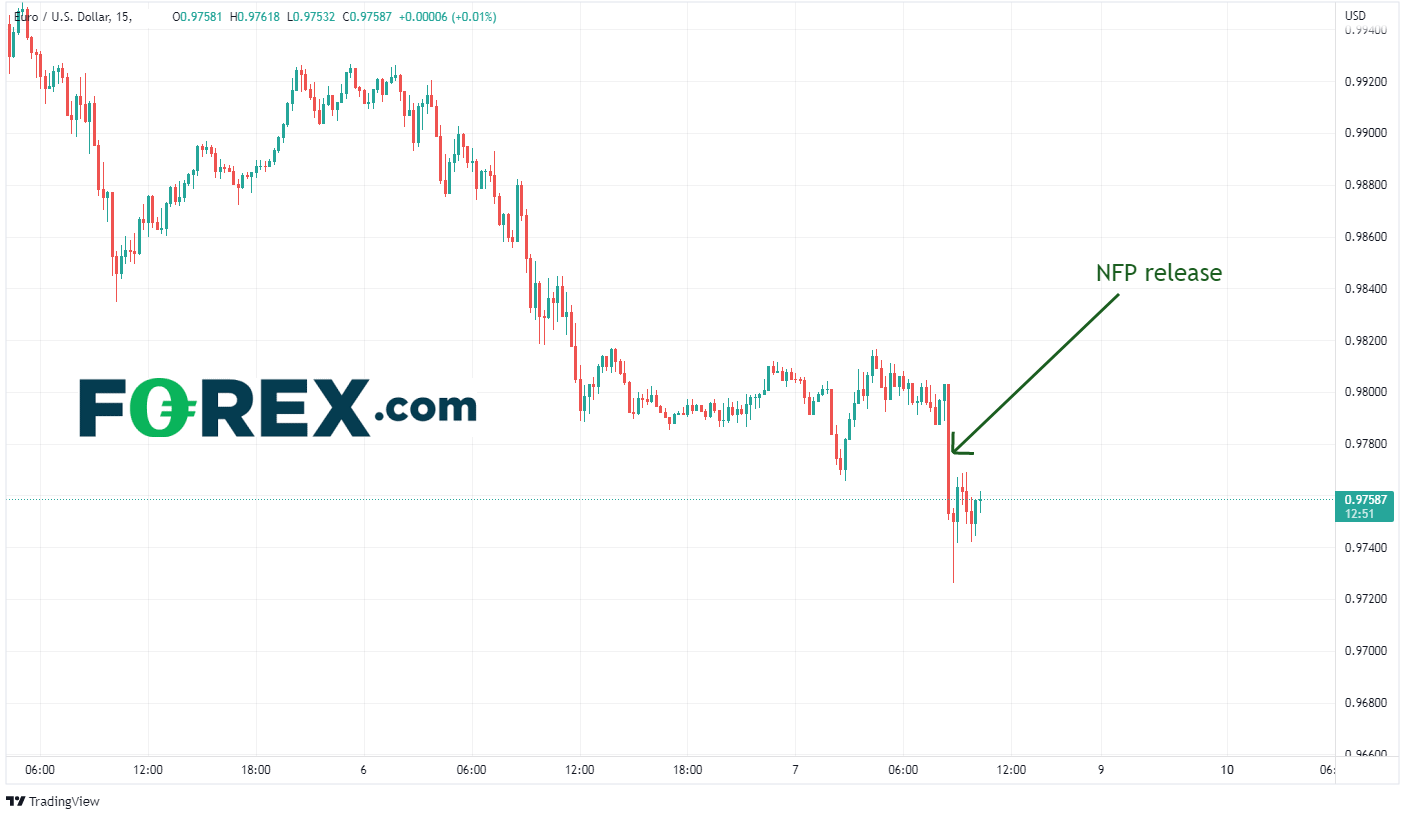
Upon the release of the data, the US Dollar went bid. The Euro makes up 57% of the US Dollar Index (DXY). Therefore, as the DXY went higher, EUR/USD moved lower. The pair moved from 0.9803 down to 0.9726, a drop of 77 pips.
Source: Tradingview, Stone X
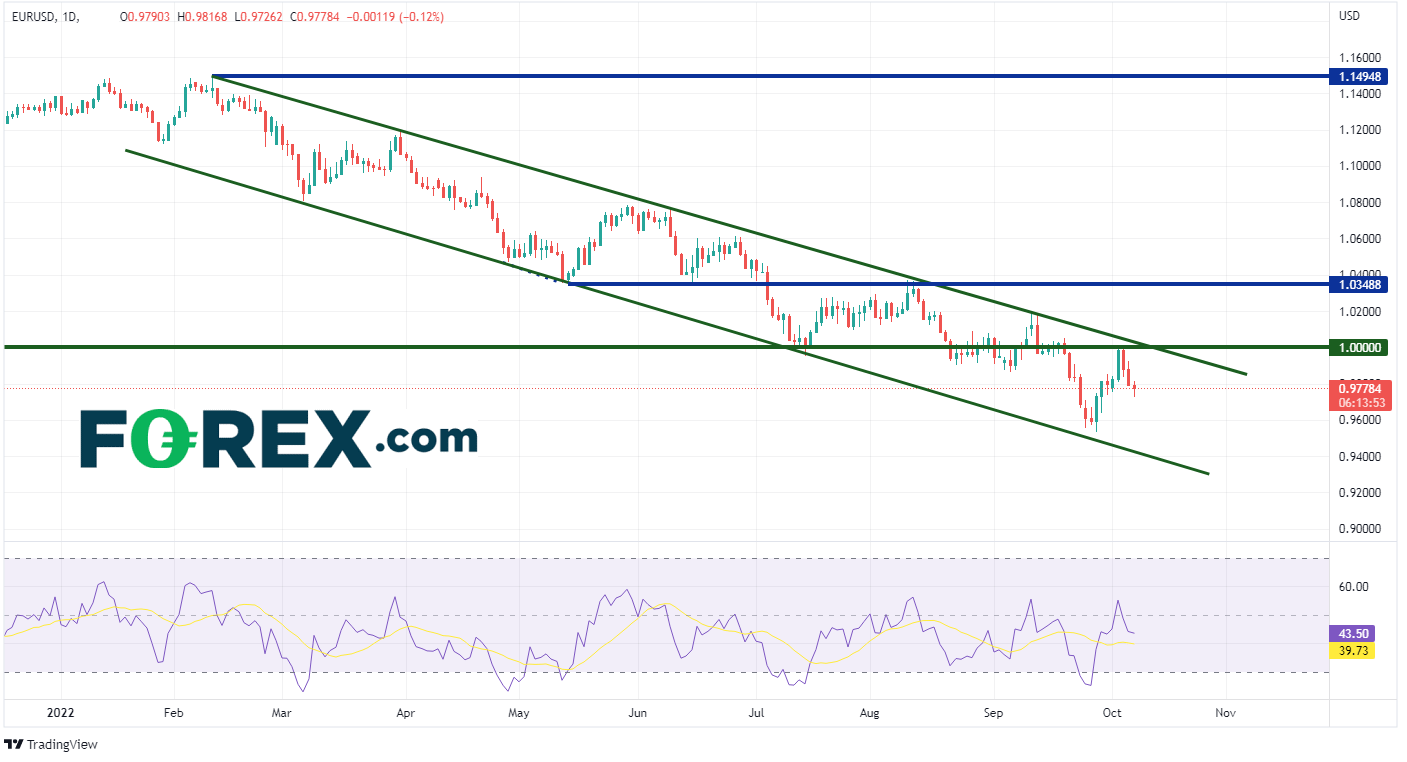
EUR/USD has already been moving aggressively lower since the pair reached a year-to-date high of 1.1495 on February 10th. The pair has been moving lower in an orderly downward channel since then as the Fed raised rates faster than the ECB. During late August and early September, EUR/USD oscillated around parity. On September 21st, EUR/USD dropped 132 pips and parity has yet to be seen since. A 20-year low was established on September 28th near 0.9536 as the RSI became oversold. The pair bounced back towards parity over the next few days, only to once again move lower into the NFP release today.
Source: Tradingview, Stone X
If EUR/USD does continue to move lower, the first support is at the 61.8% Fibonacci retracement level from the lows of September 28th to the highs of October 4th , near 0.9715. Below there, the pair can trade to the September 29th lows of 0.9635, then the lows of September 28th at 0.9536. However, if the pair bounces, first resistance is at 0.9834. Above there is a confluence of resistance at the top, downward sloping trendline of long-term channel, recent highs, and psychological resistance near 1.0000. If the pair breaks above 1.0000, the next resistance level is 1.0192.

Source: Tradingview, Stone X
Will the Fed continue to hike rates? Based on today’s NFP report, the US jobs market is still strong and should lead to more rate hikes by the Fed. However, if the inflation data next week is much weaker than expected, the Fed may look to change its tune.
September US Non-Farm Payrolls showed that the economy added 263,000 jobs to the economy, roughly in line with expectations. Although the print was less than August’s 315,000, it still shows that the jobs market is humming along nicely. The Unemployment Rate dropped back to 3.5% vs an expectation of 3.7%. This print returned to the same level as in July, which was the lowest in over 2 years. In addition, the Participation Rate fell to 62.3% vs 62.4% prior. Average Hourly Earnings was in-line with expectations at 0.3%.
The Fed should be happy with the jobs data. Although lower than August’s print, September’s NFP print still shows that the jobs market is strong. The Fed has been saying in unison lately that lowering inflation is its number one concern. The way to lower inflation is by hiking interest rates. The Fed has long said that it is willing to lower inflation at the expense of jobs. So far, the Fed’s rate hikes from 0% to 3.25% have not had a hit to the Unemployment Rate. Note also that the Average Hourly Earnings was +0.3%. This shows that earnings are continuing to move higher as inflation moves higher. Therefore, September’s jobs data should continue to give the FOMC confidence to raise rates by 75bps when it meets again on November 2nd. If the CPI data next week is stronger than expected (economist’s consensus is for 8.1% YoY), then markets may see calls for rate hikes as high at 100bps!
Everything you need to know about the Federal Reserve
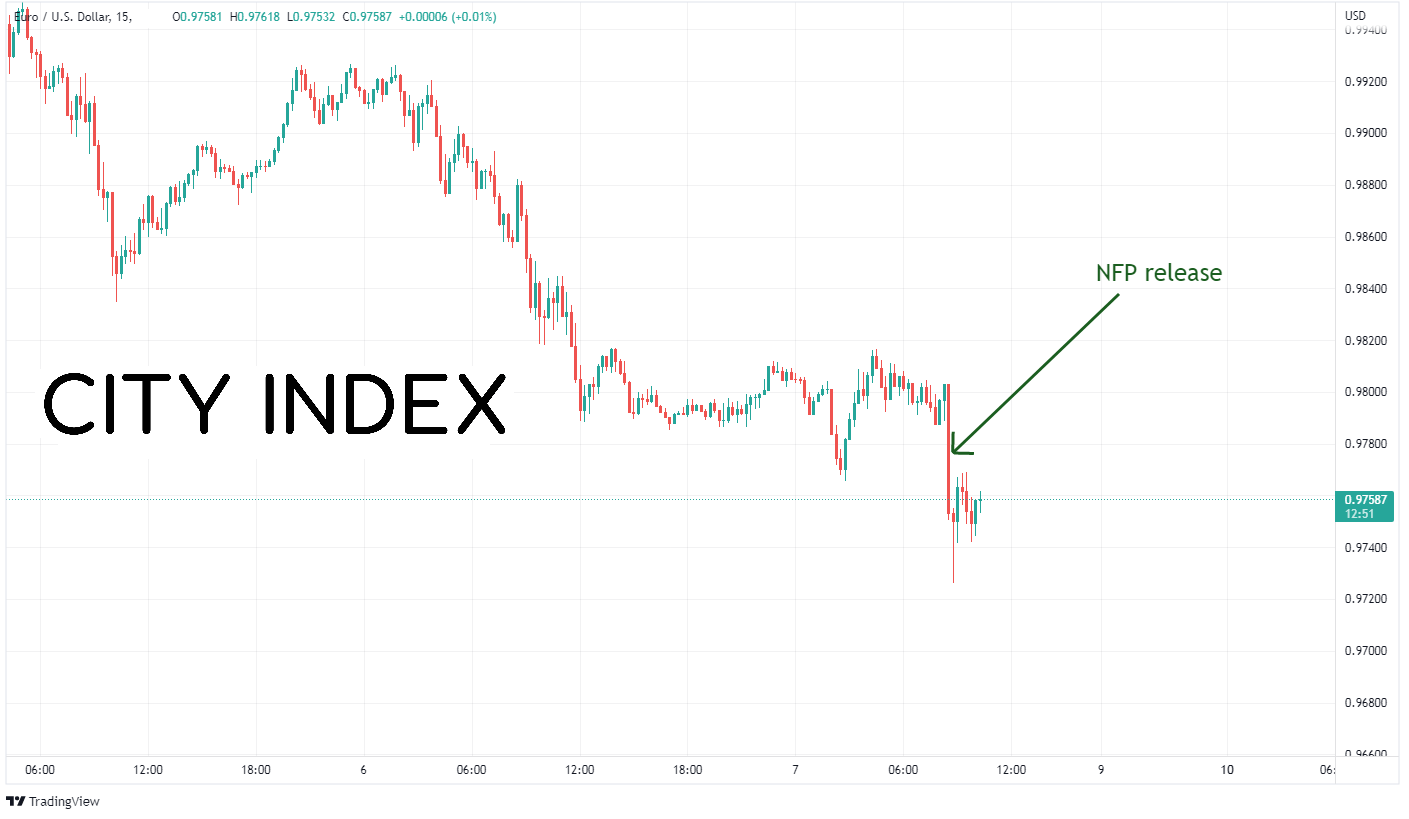
Upon the release of the data, the US Dollar went bid. The Euro makes up 57% of the US Dollar Index (DXY). Therefore, as the DXY went higher, EUR/USD moved lower. The pair moved from 0.9803 down to 0.9726, a drop of 77 pips.
Source: Tradingview, Stone X
Trade EUR/USD now: Login or Open a new account!
• Open an account in the UK
• Open an account in Australia
• Open an account in Singapore
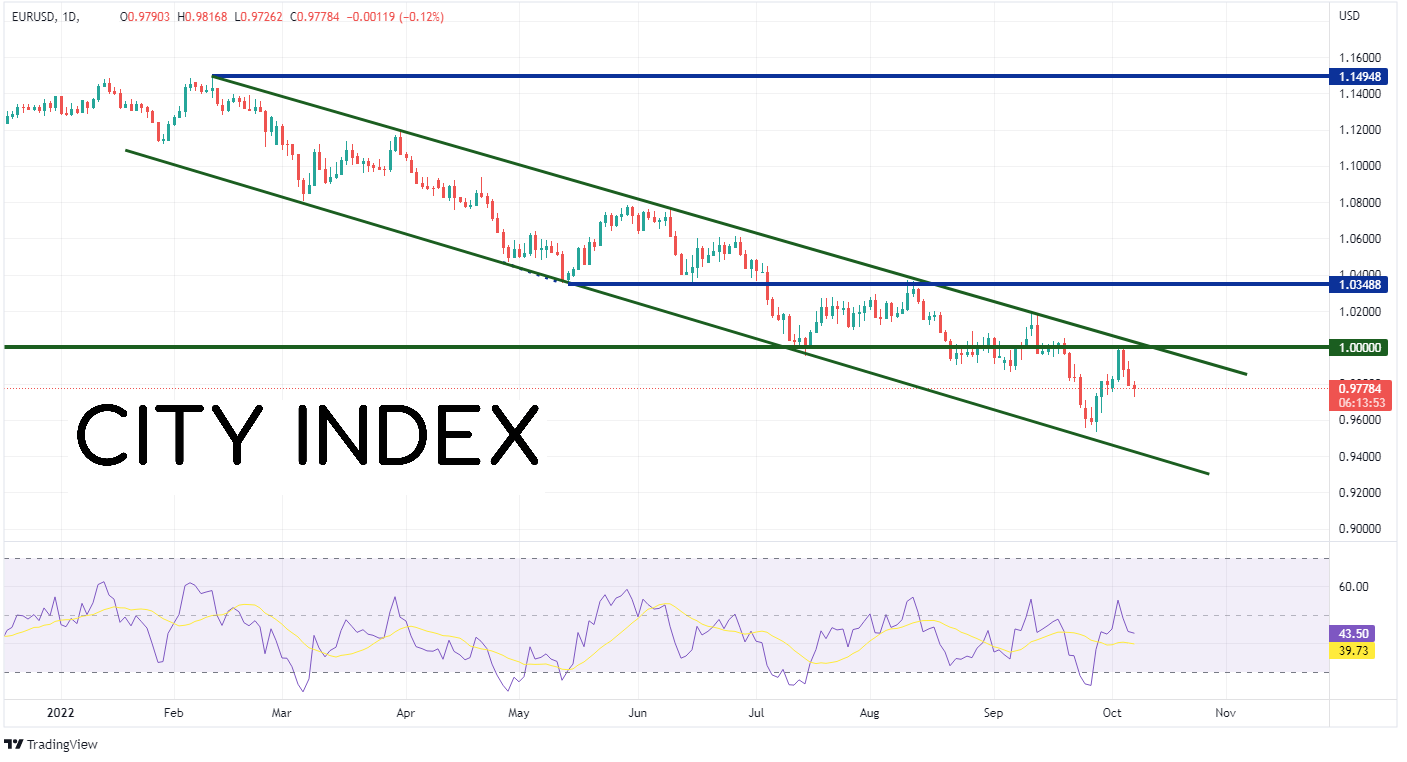
EUR/USD has already been moving aggressively lower since the pair reached a year-to-date high of 1.1495 on February 10th. The pair has been moving lower in an orderly downward channel since then as the Fed raised rates faster than the ECB. During late August and early September, EUR/USD oscillated around parity. On September 21st, EUR/USD dropped 132 pips and parity has yet to be seen since. A 20-year low was established on September 28th near 0.9536 as the RSI became oversold. The pair bounced back towards parity over the next few days, only to once again move lower into the NFP release today.
Source: Tradingview, Stone X
If EUR/USD does continue to move lower, the first support is at the 61.8% Fibonacci retracement level from the lows of September 28th to the highs of October 4th , near 0.9715. Below there, the pair can trade to the September 29th lows of 0.9635, then the lows of September 28th at 0.9536. However, if the pair bounces, first resistance is at 0.9834. Above there is a confluence of resistance at the top, downward sloping trendline of long-term channel, recent highs, and psychological resistance near 1.0000. If the pair breaks above 1.0000, the next resistance level is 1.0192.

Source: Tradingview, Stone X
Will the Fed continue to hike rates? Based on today’s NFP report, the US jobs market is still strong and should lead to more rate hikes by the Fed. However, if the inflation data next week is much weaker than expected, the Fed may look to change its tune.
Learn more about forex trading opportunities.
Related tags:
Latest market news




The complete CFD trading experience
Award-winning platforms, competitive spreads, low commissions and dedicated support.
We live and breathe the markets and are dedicated to helping traders realise their ambitions as we continue to set the industry bar.
Economic calendar
Web Trader platform
Our sophisticated web-based platform is packed with features.
Related articles
USD/JPY Q4 2026 Outlook: Hawkish Fed Pricing Clashes With Intervention Risk
The year-end tug-of-war is clear: hawkish Fed pricing supports USD/JPY, while intervention risk limits the upside.


Japanese Yen Forecast: USD/JPY 4% Rally Challenges Post-Intervention Downtrend 9 24 2026
USD/JPY momentum has shifted sharply higher, putting a major resistance confluence in focus as U.S. and Japanese event risk builds.


Oil Quietly Hands the Fed a Reason to Stay Hawkish
Oil prices and the U.S. dollar are both on the front foot as elevated energy costs feed Fed warnings that inflation may prove sticky.

StoneX Europe Ltd may make third party material available on this website which may contain information included but not limited to the conditions of financial markets. The material is for information purposes only and does not contain, and should not be construed as containing, investment advice and/or investment recommendation and/or an investment research and/or an offer of or solicitation for any transactions in financial instruments; any decision to enter into a specific transaction shall be made by the client following an assessment by him/her of their situation.
StoneX Europe Ltd makes no representation or warranty and assumes no liability as to the accuracy or completeness of the information provided, nor any loss arising from any investment based on a recommendation, forecast or other information supplied. You should always seek independent advice as to your suitability to speculate in any related markets and your ability to assume the associated risks, if you are at all unsure. We are not under any obligation to update any such material. Any opinion made may be personal to the author and may not reflect the opinion of StoneX Europe Ltd.