



USD/CHF bears stir as franc haven demand returns
The franc was the standout G10 performer after Treasury announced larger long-end buybacks this week. Strong fundamentals and shifting correlations suggest the move may have further to run.
Share this:

- Treasury intervention raises questions over dollar haven status
- Swiss franc outperforms as safe-haven demand builds
- Switzerland’s balance sheet reinforces haven case
- USD/CHF technicals favour bearish bias
Swiss franc’s haven credentials strengthened
The Swiss franc’s credentials as the last true bastion of safe-haven status in the FX universe have been reinforced by events this week.
On Wednesday, the franc was the best-performing G10 currency by some distance following the US Treasury’s announcement that it would double the size of long-dated Treasury buybacks.
While USD/CHF bounced modestly on Thursday as we saw a retracement in the move in long-end Treasury yields, the broader message is pretty obvious. If policymakers in the US are becoming more willing to actively combat market forces when it doesn’t politically suit, the franc stands out as the one true developed-market currency haven given its fundamental strength.
Looking at the charts, the question is whether more interventionist policies like these could provide the catalyst for a broader resumption of the bearish USD/CHF trend seen over recent decades.
Treasury intervention risks grow
This week’s developments suggest tinkering at the long end of the Treasury curve by Treasury may evolve into something far more significant, potentially the tsunami of interventionist activity I described in a separate analysis piece yesterday.
After announcing that long-dated Treasury buybacks would be doubled to at least $4 billion per operation a day earlier, Treasury Secretary Scott Bessent went further on Thursday, saying purchases could be increased beyond that level.
More importantly, Bessent was explicit that part of the objective was signalling that long-bond yields do not reflect underlying fundamentals. That is an extraordinary statement given the US fiscal position. It effectively amounts to Bessent saying he knows better than the market and is prepared to actively combat bearish forces when yields move to levels the government finds politically or fiscally uncomfortable.
Given the market reaction to the statement was to sell the long end, what was pitched as an operation to improve liquidity risks becoming something far more consequential for the US dollar. If Treasury is seen to be developing a broader suite of measures designed to push long-dated yields lower whenever market forces drive them higher, it risks eroding confidence in the dollar’s safe-haven credentials.
With US government debt already enormous and the cost of servicing it rising rapidly, the incentive to keep long-term borrowing costs contained is obvious.
Haven flows take over
Given the risk of more interventionist policies being used to artificially suppress bond yields, it is only natural that the investment community would seek out alternatives to the US dollar. Based on what we saw earlier this week, the Swiss franc was clearly among them.
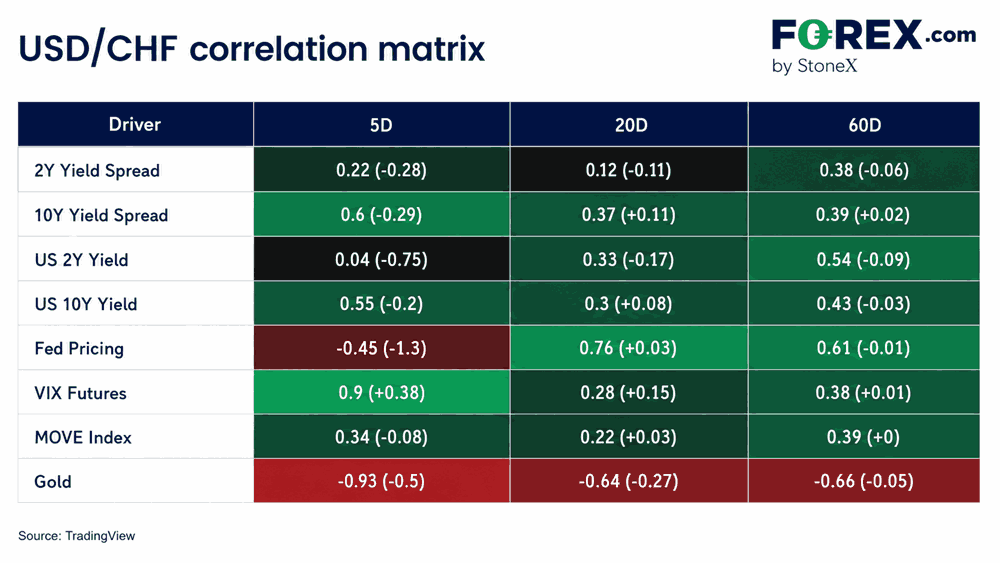
Looking at the correlation matrix below, the five-day window suggests what had been a modestly positive relationship between USD/CHF, yield differentials and US Treasury yield movements has abruptly shifted over the past week.
Source: TradingView, FOREX.com
Instead, USD/CHF has maintained a strong inverse relationship with other safe havens such as gold, while its relationship with volatility measures such as VIX futures has strengthened sharply. That points to a market increasingly trading the pair through the lens of safe-haven demand rather than relative rates alone.
You could argue that the initial reaction suggests the franc could be a significant beneficiary if the dollar debasement narrative heard earlier this year, and through parts of 2025, begins to manifest itself again.
Fundamentals back the franc
The Swiss franc’s appeal is not just about reputation. The country’s underlying finances are simply a lot stronger than those of the US.
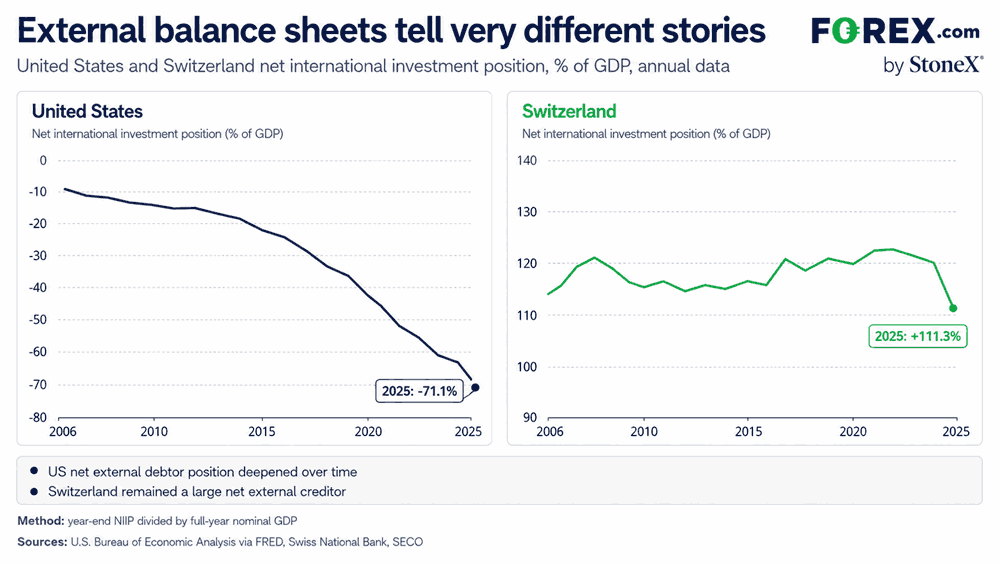
Switzerland is a major net creditor to the rest of the world, with its net international investment position sitting at around 111% of GDP in 2025. In simple terms, the Swiss own far more assets overseas than foreigners own in Switzerland.
Source: FRED, SNB, SECO, FOREX.com
The US is the complete opposite, with a net international investment position of roughly -71% of GDP. So while the dollar has the benefit of being the world’s reserve currency, the US still relies heavily on foreign investors to fund its debt. Countries such as Switzerland, with large pools of savings and overseas assets, are effectively on the other side of that trade.
Source: FRED, FOREX.com
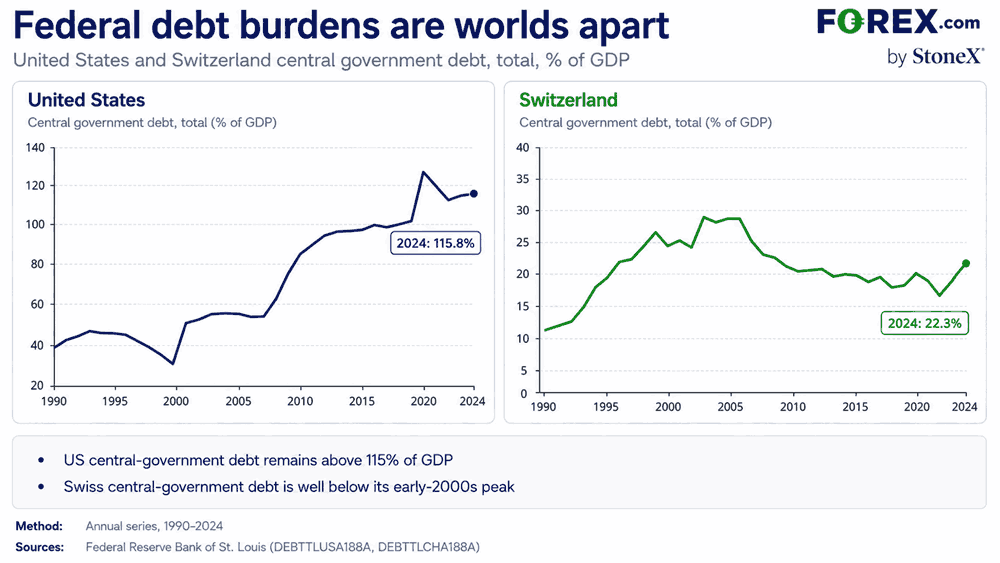
The government debt numbers tell a similar story. Central government debt in Switzerland stood at just 22.3% of GDP in 2024, compared with 115.8% in the US.
That divide is key in the safe haven debate. Switzerland has low government debt, an extremely strong international investment position and the kind of savings base that naturally supports lower borrowing costs. Relative to the States, it’s like chalk and cheese.
USD/CHF bearish bias remains
Source: TradingView
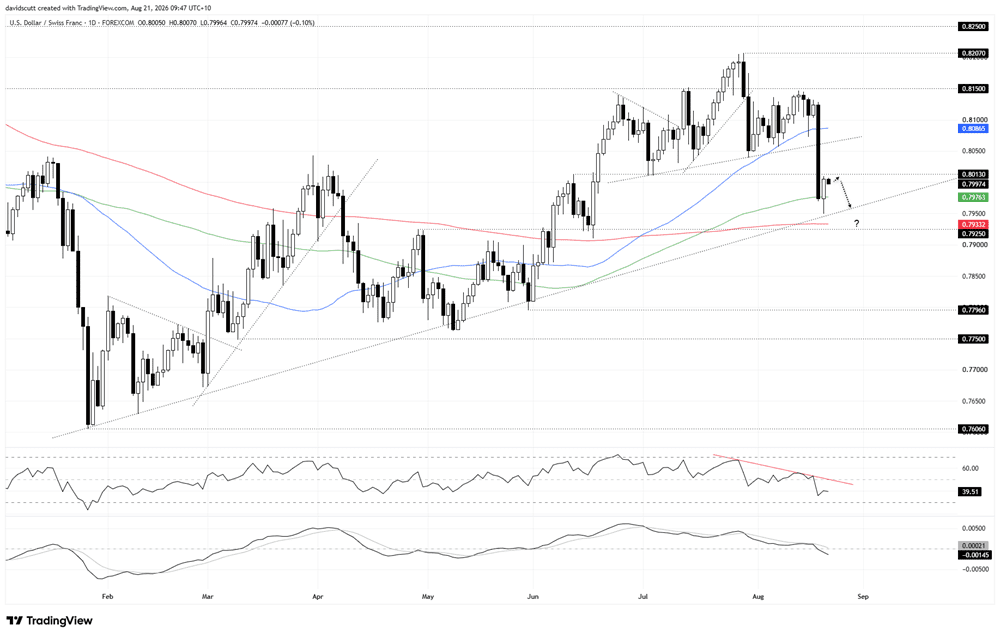
You can clearly see the reaction to Treasury’s announcement on Wednesday with a mammoth bearish bar breaking the minor uptrend that had been in place since early July, along with horizontal support at 0.8013.
The move stalled just shy of uptrend support running from the January low before reversing on Thursday, reclaiming the 100-day moving average in the process before moving back towards former support at 0.8013.
Despite the recovery, until proven otherwise, the rebound looks something akin to a dead-cat bounce.
0.8013 is the immediate focal point overhead. If the price remains beneath that level, it could be used to initiate fresh shorts with a stop above for protection, targeting a retest of 0.7950, where the pair reversed from on Thursday.
Just beneath that sits the January uptrend, along with the key 200-day moving average and horizontal support at 0.7925, making the area from the uptrend down to 0.7925 the key support zone to watch underneath where the pair trades.
If we were to see a sustained break beneath the lower end of that zone, it could open the path for a much more pronounced bearish unwind, putting levels such as 0.7796 and 0.7750 in play initially.
Of course, if the pair were to extend its rebound back above 0.8013 and hold there, the option is there to initiate longs with a tight stop beneath 0.8013 for protection. Initial targets would be 0.8050, where the price bounced on numerous occasions over recent months prior to the breakdown, followed by former uptrend support around 0.8065 today.
The message from the oscillators favours selling into strength rather than buying dips. RSI (14) continues to set lower highs and lower lows and sits beneath the neutral 50 level at 39. That message is confirmed by MACD, which has crossed beneath its signal line, flipped negative and continues to trend lower.
Given the fundamental backdrop and technical picture, shorts are favoured over longs in the near term.
Latest market news




The complete CFD trading experience
Award-winning platforms, competitive spreads, low commissions and dedicated support.
We live and breathe the markets and are dedicated to helping traders realise their ambitions as we continue to set the industry bar.
Economic calendar
Web Trader platform
Our sophisticated web-based platform is packed with features.
Related articles
Gold Q4 2026 outlook: Resilience in the face of rallying dollar and yields
As we headed towards the latter stages of Q3 and into Q4, the Fed had just hiked rates in a hawkish FOMC meeting, while the likes of the ECB and BoJ had also tightened their respective policies. Oil prices remained elevated amid the prolonged US-Iran conflict. Meanwhile, bond yields were breaking out, and the dollar was higher across the board. Yet, remarkably, gold was still holding in the positive territory for the third quarter, even if it had weakened somewhat in September.
EUR/USD Q4 2026 Outlook: Euro at a Crossroads as Fed, ECB Tighten 9 25 2026
EUR/USD enters Q4 at a pivotal inflection point as competing Fed-ECB policy paths and persistent inflation risks collide with major technical support.

USD/JPY Q4 2026 Outlook: Hawkish Fed Pricing Clashes With Intervention Risk
The year-end tug-of-war is clear: hawkish Fed pricing supports USD/JPY, while intervention risk limits the upside.
StoneX Europe Ltd may make third party material available on this website which may contain information included but not limited to the conditions of financial markets. The material is for information purposes only and does not contain, and should not be construed as containing, investment advice and/or investment recommendation and/or an investment research and/or an offer of or solicitation for any transactions in financial instruments; any decision to enter into a specific transaction shall be made by the client following an assessment by him/her of their situation.
StoneX Europe Ltd makes no representation or warranty and assumes no liability as to the accuracy or completeness of the information provided, nor any loss arising from any investment based on a recommendation, forecast or other information supplied. You should always seek independent advice as to your suitability to speculate in any related markets and your ability to assume the associated risks, if you are at all unsure. We are not under any obligation to update any such material. Any opinion made may be personal to the author and may not reflect the opinion of StoneX Europe Ltd.