



USD/JPY forecast: Dollar needs a nudge from US data to get moving again
The US dollar has had a slightly choppy start to the year, initially catching a bid on the back of weekend developments in Venezuela before giving some of that ground back, only to recover again into Tuesday. What’s notable, though, is how quickly markets have brushed aside the geopolitical noise – not just from Venezuela, but also from Greenland. With geopolitics taking a back seat, attention turns firmly to the US data calendar.
Share this:

The US dollar has had a slightly choppy start to the year, initially catching a bid on the back of weekend developments in Venezuela before giving some of that ground back, only to recover again into Tuesday. What’s notable, though, is how quickly markets have brushed aside the geopolitical noise – not just from Venezuela, but also from Greenland. With geopolitics taking a back seat, attention turns firmly to the US data calendar. This week’s employment indicators could influence the USD/JPY forecast and the near-term direction of other major pairs.

Geopolitics fail to rattle risk appetite
Following the weekend’s dramatic headlines out of Venezuela, the dollar started the first full trading week of 2026 on the front foot. The euro and Swiss franc softened, while gold, silver and equity markets all pushed higher. Oil prices were more volatile, swinging sharply before slipping back on Tuesday amid concerns over additional supply coming to market. Oil prices softened after President Trump suggested the US could take control of up to 50 million barrels of Venezuelan crude.
But the broader market reaction has been notably muted. The dollar has clawed back some ground, though this looks more like seasonal inflows and weakness for the likes of euro (hit by weaker data) than any geopolitical premium.
As mentioned, the market response has been mixed rather than defensive. That suggests investors are not expecting immediate escalation, instead weighing short-term uncertainty against longer-term implications for Venezuelan oil production. While deeper US involvement in Venezuela, or any form of military action linked to Greenland, would be more market-moving – potentially driving some flows back into the yen – risk appetite remains intact for now. That backdrop continues to underpin USD/JPY.
All eyes back on US data
A raft of US employment reports is due for the rest of this week, which could help shape market expectations for the early part of January. Historically, the dollar often struggles in December before finding its feet again as the new year gets underway. With a large chunk of Federal Reserve easing already priced in, dollar bears may find it hard going unless the data take a clear turn for the worse. Any upside surprises, therefore, should help support the USD/JPY forecast, particularly with the yen still under pressure amid a lack of meaningful pushback from either the Bank of Japan or the Japanese government.
Admittedly, it hasn’t been the strongest start to the year for US macro numbers, with this week’s ISM manufacturing PMI coming in on the soft side. That said, it followed a run of stronger-than-expected data towards the end of 2025, including jobless claims, pending home sales and Q3 GDP. Growth in Q3 was revised up to an annualised 4.3%, well above the 3.3% consensus, which complicates the argument for aggressive Fed rate cuts this year.
At present, markets aren’t fully pricing in the next 25bp cut until June, with a second one pencilled in for September. Those expectations could easily be pared back if this week’s labour market data come in firm. Today’s ISM services PMI is expected to soften, but price action is more likely to be driven by the ADP employment report – where consensus sits just below 50k – alongside the JOLTS job openings figures. With the Fed now more focused on employment than inflation, these releases carry added significance for the dollar. For now, the near-term outlook for the greenback remains neutral to mildly constructive.
Technical USD/JPY forecast: Price action still favours the upside
From a technical point of view, despite this week’s pullback from the 157.00 area, the path of least resistance for USD/JPY still looks higher. The main bearish argument at this stage is that the pair failed to post a fresh 2025 high during the rally that began back in April. The move stalled just below 158.00 in November, leaving the January 2025 peak at 158.88 intact.
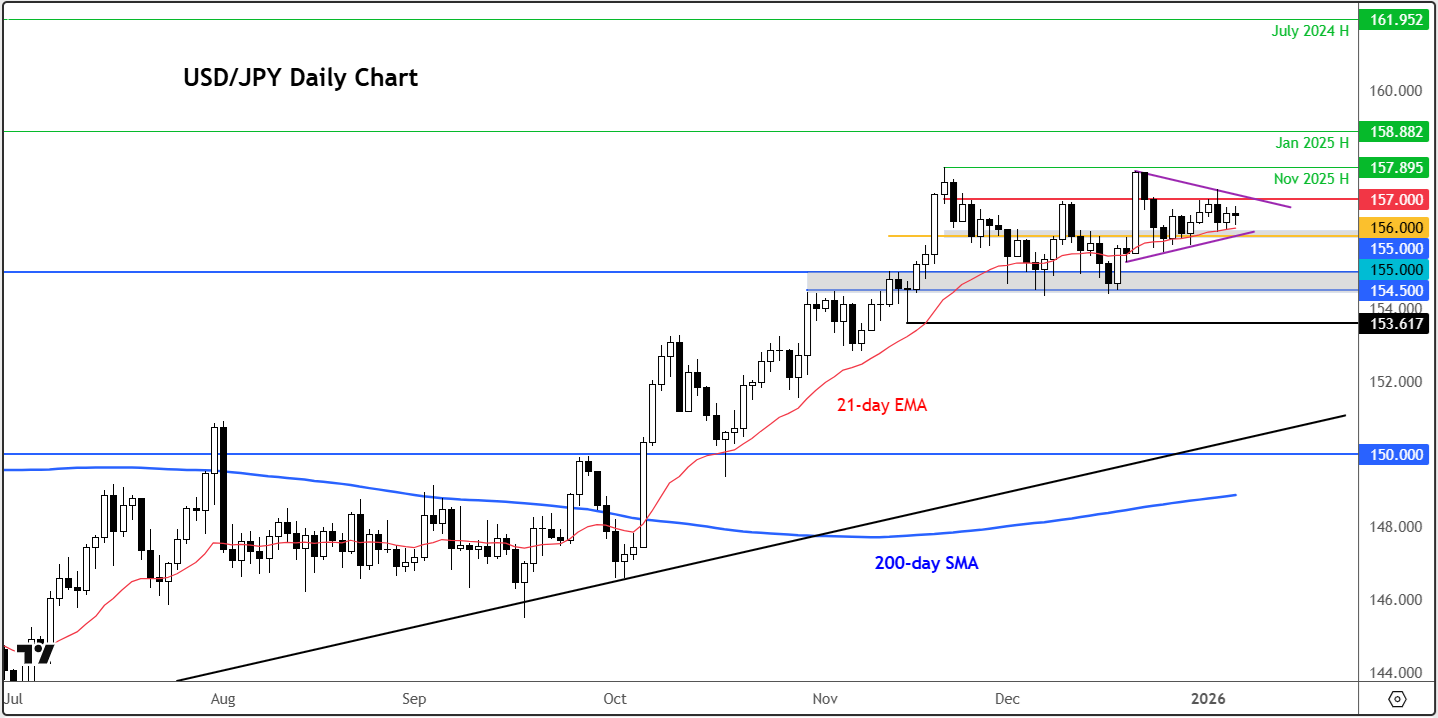
That said, this looks more like consolidation than a trend reversal on the USD/JPY chart. The key levels to watch are trend support from the broader triangle pattern and the 21-day exponential moving average, both sitting around the 156.00 area. As long as the bulls can defend that zone, the upside bias remains intact. A clear break below it, however, would open the door to a deeper pullback towards 155.00 once again.
-- Written by Fawad Razaqzada, Market Analyst
Follow Fawad on Twitter @Trader_F_R
Related tags:
Latest market news




The complete CFD trading experience
Award-winning platforms, competitive spreads, low commissions and dedicated support.
We live and breathe the markets and are dedicated to helping traders realise their ambitions as we continue to set the industry bar.
Economic calendar
Web Trader platform
Our sophisticated web-based platform is packed with features.
Related articles
EUR/USD weekly outlook: Oil, inflation and NFP in focus
After coming under significant pressure in recent weeks, the EUR/USD came off its lows to finish the week on a positive note on Friday, albeit with only a mild rebound. That was not enough to prevent the exchange rate falling for the third consecutive week, as the US dollar and bond yields rallied across the board.
Gold Q4 2026 outlook: Resilience in the face of rallying dollar and yields
As we headed towards the latter stages of Q3 and into Q4, the Fed had just hiked rates in a hawkish FOMC meeting, while the likes of the ECB and BoJ had also tightened their respective policies. Oil prices remained elevated amid the prolonged US-Iran conflict. Meanwhile, bond yields were breaking out, and the dollar was higher across the board. Yet, remarkably, gold was still holding in the positive territory for the third quarter, even if it had weakened somewhat in September.

EUR/USD Q4 2026 Outlook: Euro at a Crossroads as Fed, ECB Tighten 9 25 2026
EUR/USD enters Q4 at a pivotal inflection point as competing Fed-ECB policy paths and persistent inflation risks collide with major technical support.

StoneX Europe Ltd may make third party material available on this website which may contain information included but not limited to the conditions of financial markets. The material is for information purposes only and does not contain, and should not be construed as containing, investment advice and/or investment recommendation and/or an investment research and/or an offer of or solicitation for any transactions in financial instruments; any decision to enter into a specific transaction shall be made by the client following an assessment by him/her of their situation.
StoneX Europe Ltd makes no representation or warranty and assumes no liability as to the accuracy or completeness of the information provided, nor any loss arising from any investment based on a recommendation, forecast or other information supplied. You should always seek independent advice as to your suitability to speculate in any related markets and your ability to assume the associated risks, if you are at all unsure. We are not under any obligation to update any such material. Any opinion made may be personal to the author and may not reflect the opinion of StoneX Europe Ltd.