



USD/JPY Forecast: Payrolls Need to Crack Before the Bulls Blink
The bar for meaningful USD/JPY downside remains high. With energy prices supporting the dollar and markets still favouring a BOJ hike, it may take a weak payrolls report to shake the bullish narrative.
Share this:

- Higher energy prices may continue to favour USD/JPY
- US labour market weakness remains the key downside risk
- Ueda may need to validate BOJ hike expectations
- 160 remains a major level overhead for USD/JPY
Energy Shock Hits Japan Harder
While no one knows when a truce in the Gulf will truly hold, allowing energy supplies to transit the Strait of Hormuz freely, the uncertainty continues to expose a major vulnerability for Japan. As a significant net energy importer, higher prices threaten to worsen both its terms of trade and current account position, creating a headwind for the yen. The opposite forces are at play in the US, helping to support the dollar.
Throw in continued US economic exceptionalism, fuelled in part by the ongoing buildout of AI infrastructure, and it's a potent mix for USD/JPY upside.
But beyond the noise created by the constant torrent of Gulf-related headlines, it will likely take something far more significant to trigger meaningful USD/JPY downside. Right now, that probably means a genuine US growth scare driven by a deterioration in labour market conditions, similar to what we saw in 2024 and again last year.
That's what makes this week's run of US economic data especially important.
Positive Surprises Everywhere
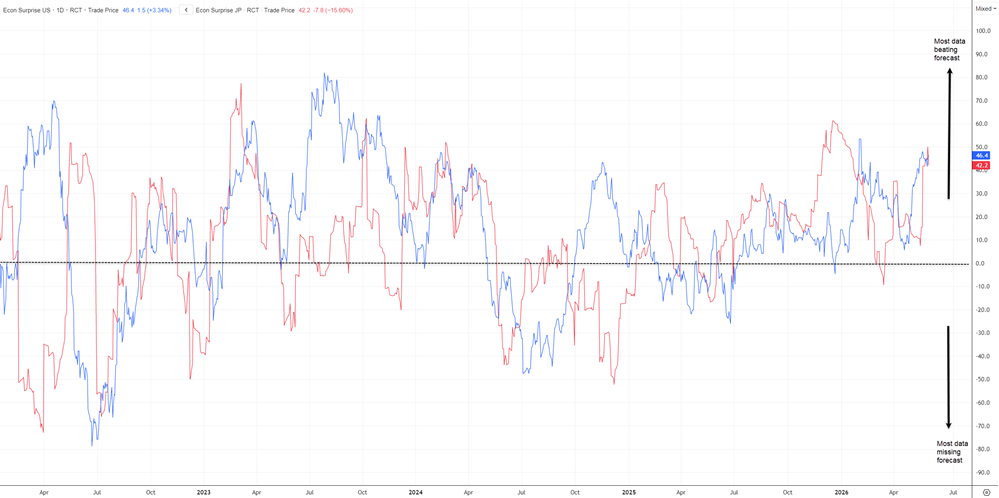
Source: LSEG
Looking at Citi's economic surprise indices above, what stands out is that it's not just the US (blue line) that has delivered a sustained run of positive surprises over the past year. Japanese data (red line) has also generally topped forecasts, with both countries spending most of the period in positive territory aside from a handful of brief setbacks.
Yet despite that, it has done little to support the yen. If anything, the weaker currency may have contributed to the resilience seen in the Japanese economy by improving export competitiveness and helping to lift imported inflation.
As a result, the fact Japanese data continues to beat forecasts appears of secondary importance for USD/JPY. Instead, the focus remains firmly on whether incoming US data can continue to support the exceptionalism narrative that has helped underpin the pair's recovery in recent months.
Watching for US Labour Market Cracks
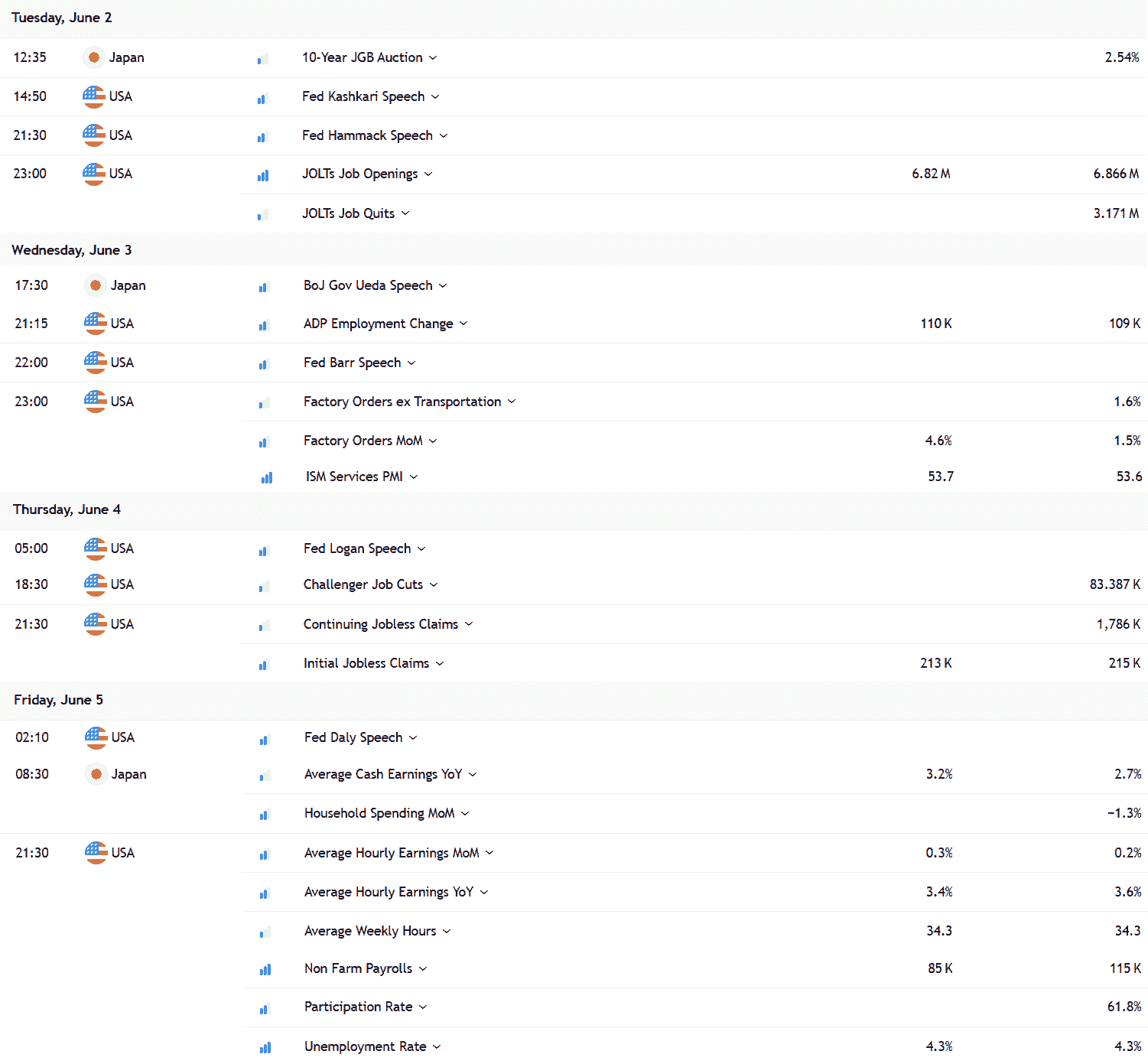
Source: TradingView (Japan standard time)
The calendar is loaded with US economic releases this week, headlined by nonfarm payrolls on Friday.
Before then, attention turns to the JOLTS report later Tuesday. While job openings tend to be volatile from month to month, perhaps of greater interest is whether the improvement seen in the hires and quits rates in March, both of which are generally associated with stronger labour market conditions, extended into April.
A further pickup would help reinforce the view that labour market conditions remain solid, reducing the likelihood of the type of growth scare capable of delivering meaningful USD/JPY downside.
The ISM services PMI will also be closely watched given it covers the largest and most important segment of the US economy. ADP employment may generate volatility too, having done a reasonable job of signalling trends in private sector hiring ahead of the official payrolls report in recent months.
On the Japanese side, attention will centre on Governor Ueda's speech on Wednesday. With markets continuing to favour a rate hike later this month, his job is to sound confident that continuing to normalise policy remains the appropriate course of action. Failure to do so risks sparking another round of yen weakness, potentially sending USD/JPY hurtling higher.
The 10-year JGB auction later Tuesday may also be worth watching for any meaningful shift in demand relative to prior auctions of similar maturity, especially given the recent focus on longer-dated government bond yields globally.
Looking further ahead, wages and household spending data due on Friday are the other releases to watch. After several softer inflation prints impacted by government subsidies and cost-of-living measures, markets will want confirmation that wage pressures remain firm enough to support household spending in the current inflationary environment. That would help reinforce the case for further policy normalisation from the BOJ.
160 Back on the Radar
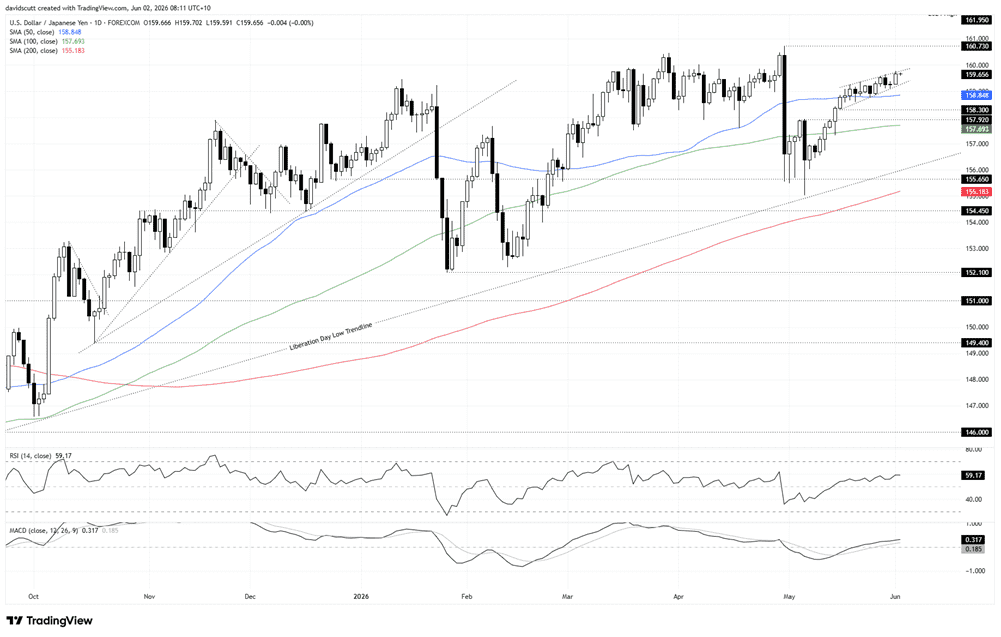
Source: TradingView
USD/JPY finds itself coiling within a rising wedge currently, grinding higher after a sharp rebound following a string of intervention episodes from the BOJ on behalf of Japan's finance ministry either side of the calendar turn from April into May.
While the structure warns of the potential for an eventual downside break, putting the 50DMA and 158.30 on the radar given the latter marks where the wedge started to form, there's little need to pre-empt such a move until wedge support breaks given it would run counter to both the prevailing trend and fundamental backdrop. The former breakout zone at 157.92, which also coincides with the 50% retracement of the April-May decline, is another level of note on the downside alongside the 100DMA.
Overhead, 160 remains a significant psychological level given it has been the scene of multiple intervention episodes in recent years. Above that, the year-to-date high of 160.73 and the multi-decade high of 161.95 set in 2024 are the levels to watch.
The message from the oscillators remains mildly bullish with RSI (14) continuing to grind higher above 50 while MACD has done the same after crossing above the signal line midway through last month. Combined, the message favours buying dips over fading rips.
Latest market news




The complete CFD trading experience
Award-winning platforms, competitive spreads, low commissions and dedicated support.
We live and breathe the markets and are dedicated to helping traders realise their ambitions as we continue to set the industry bar.
Economic calendar
Web Trader platform
Our sophisticated web-based platform is packed with features.
Related articles
S&P 500, Nasdaq, Dow Forecast: Wall Street Split Widens Into Month-End 9 26 2026
Nasdaq strength contrasts with mounting Dow pressure as rising Treasury yields raise the stakes for stocks heading into the monthly close.
EUR/USD weekly outlook: Oil, inflation and NFP in focus
After coming under significant pressure in recent weeks, the EUR/USD came off its lows to finish the week on a positive note on Friday, albeit with only a mild rebound. That was not enough to prevent the exchange rate falling for the third consecutive week, as the US dollar and bond yields rallied across the board.

Gold Q4 2026 outlook: Resilience in the face of rallying dollar and yields
As we headed towards the latter stages of Q3 and into Q4, the Fed had just hiked rates in a hawkish FOMC meeting, while the likes of the ECB and BoJ had also tightened their respective policies. Oil prices remained elevated amid the prolonged US-Iran conflict. Meanwhile, bond yields were breaking out, and the dollar was higher across the board. Yet, remarkably, gold was still holding in the positive territory for the third quarter, even if it had weakened somewhat in September.
StoneX Europe Ltd may make third party material available on this website which may contain information included but not limited to the conditions of financial markets. The material is for information purposes only and does not contain, and should not be construed as containing, investment advice and/or investment recommendation and/or an investment research and/or an offer of or solicitation for any transactions in financial instruments; any decision to enter into a specific transaction shall be made by the client following an assessment by him/her of their situation.
StoneX Europe Ltd makes no representation or warranty and assumes no liability as to the accuracy or completeness of the information provided, nor any loss arising from any investment based on a recommendation, forecast or other information supplied. You should always seek independent advice as to your suitability to speculate in any related markets and your ability to assume the associated risks, if you are at all unsure. We are not under any obligation to update any such material. Any opinion made may be personal to the author and may not reflect the opinion of StoneX Europe Ltd.