



USD/MXN Outlook: The Mexican Peso Maintains Its Strength Ahead of Banxico’s Final Decision of the Year
Over the past five trading sessions, USD/MXN has maintained a consistent bearish bias in favor of the Mexican peso, accumulating a decline of more than 1%. The current selling pressure is driven, on one hand, by the structural weakness of the U.S. dollar, which has allowed the peso to continue strengthening; and on the other hand, by the proximity of Banxico’s final rate decision of the year, where guidance for 2026 monetary policy will be revealed.
Share this:

Over the past five trading sessions, USD/MXN has maintained a consistent bearish bias in favor of the Mexican peso, accumulating a decline of more than 1%. The current selling pressure is driven, on one hand, by the structural weakness of the U.S. dollar, which has allowed the peso to continue strengthening; and on the other hand, by the proximity of Banxico’s final rate decision of the year, where guidance for 2026 monetary policy will be revealed. Both factors appear to support the peso in the short term, and as long as no unexpected developments arise, selling pressure may remain dominant in the coming sessions.


What to Expect from Banxico?
Tomorrow, December 18, Banxico will announce its interest rate decision. The institution is expected to close the year with a 0.25% rate cut, lowering the benchmark rate from 7.25% to 7.00%, in line with the sustained easing cycle observed throughout much of 2025.
However, the most relevant aspect will be Banxico’s post-decision commentary, which may offer key signals regarding the bank’s stance for 2026. One of the determining factors will be the recent trend in inflation, which held at 3.57% in October but rose to 3.8% in November, moving further away from the 3.00% target.

Source: TradingEconomics
If inflation continues rising, Banxico may be forced to adopt a less flexible stance in 2026, limiting the room for additional rate cuts. It is worth noting that one of the factors that has strongly supported the peso’s appreciation is its high interest rate, especially relative to other countries. Even with a reduction to 7.00%, Mexico’s rate remains far above that of the United States (3.75%), keeping peso-denominated assets more attractive than dollar-denominated ones.
In this context, if Banxico signals that inflation is deviating from target and indicates that there will be no consistent rate cuts in 2026, the peso’s carry advantage could continue supporting its strength, maintaining persistent selling pressure on USD/MXN through the end of 2025.
Is the U.S. Dollar Failing to Recover?
Another factor supporting the Mexican peso is the ongoing weakness of the U.S. dollar in recent weeks. This has been influenced by comments from the Federal Reserve, noting that there is no room for rate hikes in 2026, suggesting that U.S. fixed-income yields could continue declining.
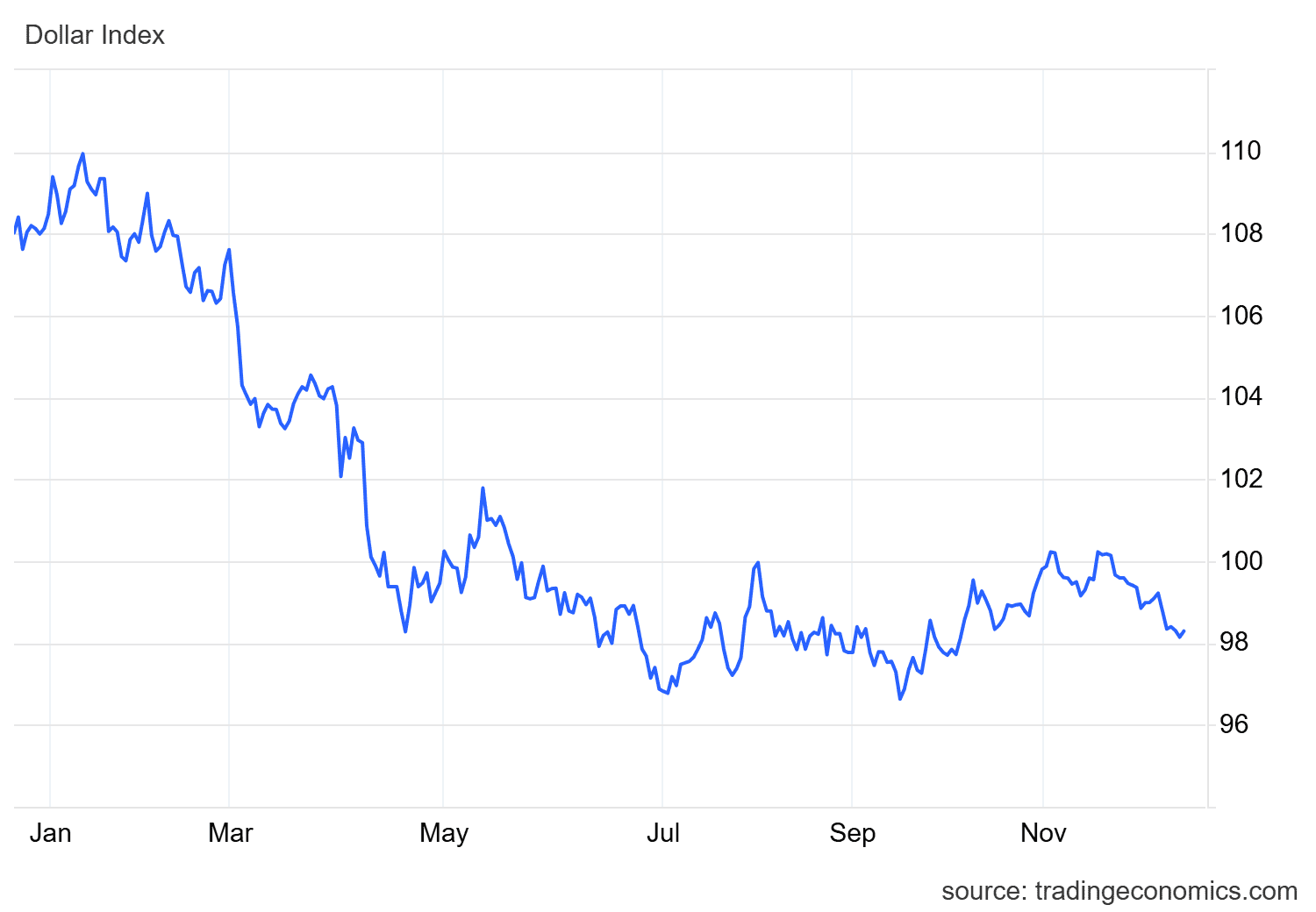
Dollar weakness is also reflected in the DXY index, which measures the dollar’s strength against a basket of currencies. The index currently maintains a consistent downward slope, moving away from the psychological 100-point level and trading near 98 points, indicating reduced demand for dollars in the short term.
Source: TradingEconomics
This loss of strength has allowed the Mexican peso to continue appreciating, and as long as the DXY remains weak, selling pressure on USD/MXN is likely to persist. If this dynamic continues in the coming sessions, the pair could register further notable declines toward year-end.
USD/MXN Technical Outlook
Source: StoneX, Tradingview
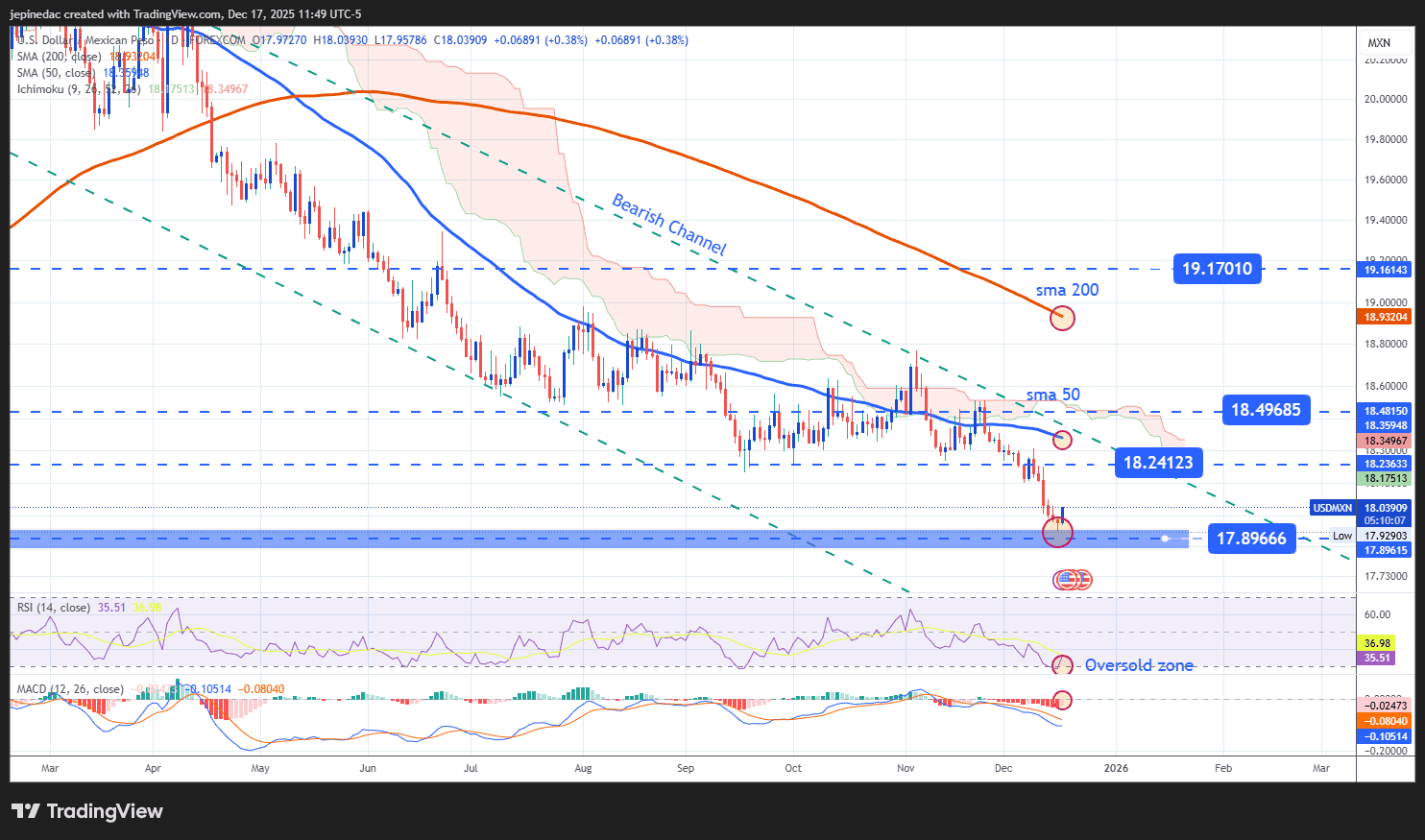
- Nothing Stops the Major Downward Channel: As we move into the final trading days of 2025, USD/MXN remains within a major downward channel that has been intact since mid-January of the year. So far, bullish movements have been insufficient to reverse the trend, making this technical structure the dominant pattern guiding the pair. However, price is beginning to approach levels not seen since 2024, which could allow room for short-term bullish corrections if selling pressure struggles to break these zones.
- RSI: The RSI continues to hold below the neutral 50 level, indicating that bearish momentum remains dominant in the short term. However, the indicator is now approaching 30, which marks the beginning of the oversold zone, potentially signaling an imbalance caused by excessive selling pressure and creating space for short-term upward corrections.
- MACD: The MACD histogram shows a neutral slope, with oscillations moving gradually back toward the zero line. This behavior suggests a possible balance of forces within short-term moving averages. If this dynamic persists, USD/MXN may enter a phase of indecision, creating room for moderate upward corrections.
Key Levels:
- 18.50 – Main Resistance: A barrier located above the 50-period moving average. A sustained bullish break above this level could threaten the major downward channel and activate a short-term bullish bias into year-end.
- 18.24 – Nearby Barrier: A recent neutrality zone that may serve as an initial reference level for potential short-term bullish corrections.
- 17.89 – Relevant Support: This marks the 2025 lows and levels not seen since 2024. If selling pressure sustains a move below this zone, the major downward channel could extend into the coming weeks.
Written by Julian Pineda, CFA – Market Analyst
Follow him at: @julianpineda25
Related tags:
Latest market news




The complete CFD trading experience
Award-winning platforms, competitive spreads, low commissions and dedicated support.
We live and breathe the markets and are dedicated to helping traders realise their ambitions as we continue to set the industry bar.
Economic calendar
Web Trader platform
Our sophisticated web-based platform is packed with features.
Related articles
Australian Dollar Technical Outlook: AUD/USD Breakdown Threatens Deeper Correction 9 23 2026
AUD/USD remains under pressure after breaking key trend support, with the latest decline putting the focus on the next major downside pivot.
USD/JPY forecast: US dollar strengths amid hawkish Fed despite recent oil weakness
The US dollar has extended its gains this morning, even if oil prices finished lower for the fifth consecutive day yesterday. Oil prices have bounced back in this first half of today’s session, causing a bit of pressure on currencies that rely on energy imports such as the euro, pound, Swiss franc, and Japanese yen. But it was the dollar that was exerting the most pressure, amid hawkish FedSpeak. Meanwhile, European indices and precious metals were also under a bit of pressure amid the strength of the dollar.


EUR/AUD, GBP/AUD Outlook: Rates, risk and metals reinforce bearish technical case
EUR/AUD and GBP/AUD are coiling near support, with recent correlations suggesting the Aussie’s strength is being driven more by rates, risk and metals than energy.

StoneX Europe Ltd may make third party material available on this website which may contain information included but not limited to the conditions of financial markets. The material is for information purposes only and does not contain, and should not be construed as containing, investment advice and/or investment recommendation and/or an investment research and/or an offer of or solicitation for any transactions in financial instruments; any decision to enter into a specific transaction shall be made by the client following an assessment by him/her of their situation.
StoneX Europe Ltd makes no representation or warranty and assumes no liability as to the accuracy or completeness of the information provided, nor any loss arising from any investment based on a recommendation, forecast or other information supplied. You should always seek independent advice as to your suitability to speculate in any related markets and your ability to assume the associated risks, if you are at all unsure. We are not under any obligation to update any such material. Any opinion made may be personal to the author and may not reflect the opinion of StoneX Europe Ltd.